Representative End User Clients







Representative Automation Clients







Representative Software Clients









Keywords: Industrial Wi-Fi, Industrial WLAN, Industrial WLAN Infrastructure, Wi-Fi 6/6E, Wi-Fi 7, Industrial Private Networks, Industrial 5G
The push for improved business performance and sustainable manufacturing operations are primary drivers behind current automation investment. Network connectivity is a primary enabler underpinning the monitoring and control of core processes and key performance metrics that drive today’s digital transformation strategies. Incremental use cases ranging from AI-enabled predictive analytics to robotics, remote, mobile, and autonomous operations, and ongoing business innovation all require a solid connectivity foundation.
Increasingly demanding connectivity requirements are driving expanding reliance on wireless communications. As these requirements continue to expand, so too do the options for wireless transmission of critical network traffic. While the initial rush to 5G has subsided, many customers, particularly those with large engineering organizations and expansive infrastructure requirements, continue to explore private cellular networks for their wireless installations. Private networks, whether 5G, 4G LTE, or CBRS, are increasingly viewed as enabling the latency, reliability, determinism, scale, and other requirements of digitally transformed architectures.
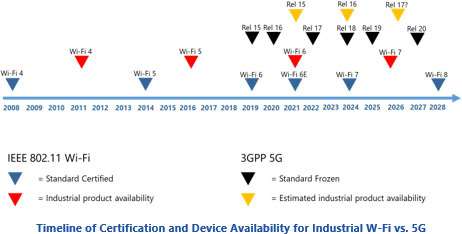
Certification of incremental Wi-Fi standards, particularly IEEE 802.1ax (Wi-Fi 6/6E) and IEEE 802.1be (Wi-Fi 7) and associated support for operation in the increasingly available 6 GHz band, is narrowing the functional gap between Wi-Fi and 5G or private networks. Functional capabilities are not the only consideration, however, for deciding between industrial Wi-Fi and private cellular networks.
While wireline infrastructure remains the default choice, wireless network performance is increasingly comparative in key areas such as latency, throughput, and ability to operate in dense, harsh environments. Ongoing improvements in cellular technology, starting with 4G LTE and now focused on 5G and private wireless, are leading to its increased consideration as a primary communication medium relative to traditional Wi-Fi networks.
Private networks and 5G are the increasingly preferred choice for large backhaul infrastructure installations versus the local point solutions with no available supporting infrastructure that is typical of Wi-Fi installations. Cellular is also increasingly well-suited for use in a growing number of mobile, remote, indoor, and outdoor applications, including in service to critical AGV, AMR, robotic, and other applications in automotive, transportation, logistics, and other important sectors. Discrete operations, ranging from factory production to port operations, have been some of the earliest adopters of 5G and private networks in formerly WiFi-based installations.
But the 5G evolution is taking longer than anticipated to come to fruition. The combination of the 5G release and device availability timeline, the need for spectrum acquisition, lack of availability of an industrial 5G support ecosystem, and the significant price premium existing 5G devices represent are primary inhibitors to its adoption to date.
Despite delays in 5G adoption and availability, large customers are already evaluating use of both 5G and private networks in industrial applications. These investigations reveal the need for significant infrastructure investment and an end-to-end solution approach as well as challenges with spectrum acquisition and knowledge and skill sets required. 5G and private networks are emerging as a complex, comprehensive implementation that requires new skills not only in cellular spectrum acquisition and management, but also significant software and service content.
ARC Advisory Group clients can view the complete report at the ARC Client Portal.
Contact Us if you would like to speak with the author.
Obtain more ARC In-depth Research Market Analysis.