The 29th Annual ARC Industry Leadership Forum
Winning in the Industrial AI Era
February 10-13, 2025 - Orlando, Florida
February 10-13, 2025 - Orlando, Florida
End Users Share Progress on their Digital Transformation Journeys at ARC Industry Forum
ARC’s 29th annual Industry Leadership Forum in Orlando featured over 650 attendees and continued our theme of digital transformation for manufacturing end users through the adoption of new technologies like Industrial AI and digital twins. By using these technologies as enablers, dozens of end users shared their successes and challenges in addressing today’s major business challenges, the most prevalent being improving operational excellence, sustainability, energy transition, increasing energy efficiency, improving cybersecurity and supply chain resilience, reducing risk, and improving safety.
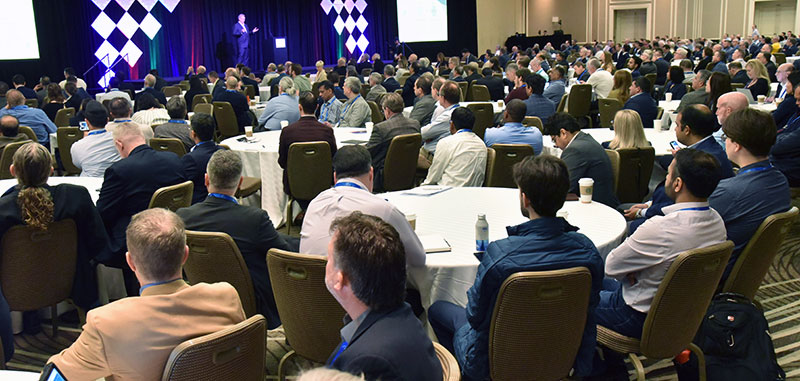
Including ARC analysts and suppliers, the Forum featured over 180 speakers, while about 80 of those were end users sharing their case studies and discussing how they apply these technologies to solve their business problems. The ARC Industry Forum is meant to be for end users where the content is primarily driven by end users, with a little help from ARC’s analyst team.
The shift was palpable as our industrial customers shared concrete progress on their Industrial AI journeys across all four tracks of the Forum. The atmosphere was a stark contrast to the 2024 Forum. Just a year ago, industrial end users were largely observers, eager to learn about Gen AI plans from cloud hyperscalers and foundation model pioneers, as well as industrial automation and software vendors.
The Tuesday executive keynote sessions embodied many of the themes repeated by end users throughout the Forum, including the adoption of new technologies like AI and data fabrics for increased sustainability, the importance of digital twins, and various approaches to managing data in the age of Industrial AI.
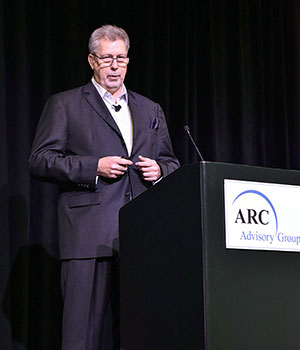
Nico Duursema of Cerilon: An Integrative Framework for Digital Transformation
Cerilon CEO Nico Duursema kicked off our executive keynote discussions. Nico has been a leader in the global energy industry for over 30 years. His expansive international experience includes roles in North and South America, Africa, and the Middle East and Asia within the petrochemical, transportation, mining, and oil and gas sectors. Nico leads Cerilon in key areas to provide energy transition solutions, including lower-carbon technologies such as gas-to-liquids (GTL), renewables, bio-to-liquids (BTL), and downstream petrochemicals.
As a new business with new facilities, Cerilon is unburdened by the legacy of an installed base, and this allows the company to adopt a pure digital transformation mindset from the outset. The company emphasizes the need to adapt to a disruptive environment by fostering a solutions-focused mindset among employees and partners. This approach encourages ownership, innovation, and the integration of new technologies. Cerilon's strategy involves a multi-dimensional approach that includes leadership adaptability, data centrality, and rigorous management of change processes. This enables the replication of successful practices in different environments.
Cerilon is a great example of how new businesses focused on new and sustainable processes can be “digitally native” by embracing technologies like AI and industrial data frameworks at the outset. It’s also a great example of how digitalization can be used to get new workers up to speed fast and adopt a native culture of continuous improvement.
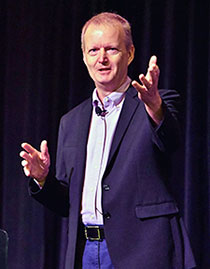
Rob Kelly of BP: A Digital Transformation Blueprint for Oil and Gas Producers
Rob Kelly of BP was appointed Vice President, Digital Production & Projects in BP’s Innovation & Engineering organization in January 2021 as part of the “Reinventing BP” re-organization. In January 2022, the BP Refineries were added to his portfolio, and then in January 2023 the digital support to Subsurface, Wells and Low Carbon Energy businesses. He is based in Houston, with accountability to deliver Digital Transformation across BP’s Production & Operations and Gas & Low Carbon Energy entities.
Rob spoke on behalf of 92 members of International Association of Oil and Gas Producers (IOGP). IOGP members have been working on many key initiatives to optimize digital transformation of oil and gas operations. IOGP emphasize the need for digital skills and knowledge in the workforce, aligning with industry standards and focusing on AI, digital twins, and automation. Rob discussed how IOGP has been focusing on digital transformation for the past few years, aiming to support all aspects of their oil and gas operations, including exploration, projects, drilling, and decommissioning. In January 2023, a digital transformation committee was formed within the International Association of Oil and Gas Producers (IOGP) to create an open, interoperable ecosystem across the industry. The committee aims to drive standardization across the oil and gas industry through digital technology, focusing on data centricity, foundational information standards, and seamless data exchange.

Michael Hotaling of ExxonMobil
Michael Hotaling of ExxonMobil discussed his company’s progress on its own digital transformation journey. Michael manages the global digital footprint for refining, chemical and midstream operations at ExxonMobil. Michael’s organization represents the business interests in the operations technology/ process control strategy, digital solutions, and ICS cybersecurity.
Michael’s presentation introduced the concept of the Open Asset Digital Twin, discussed the company’s involvement in the Open Process Automation Forum, and highlighted the journey towards a more visual way of working and the need for an ecosystem built on interoperability, reality capture, and open standards.
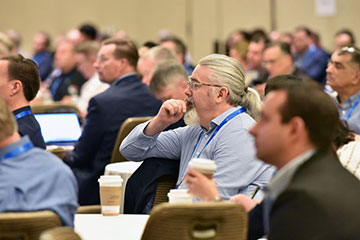
ExxonMobil is working towards a more visual way of working by integrating data and making it accessible through intuitive platforms, which will improve safety and efficiency. The company’s Digital Reality Ecosystem is a connected highway that leverages multiple AI/ML agents to integrate and drive value. It ensures a seamless flow of data between systems, free from custom integration, and provides valuable opportunities for business owners and suppliers.
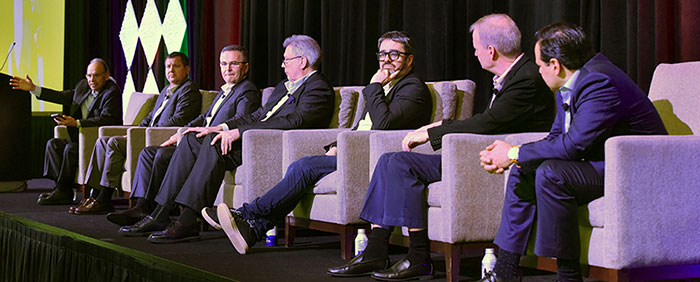
Tuesday Executive Panel Discussion
The panel discussion focused on various aspects of technology integration, operational excellence, and the challenges faced by industries in adopting new technologies. It’s worth noting that cybersecurity was mentioned by more than one panelist. With the integration of technologies such as AI, ML, and digital twin to enhance process performance, energy optimization, and carbon management, end users must ensure that they are doing this in a secure manner. Other key points included:
- The importance of Asset Performance Management (APM) as part of the digital transformation strategy, including technologies to compensate for failing equipment, shift change management, and automated maintenance scheduling.
- The need for data centrality, ownership, and open digital ecosystems to facilitate industry collaboration and standardization.
- The uneven pace of technology adoption globally and the need for co-creation, investment, and addressing the skill gap to accelerate progress remains a challenge.
- The continued importance of subject matter expertise in conjunction with AI tools to optimize self-optimization problems and industry reinvention.
- The importance of breaking down customer visions into manageable road maps to show value and earn executive support for continued technological advancements.
- The need for a mindset shifts within companies and industry-wide collaboration to adapt business models and practices to leverage new technologies effectively.
- The importance of considering financial systems, supply chain flexibility, and the integration of financial data with operational data to optimize business processes.
Forum Topics
Industrial AI, Data Fabric, and Metaverses
Industrial AI, a subset of the broader field of artificial intelligence (AI), refers to the application of AI technologies (including Generative AI) in industrial settings to augment the workforce in pursuit of growth, profitability, more sustainable products and production processes, enhanced customer service, and business outcomes. Industrial AI leverages machine learning, deep learning, neural networks, and other approaches. Some of these techniques have been used for decades to build AI systems using data from various sources within an industrial environment, such as sensors, machinery, industrial engineers, and frontline workers.
It's still all about data, and how to leverage public and enterprise data securely to protect and preserve IP, while garnering new insights, reducing waste, and achieving new levels of productivity and business process optimization by leveraging industrial grade AI solutions. Breakthroughs in Generative AI, and the massive investments being made to drive its mainstream adoption are changing the whole software landscape, creating new alliances and partnerships, and how we interact with software in our daily lives, and on the manufacturing shop floor.
New software design patterns accommodating the desire to leverage Generative AI, are driving new requirements for the Industrial Data Fabric at the core of industrial organizations digital transformation.
This program will:
- Cut through the confusion surrounding AI in the industrial space
- Highlight new AI breakthroughs such as Large Language Models for Generative AI
- Provide a useful conceptual framework for governing and prioritizing Industrial AI use cases
- Provide context for how AI relates to Industrial Metaverse, Industrial Data Fabric, etc.
- Present case studies and examples from early adopters of Industrial AI
- Provide industrial companies the information they need to begin their own Industrial AI journey
Transforming to 21st Century Operations
 Leading industrial companies are actively engaged in transformation programs that will reshape their production operations to be more integrated, responsive, and optimized to meet business and customer needs. Realizing these innovations requires an understanding of the emerging 21st century operations ecosystem and how it interacts with business, engineering, supply chain, and other organizations. Today's connected environments surface machine data that was heretofore unavailable, and so enable new business models. New systems may monitor the assets, and new actors may interact with the assets in new ways. Industrial plant operations, typically siloed and fairly isolated today, will be reshaped as the core of a 21st century industrial production operations ecosystem. A similar evolution is taking place for field operations - such as mining or agriculture. In other cases, such as automotive, where the assets operate in public spaces and both the assets and ecosystems are evolving quickly, other factors come into play.
In 21st century production operations, work is accomplished with a combination of internal and external actors (such as asset manufacturers, 3rd party machine monitoring services, spare parts suppliers, etc.), putting new demands on data requirements and cybersecurity strategies. New types of production systems (such as additive manufactuiring) and new types of data are being generated (from wearables, vision systems, machine health sensors, etc.). And digital twins and machine learning systems can work at various levels to optimize the overall system in synchrony with the needs of customers and business operations.
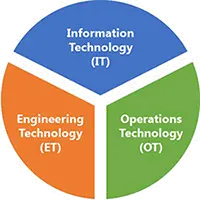
An important enabler for this innovation in industrial companies is the convergence of IT (Information Technology at the enterprise level), OT (Operations Technology, the information and automation technologies employed in the plant), and ET (Engineering Technology, the newer technologies that create virtual models). IT/OT/ET convergence is among the drivers of the digital transformation that leading companies are embarking upon. A wide range of technologies, such as Ethernet/Wi-Fi, virtualization, cloud, SaaS, analytics, Big Data, mobile, social, modeling, augmented reality, machine learning, remote monitoring, and digital twin are now being employed in industrial operations to improve operating performance, create a virtual environment, or introduce the Industrial Internet of Things. But the big payoff comes when companies begin to operate in new, collaborative ways across the whole of the enterprise.
This program features speakers talking about moving to 21st century operating models, and how they utilized the IT/OT/ET enablers of digitization and innovation to improve performance in their production operations and throughout their organizations.
Energy Transition and Industrial Sustainability
Energy transition and sustainability are now being woven into the core business strategies of industrial companies, who now have the mandate and opportunity to tackle environmental and social challenges. What are the market drivers behind the dramatic uptick in board-level attention - and the ensuing formalization and execution - of environmental, social, and governance (ESG) strategies? How are companies tackling decarbonization, new tracking requirements, and the many, complex threads associated with the energy transition and improved environmental stewardship? How are these efforts being balanced with demands for financial performance, reliability, and ongoing digital transformation?
Companies who are more advanced in their digital journeys are already integrating sustainability and energy transition initiatives, together with competitive excellence, resilience and agility, and workforce goals, into a comprehensive strategy driving towards becoming a focused, integrated, digital organization. Powered by transformative technologies, innovative processes, and data, they are creating smart integrated systems that can develop new insights and, in some cases, even automate decision making, while optimizing to corporate performance goals and improving competitive excellence. These new systems can also support improved cybersecurity, helping industrial companies protect against a significant and growing risk.
Sustainable Operations Through Decarbonization and Energy Transition Workshop
Asset Performance Management
Asset Performance Management incorporates Industrial IoT (IIoT) and new analytics solutions like machine learning. It uses information from production management, control systems, and asset management applications to provide new opportunities to optimize asset availability and operational performance. This optimization goes beyond functional silos and occurs between silos where significant inefficiency, waste, and sometimes dysfunction often reside.
Balancing the objectives of operations for on-time delivery, volume, and quality with those of maintenance for asset availability, longevity, and reliability requires sharing information and harmonizing these objectives with the goals of the enterprise. New information technologies provide functionality to intensify cross-functional collaboration, business process improvements, and higher levels of performance to achieve asset performance management excellence.
The ability to interact with equipment – like a variety of devices on a single site, or widely dispersed machines – presents new opportunities for industrial companies, utilities, and equipment suppliers. These networks provide a new “connected ecosystem” of equipment manufacturers, systems integrators, and end users. Some manufacturers and utilities have begun adopting these technologies.
Those attending this Asset Performance Management program will learn what was successful, and gain insights into what is next. The objective is to make fact-based decisions using reliable information that aligns with the organization’s objectives. An APM strategy helps ensure the best possible returns on capital investments over the lifecycle of the asset. If you are involved in operations, maintenance, or industrial IT, you will want to attend these program sessions.
Automation Innovations
We have entered a period of intense innovation in industrial automation. In the areas of high value-added manufacturing there is growing global competition. Countries with developed economies want to maintain and grow their existing competitive advantages and support their exporting industries. Countries with developing economies want to improve their competitiveness as well.
This competition is, in part, taking the form of national initiatives to improve manufacturing competitiveness. These initiatives are found in Germany, the US, Japan, Korea, and China. In the US the Industrial Internet Consortium has formed. Platform Industrie 4.0 is the German initiative; the “4.0” referring to a 4th industrial revolution (following steam, mass production, and IT). This can be thought of as a set of new technologies that are fusing the physical, digital, and biological worlds, and impacting all disciplines, economies and industries.
Some of the topics that will be covered in the sessions for this program include:
Devices that will use the future 2‐wire Ethernet standard now in development by the IEEE 802.3cg committee. This 2019 standard will enable high speed communication to process field devices over distances as long as 1 kM.
The Open Process Automation Forum: The Latest Update
The Open Group’s Open Process Automation Forum is noteworthy for several reasons. First, because of its genesis within ExxonMobil, a leading international oil company with a long reputation for operational excellence. Second, because the products of this program will be technologically quite different from the process automation systems used today. Third, because the value chain envisioned for this program is also quite different from the way the process automation market works today. The latest developments in this initiative will be presented and discussed.
Industrial Automation and the Industrie 4.0/Industrial Internet Initiatives
What will be the impact on manufacturing and automation of these major national initiatives? How will the process industries, discrete manufacturers, and automation suppliers adapt and change their products in response to these programs? What are thought leaders in Europe and North America doing now and planning for the next few years? End users will present the current programs for rapid integration of skid-mounted process systems, based on the Module Type Package (MTP) initiative of the NAMUR group in Europe. Also, European end users will discuss their pilot work with the future 2‐wire “single pair Ethernet” standard now in development by the IEEE 802.3cg committee. This 2019 standard will enable high speed communication to process field devices over distances as long as 1 kM.
Cybersecurity for Digitalization and Sustainability
New business processes are driving higher performance and lower costs across the industrial landscape. Companies are leveraging new developments in cloud computing, AI, IoT, edge solutions, and digital twins to identify bottlenecks and opportunities for improvement. Technological developments are likewise driving improvements in the safety and reliability of critical operations. Benefits from these developments can be large, but they can be quickly erased unless companies also address the increased risks of serious, costly cyber incidents.
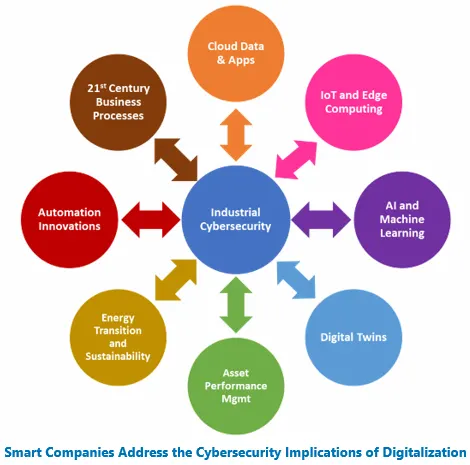
Industrial cybersecurity has never been more important. New business processes and technologies are rapidly expanding the pathways for attackers to steal information and disrupt operations. At the same time, industrial security teams are struggling to deal with ransomware and sophisticated nation-state attacks. This situation is jeopardizing worker safety, delivery of critical services, and the operational continuity of plants and facilities that fuel profitability.
Conventional industrial IT and OT security programs weren’t designed to handle all of these new challenges. Digitalized organizations need security strategies that monitor, control, and coordinate security across every corporate device, application, system, and network regardless of where it is located. Security programs also need to ensure consistent management across IT, ET, OT, Cloud, Mobile and IoT environments. Likewise, security needs to span every business process and worker regardless of where, when, and how they are performed. Developing a comprehensive cybersecurity strategy that addresses the current and emerging risks of digitalization has never been more urgent.
The Industrial Cybersecurity program addresses these issues with informative workshops, panel discussions, and case study presentations. It is the ideal venue to learn what others are doing, how they are doing it, and the benefits they are achieving. Attendees will also have opportunities to discuss their unique challenges with peers, researchers, educators, service providers, and solution providers.
Digital Twins and Connected Smart Machines
Autonomy and intelligence embedded pervasively in automation equipment is one of the key attributes to realization of connected smart machinery. Connected smart machinery is important in virtually every application imaginable, but is even more valuable in cases where there is limited communications. Machinery that analyzes and compresses large data sets are essential to ensuring that the data traffic on the Internet does not overwhelm the system or data can be analyzed local to the device. The connected smart machine will require not just more sensors, but also more intelligent sensors. Sensors must perform more sophisticated signal processing “at the edge” to provide accurate signals that filter out the noise before it gets to the automation system.
In this program, machine builders employing intelligent sensors into the machinery to perform complex condition monitoring algorithms into automation systems will be highlighted. Key topics for discussion include:
- Creating new maintenance service revenue streams for machine builders
- Development of equipment protection algorithms that increase resilience of machinery to stay operational for much longer periods of time.
- Adaptive control algorithms allowing systems to operate over a wider range.
- Predictive condition monitoring systems that use real-time control algorithms to provide a new level of maintenance information.
- Exploring the potential of the Industrial Internet of Things (IIoT) to combine the benefits of multivariate analysis, predictive modeling, and inferential information to preempt abnormal situations.
Digital Workforce and Culture
The digital transformation of industry, infrastructure, and cities is under way, with new business processes, services, and models being pursued. This energy and investment is a rational response by organizations to digital economies that present new and very real opportunities. When combined appropriately, data and technology can provide competitive advantage, that – in some cases – enables organizations to leapfrog their peers.
Yet, when planning or executing this transformation, what is often missing is a focus on the human element of digital transformation. Where do people fit in? The changes that digital transformation will have on the workforce are likely to be the most far-reaching and sustained effects. Not only will digital transformation change the number of people needed to do work, it will rewrite how that work gets done. Those going through digital transformation quickly realize that managing the human element can be the most difficult aspect. However, as they work through their journey, people begin to better understand the human-centric benefits of digital transformation. Enabled by technology, the workforce will become more empowered to identify challenges, adapt to circumstances, and find new ways to solve problems.
This program will:
- Discuss digital transformation through the lens of people, examining the changes in the workforce as organizations become increasingly data-enabled and service-based.
- Identify the common human-centered challenges to successful digital transformation.
- Provide a framework for creating an organizational strategy and culture for digital change
- Present case studies of how companies organized people and work cultures around digital-first thinking
- Outline how to evolve customer relationships and engagement for a digital world
Industrial IoT Platforms, Edge Infrastructure, and End Devices
Industrial Internet platforms are emerging as pivotal, value-added components of the Industrial Internet of Things (IIoT) architecture. These platforms add incremental value by functioning not only as the glue linking connected industrial devices to higher level performance-enhancing applications, but also as the execution environment for the applications themselves.
 Industrial Internet platforms play an integral role in analytics, big data, remote asset monitoring, performance management, decision support, universal visualization, and the value chains for connected products and products-as-a-service. The ability of these applications to access, analyze, and process industrial data is central to the IIoT value proposition.
Industrial Internet platforms architecturally reside between intelligent devices and higher levels of the enterprise architecture. Device connectivity platforms monitor, collect, process, and transmit data from a variety of intelligent sensors, devices, machines, products, and other assets to higher levels of the architecture, while analytics, big data, machine learning, and numerous other applications that deliver incremental process improvements typically reside in enterprise-level platforms.
The IoT network edge has emerged as a primary vehicle for delivering incremental business value via internet-enabled business strategies such as the Industrial Internet of Things (IIoT), Industrie 4.0 (I4.0), and Smart Cities and Infrastructure.
Escalating demands to feed information from data-rich intelligent edge devices to the cloud is one of the most pressing issues facing OT and IT professionals in the era of internet-enabled business strategies. Standard options include support of common API or protocols, but cloud-based agents themselves are migrating into network edge devices. These agents are increasingly viewed as not only vehicles for closer edge-to-cloud integration, but also as platforms for edge computing applications that execute locally, offloading processing from the cloud and providing enhanced security and closer to real time performance.
This program will highlight current and prospective demands on both network edge infrastructure, such as gateways, routers, and switches, as well as smart end devices that function as edge nodes in the IoT architecture. In addition, this program will look at the central role of Industrial Internet platforms in the emerging Industrial Internet of Things and how to use them to achieve incremental business benefit.
Supply Chain Sustainability
Supply Chain and the Attainment of ESG Goals
Companies are under increased pressure to reduce carbon emissions, ensure that they are not trading with bad actors across their extended supply chain, and are treating their employees and subcontractors fairly. Many large companies have announced the goal of becoming Net Zero by 2050. This will involve not just controlling internal carbon emissions, but Scope 3 emissions as well. Clearly, reaching ESG goals will require not just participation from the supply chain team, but creativity and commitment. How can the supply chain team participate in reaching these goals across the factory floor, warehouses transportation, and importing/exporting? What tools are needed? How do processes, like integrated business planning, need to change? How do procurement, planning, manufacturing, and distribution need to collaborate?
Artificial Intelligence in the Supply Chain
Many large enterprises use one form or another of a supply chain application to help manage their supply chains. Supply chain vendors have been touting their investments in artificial intelligence for the last several years. What artificial intelligence does well is make predictions. But what does the near future hold? Both predictive and generative artificial intelligence play a role in supplying intelligence to the supply chain. Predictive AI is focused on analyzing data and making predictions about future events, and generative AI is focused on creating new content based on existing data. As predictive AI has become more powerful, companies can make hundreds of what-if scenarios in minutes, across transportation, warehouse, and supply chain planning functions. Generative AI is more intuitive and easier to harness. This will enable workers with less experience to operate at higher levels, helping to bridge the talent gap. There is more promise in broader applications such as code generation, knowledge management, and user interfaces.
Featured Speakers
The following executives are featured speakers at the Forum.
Nico Duursema
CEO
Cerilon

Nico has been a leader in the global energy industry for over 30 years. His expansive international experience includes roles in North and South America, Africa, and the Middle and Far East within the petrochemical, transportation, mining, and oil and gas sectors. Nico is the CEO of the Cerilon group of companies. Cerilon contributes to global energy security while supporting the transition towards a lower-carbon future. Nico leads Cerilon in key areas to provide energy transition solutions, including lower-carbon technologies such as gas-to-liquid (GTL), renewables, bio-to-liquids (BTL), and downstream petrochemicals. Cerilon specializes in integrating new technologies into adaptive business models and operations. Nico has a a BSc (Industrial Eng) from the University of Pretoria, South Africa, and Honours in Business. He also holds an MBA from Stellenbosch University, South Africa, and concluded an Executive Leadership Development Program at Daniels College of Business, Denver, Colorado, USA.
Henning Loeser
Head of Innovation Management Production
Audi

Henning studied physics at the Philipps Universität Marburg and the UIUC in Urbana-Champaign, Illinois, USA and earned his PhD on the topic of high temperature diffusion on single crystal surfaces at the University of Marburg. In 2004 he joined Audi, starting in car development superstructure before moving on to production development. He has been a member of senior management since 2012. Since 2014, Henning has worked on Audi’s future vision of the 360Factory and has been Head of the Audi Production Lab since 2016. In the P-Lab he and his team work on the factory of the future, developing new technologies and production concepts by trying them out and evaluating them in a real production environment.
Robert Kelly
Vice President Digital Product, Asset Management
BP

Rob was appointed Vice President, Digital Production & Projects in BP’s Innovation & Engineering organization in January 2021 as part of the ‘Reinventing bp’ re-organization. In January 2022 the bp Refineries were added to his portfolio, and then in January 2023 the digital support to Subsurface, Wells and Low Carbon Energy businesses. He is based in Houston, with accountability to deliver Digital Transformation across bp’s Production & Operations and Gas & Low Carbon Energy entities. Rob has 36 years industry experience, joining BP straight from college in 1988. His career has spanned a variety of roles worldwide including digital, logistics, commercial, operations, project management, joint venture management and strategy in London, Aberdeen, Grangemouth, Teesside, Jakarta, Baku, Houston and Bogota. Rob has a first-class honors BSc in Chemistry and a PhD in Organometallic Chemistry, both from Imperial College, London. He is a member of the Royal Society of Chemistry and an associate of the Royal College of Science.
Michael Carroll
Vice President of Innovation (Retired)
Georgia-Pacific
 Mike is a dynamic industry executive with a diverse background. He has a robust track record of driving innovation, leading organizational transformation, and boosting profitability in top-tier companies. Mike's groundbreaking work beyond Generative AI to Automated Reasoning and Special Purpose Intelligence has led International Data Corporation (IDC) to create an entirely new domain, named "Deep Automation". He is recognized for his expertise in leadership, innovation, organizational transformation, and intellectual honesty. As a leader in industrial transformation (IX), Mike is known for orchestrating innovative changes in companies, guiding them toward becoming a "Limitless Enterprise" that maximizes technology's potential and delivers tangible value.
Michael Hotaling
Operations Excellence Digital Manager
ExxonMobil

Michael’s scope includes managing the global digital footprint for refining, chemical and midstream operations. Additionally, Michael’s organization represents the business interests in the operations technology/ process control strategy, digital solutions, and ICS cybersecurity. He has been a key member of corporate business transformation activities in recent years to leverage ExxonMobil scale and integration. Michael has over 30 years of manufacturing experience within the refining, chemicals, lubes, supply/trading organizations for ExxonMobil. He has served at 9 different ExxonMobil facilities where his previous roles have included Process Manager, Technical Manager and Maintenance Manager for various operating sites. He has been in the digital and plant computing capacity since 2017.
Lucian Boldea
President & CEO, Industrial Automation
Honeywell

Lucian is responsible for Honeywell’s IA business, which leverages the company’s deep history in industrial automation to enable process industry operations, create world-class sensor technologies, automate supply chains, make warehouses smarter, and improve worker safety. Previously, Lucian was President and CEO of Honeywell’s Performance Materials and Technologies business. Prior to joining Honeywell, Lucian served as Executive Vice President for Eastman Chemical Company where he led global strategy, business operations and financial performance. He has also held other leadership roles at Eastman including his role as Senior Vice President for the Additives & Functional Products Business where he was responsible for Eastman’s largest, most profitable business segment. Lucian began his career with Eastman as a chemist in 1997. Lucian earned a doctorate in organic chemistry from the University of Florida, an MBA in finance from the Wharton School of Management in Philadelphia, and a bachelor’s degree in chemistry from the University of West Florida.
Cyril Perducat
Sr. Vice President and Chief Technology Officer
Rockwell Automation

Cyril and his team of technologists are focused on growing Rockwell’s already broad technology offering and expanding what is possible in the industrial automation space. He is responsible for charting the company’s technology roadmap, our reusable intellectual property library, and research related to core technology. Throughout his career, Cyril has focused on developing innovative solutions to enhance manufacturing technologies. He has an extensive background as a technology strategist, particularly in systems, software, networks, and solutions businesses. Cyril joined Rockwell following a 25-year career with Schneider Electric, where he most recently served as executive vice president, Internet of Things and Digital Offers. He has a passion for innovating and building teams, and a drive for implementing successful outcomes based in effective change management. Cyril holds a master’s degree in Engineering from Ecole Nationale Supérieure des Arts et Métiers (ENSAM Paritech) and a Masters Degree in International Project Management from ESCP Europe Business School.
A complete list of speakers is listed on the Registration Page.
Monday, February 10
| 12:00 PM | Workshop Sessions |
| 3:30 PM | Break |
| 4:00 PM | Workshop Sessions |
| 6:00 PM | Welcome Reception |
Tuesday, February 11
| 8:30 AM | Keynote Presentations |
| 10:00 AM | Break |
| 10:30 AM | Executive Panel |
| 12:00 PM | Lunch |
| 2:00 PM | Concurrent Track Sessions |
| 3:30 PM | Break |
| 4:00 PM | Concurrent Track Sessions |
| 5:30 PM | Evening Reception |
Wednesday, February 12
| 8:30 AM | Keynote and Executive Panel |
| 10:00 AM | Break |
| 10:30 AM | Concurrent Track Sessions |
| 12:00 PM | Lunch |
| 2:00 PM | Concurrent Track Sessions |
| 3:30 PM | Break |
| 4:00 PM | Concurrent Track Sessions |
| 6:30 PM | Evening Reception |
Thursday, February 13
| 8:30 AM | Concurrent Track Sessions |
| 10:00 AM | Break |
| 10:30 AM | Concurrent Track Sessions |
| 12:00 PM | Forum Ends |
Attendee Perspectives
It was an honor and pleasure to be invited to speak at the ARC event. I was impressed with the level of knowledge I was exposed to at this conference; this will become an annual event for me. A sincere thank you to ARC for organizing a "WOW" event.
Marty Martin
Director, Process Control Technology

ARC Advisory Group industry events are extremely valuable (to Saudi Aramco). ARC is the barometer for our industry.
Abdullah Al-Khalifah
Senior Engineering Consultant

For me, since I’m from the pharma industry, coming to the ARC forum gives me a chance to interact with folks in like roles from different industries. It’s been very valuable for me to bring ideas and new connections back to my company and apply them to our business.
Kevin Fulton
Director of Engineering

It was a high honor for me to participate [at ARC's Forum] on behalf of the City of Orlando!
Charles Ramdatt
Director, Smart Cities and Special Projects

Innovations Showcase
New industry solutions are on display at the Innovations Showcase. The Showcase provides an excellent opportunity for executives to assess the potential for emerging applications in production management, interoperability, virtual manufacturing, process improvement, asset management, operations management, supply chain synchronization, and more. Exhibits have application scenarios for attendees to see how emerging technologies are applied to help solve issues across all industries.
The Showcase is open during the Monday Evening Reception and during breakfasts, breaks, and lunches. It is held adjacent to the forum where refreshments are served.


Location
 The Forum is held at the Renaissance Orlando Hotel in Orlando, Florida.
Renaissance Orlando at SeaWorld
6677 Sea Harbor Drive
Orlando, Florida 32821
renaissanceseaworldorlando.com
Alternative hotel: Hilton Garden at SeaWorld
Note: Please make your hotel reservations by contacting the hotel directly. Beware of any offers from third parties selling room reservations pretending to be calling on behalf of ARC or the hotel.
The Renaissance is just a short shuttle or taxi ride from the most popular Orlando attractions and within easy access of Orlando airports. Hotel amenities include complimentary 24 hour fitness center use; transportation to SeaWorld Orlando, Discovery Cove, Aquatica, and Universal Studios Orlando based on shuttle schedule; and public area wireless Internet.
Orlando Visiting Information
Please contact Orlando's Visitor Information Center at 407-363-5874, www.visitorlando.com, for information regarding current events in Orlando. For discounted attractions in Orlando, please visit Orlando Convention Aid website. Their on-line travel guide offers discounts to restaurants, golf, attractions, nightlife, shopping, and more, including making dinner reservations for you.
Previous Attendees
Previous Attendees
The following companies have attended recent ARC forums:
3M
ABB
Abbott
Accenture
Adani Power
Aegea Saneamento
Adani Power
Aegea Saneamento
Aera Energy
AGCO Corporation
Air Liquide
Air Liquide
Air Products & Chemicals
Airgas
Akzo Nobel
Albensi Group
Akzo Nobel
Albensi Group
Albemarle
Alcoa
Alliance Pipeline
AMEC Natural Resources
Alliance Pipeline
AMEC Natural Resources
American Axle & Manufacturing
American Water Works
Amphenol Aerospace
Analog Devices
Anglo American
Analog Devices
Anglo American
Apache Energy
Applied Materials
Aramco Services
ArcelorMittal
Archer Daniels Midland
Archer Daniels Midland
Arkema
Artera Services
Artera Services
Arthrex Manufacturing
Ashland
ASK Chemicals
Aspen Technology
AT&T Business
Atos
AVEVA
Avgol
Axiall
Bahrain Petroleum
Avgol
Axiall
Bahrain Petroleum
Baker Hughes
Barilla
BASF
Bayer
Bechtel
Bedrock Automation
Bentley Systems
BHP Billiton
Blackrock
BHP Billiton
Blackrock
Boeing
Boise Cascade
BorgWarner
Bosch Rexroth
BorgWarner
Bosch Rexroth
BP
Brady
Bracell Celulose e Papel
Brady
Bracell Celulose e Papel
Braskem
Bristol Myers Squibb
British American Tobacco
Buckeye Partners
Capenture
Capenture
Cardinal Ethanol
Cambell Soup
Cambell Soup
Cargill
Casa da Moeda do Brasil
CBMM
Casa da Moeda do Brasil
CBMM
Celanese
Cenovus Energy
CF Industries
Cenovus Energy
CF Industries
CH Robinson Worldwide
Chemours
Chevron
Chevron
Chevron Philips Chemical
CHS
Cincinnati Water Works
Chiyoda
Church & Dwight
Church & Dwight
Cisco Systems
City of Des Moines
City of Lakeland
City of Orlando
Coca-Cola
Colonial Pipeline
Comau
Colonial Pipeline
Comau
ConAgra
Connacher Oil and Gas
Connacher Oil and Gas
ConocoPhillips
Consumers Energy
Constellation Energy Group
Consumers Energy
Constellation Energy Group
Continental Automotive
Continental Mills
Cooper Industries
Corning
Correios
Corteva Agriscience
CORYS
Correios
Corteva Agriscience
CORYS
Country Maid
Covestro
Creedence Energy Services
CSIA
CSN - Companhia Siderurgica Nacional
CSN - Companhia Siderurgica Nacional
CSX
Cummins
Cummins
Dakota Gasification
Danaher
Danaher
Danfoss Drives
Dassault Systems
DC Water and Sewer Authority
DCM Shiram
DCM Shiram
Delek US Holdings
Diageo
Del Monte Foods
Dell
Dell
Devon Energy
Dolphin Energy
Dominion Energy
Dominion Energy
Dow
DTE Energy
Duke Energy
DTE Energy
Duke Energy
DuPont
Eastman Chemical
Eaton
Eaton
Ecolab
Ecopetrol
Eldorado Brasil Celulose
Ecopetrol
Eldorado Brasil Celulose
Eli LIlly
Elkay Manufacturing
Embraer
Elkay Manufacturing
Embraer
Emerson Automation Solutions
Emirates Global Aluminum
Emirates Global Aluminum
Enap Refinerias
Enbridge
Endress+Hauser
Enbridge
Endress+Hauser
EnerNOC
EnQuest
Entergy
EQUATE Petrochemical
Entergy
EQUATE Petrochemical
Equinor
Ergon Refining
Ero Brasil
Ero Brasil
Evonik
EVTransports
ExxonMobil
New-Indy Containerboard
Newmont Goldcorp
Nexen
Nissan
Nissan
NIST
North West Redwater Partnership
North West Redwater Partnership
NOVA Chemicals
NRG Energy
Nucor Steel
NuScale Power
NuScale Power
Oak Ridge National Laboratory
OBE Power
Okuma America
Olympic Scientific Solutions
OBE Power
Okuma America
Olympic Scientific Solutions
Omron
OPC Foundation
OpenText
Opto 22
Oracle
Orange County Government
Orange County Government
Orlando Utilities Commission
Osaka International Refining
Osaka International Refining
OSIsoft
Owens Corning
Pacific Gas & Electric
Pacific Northwest National Lab
Pacific Northwest National Lab
Pall Corporation
Palmer Foundry
Pan American Energy
Panasonic
Panduit
Paper Converting Machine
Parker Hannifin
Patti Engineering
Palmer Foundry
Pan American Energy
Panasonic
Panduit
Paper Converting Machine
Parker Hannifin
Patti Engineering
PEECO
Penske Logistics
Penske Logistics
PepsiCo
Petro Rabigh
Petrobras
Petro Rabigh
Petrobras
Petronas
Pfizer
Pharmaceutical Manufacturing
Phoenix Contact
Phoenix Contact
Pioneer Natural Resources
Praxair
Procter & Gamble
PTC
Public Service Co. of New Mexico
PureCycle Technologies
Quiet Logistics
PTC
Public Service Co. of New Mexico
PureCycle Technologies
Quiet Logistics
Radix
Rain Manufacturing
Raizen
Red Arrow Logistics
Rain Manufacturing
Raizen
Red Arrow Logistics
Reichhold
Reliance Industries
Rockwell Automation
Rolls-Royce
Ryder System
Sabic
Sagar Cements
Sandia National Laboratories
Rolls-Royce
Ryder System
Sabic
Sagar Cements
Sandia National Laboratories
Sanofi Pasteur
SAP
Sasol
Saudi Aramco
Savannah River Nuclear Solutions
Schlumberger
Schneider Electric
Schnitzer Steel
Seattle City Light
Sekuworks
Shell
Seattle City Light
Sekuworks
Shell
Siemens
Smurfit-Stone Container
Smurfit-Stone Container
Software Toolbox
Solvay Brazil
Sony Electronics
Sonoco Metal Packaging
South Jersey Industries
Solvay Brazil
Sony Electronics
Sonoco Metal Packaging
South Jersey Industries
Southern Company
Spire
SSR Mining
Spire
SSR Mining
Stanley Black & Decker
Styron
Suburban Renewable Energy
Suburban Renewable Energy
SugarCreek
Sun Chemical
Sun Chemical
Suncor Energy
Syngenta
Takeda Austria
Tallgrass Energy
Tampa Electric
Syngenta
Takeda Austria
Tallgrass Energy
Tampa Electric
Tata Consultancy Services
Telenav
Tennessee Valley Authority
TetraPak
TetraPak
ThyssenKrupp
TOTAL
TotalEnergies
Toyota Motor Manufacturing
Transpetro
Transportadora Associada de Gas
TOTAL
TotalEnergies
Toyota Motor Manufacturing
Transpetro
Transportadora Associada de Gas
Trinseo
Unilever
U.S. Air Force
U.S. Corrugated
U.S. Dept. of Energy
U.S. Corrugated
U.S. Dept. of Energy
U.S. Dept. of Homeland Security
Universal Parks & Resorts
Vale
Valero Energy
Vallourec & Mannesmann
VEOLIA
Veracel Cellulose
Universal Parks & Resorts
Vale
Valero Energy
Vallourec & Mannesmann
VEOLIA
Veracel Cellulose
Voith
Walmart
Walt Disney World
Walt Disney World
Wells Fargo
WestRock
Whirlpool
WestRock
Whirlpool
Williams Companies
Wipro Technologies
Wipro Technologies
Worley Parsons
Xerox
Xerox
Xstrata
Yanbu National Petrochemical
Yaskawa
Yanbu National Petrochemical
Yaskawa
Yokogawa
YPF