Representative End User Clients







Representative Automation Clients







Representative Software Clients








In 2024, renewable energy—including solar, wind, batteries, hydro, biomass, and geothermal—generated more than 20 percent of US power. Over the next five years, the vast majority of new US grid power will be from SWB (Solar, Wind, and Batteries), with new natural gas likely to account for less than 4 percent of new additions. The question is no longer whether renewables will play a significant role, but how quickly and completely our electric grids can operate reliably, stably, and affordably when generation is dominated by these variable sources, backed by battery storage.
The feasibility of such a grid is no longer just a theoretical concept; it’s increasingly becoming a reality, driven by powerful technological advancements and compelling economic shifts. Unlike fossil fuels and nuclear power, in the past decade the cost of solar power dropped by 70 to 90 percent, the cost of wind by 50 to 70 percent, and the cost of batteries by 85 to 90 percent—making SWB the lowest-cost source of new power. These costs will continue to decline over the coming decades, ensuring that SWB will increasingly dominate grid power. However, this transition demands fundamental changes in how we design, operate, and manage our power infrastructure.
Supportive policies, such as the U.S. Inflation Reduction Act (IRA) and Europe’s Green Deal initiatives, are providing significant financial incentives for renewable energy and storage deployment, accelerating their integration into the grid. Carbon pricing mechanisms in some regions also make fossil fuels less competitive. Recent US tariffs, executive orders, and a potential new Republican tax and spending bill may introduce some short-term delays for SWB in the US, but the economic advantages of SWB remain compelling. New SMR (Small Modular Reactors) and advanced nuclear technologies continue to have strong government support, but in terms of dollars per megawatt, these reactors are more expensive than the full-size BWR and PWR reactor technology they’re intended to replace. It remains to be seen if safer nuclear technology can compete with low-cost SWB in the future—it will be at least a decade before we find out.
Operating a grid dominated by solar, wind, and batteries depends on several critical pillars:
Diversity of Renewables: Relying solely on solar or wind would be problematic. However, combining geographically diverse solar (strong during daylight hours) and wind (often stronger at night, in different seasons, or across different regions) creates a more complementary and predictable combined generation profile, smoothing out the overall power supply.
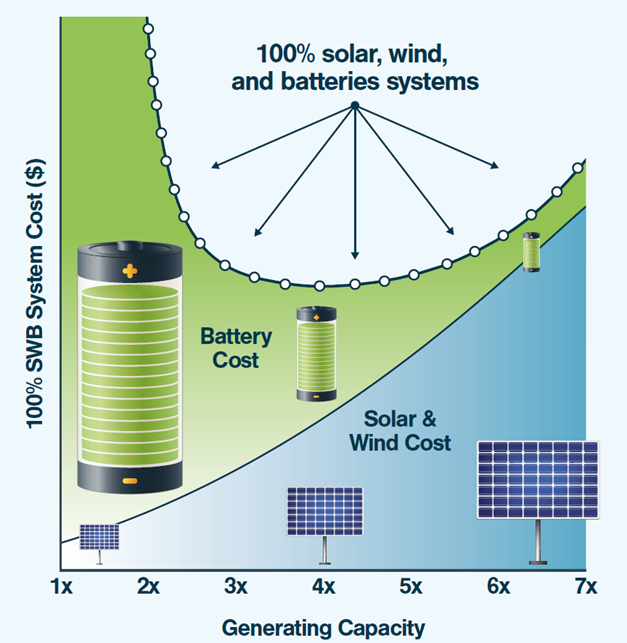
RethinkX calculations indicate that adding generating capacity at three to four times the yearly power needs may result in the lowest system cost—an aggressive approach compared to conventional thinking. RethinkX’s projections for renewable energy deployment have been consistently more accurate than those from the U.S. Energy Information Administration (EIA). The chart below shows their optimization calculations, which vary by region. To minimize overall system capital expenditure (capex), an optimal balance between generation and storage must be identified. This tradeoff relationship is not linear and is characterized by a convex (U-shaped) curve.
Short-duration Batteries: Primarily lithium-ion batteries, these are crucial for rapid frequency regulation, managing sudden ramps in renewable output (e.g., cloud cover over a solar farm), providing immediate reserves, and shifting solar peak generation a few hours later into the evening demand peak.
Long-duration Storage: Balancing supply and demand over days requires technologies like pumped hydro, compressed air energy storage (CAES), and various forms of thermal storage. A significant overcapacity of renewable generation can keep the number of days of storage surprisingly low.
Enhanced Grid Control and Digitalization (The Smart Grid): The grid is evolving from a one-way, centralized system to a complex, multi-directional network requiring:
Advanced Grid Automation: Real-time monitoring and control systems capable of managing thousands of distributed generation points and dynamic loads. Once built, solar and wind power have a very low (near-zero) marginal cost of generating electricity and will reduce the operating time (capacity factor) of gas power plants and the profitability of nuclear power, which typically stays at full load even when power prices go negative.
AI and Machine Learning: Crucial for accurate forecasting of renewable generation and demand, optimizing power flow, and enabling predictive maintenance.
Integrated Management Systems: Advanced Distribution Management Systems (ADMS) and Distributed Energy Resource Management Systems (DERMS) are essential for coordinating distributed energy resources with central grid operations.
Despite the clear momentum and technological progress, significant challenges remain:
Variability and Intermittency: Solar and wind output fluctuates based on weather conditions, requiring robust balancing mechanisms.
Grid Stability and Inertia: Traditional plants provide “inertia” that stabilizes grid frequency. Renewables connected via inverters do not inherently provide this. Solutions include advanced inverter controls (grid-forming inverters), synchronous condensers, and fast-responding battery storage. Grids can measure and control available inertia in real time.
Transmission Bottlenecks: Renewables are often in remote areas, requiring significant investment in new transmission infrastructure that faces siting, permitting, and cost hurdles.
Demand Flexibility: In a renewable-heavy grid, demand needs to become more flexible and responsive, including demand response programs, smart EV charging, and flexible industrial processes.
Cybersecurity: A more digitized and interconnected grid presents a larger attack surface, increasing the risk of cyberattacks.
Market Design: Current electricity markets must evolve to properly value and incentivize demand response flexibility, reliability services, and storage.
Addressing these challenges requires:
Advanced Grid Automation and Digitalization: AI and ML-driven forecasting, sophisticated ADMS and DERMS for real-time control, automated fault detection, and dynamic Volt/VAR optimization (VVO).
Massive Transmission Expansion: Investment in high-capacity transmission lines and stronger inter-regional ties to leverage geographic diversity. It is inefficient for the US to have the Eastern, Western, and Texas grids operating largely independently.
Accelerated Energy Storage Deployment: Continued deployment of short-duration batteries and robust investment in long-duration storage technologies.
Aggressive Demand-Side Management: Expanding demand response programs, Virtual Power Plants (VPPs), smart EV charging, and industrial process flexibility.
Policy and Regulatory Modernization: Evolving grid codes, market rules, and permitting processes to accelerate renewable and storage deployment while ensuring reliability.
International and Inter-regional Interconnection: Sharing diverse renewable resources and balancing supply and demand over larger areas. The US and Canada are natural partners.
Robust Cybersecurity Investments: Embedding cybersecurity in all new grid automation components and continuously monitoring existing infrastructure.
The power outages that swept across Spain and Portugal on April 28, 2025, were a painful reminder of how deeply our lives depend on reliable energy. For many of those affected, the disruption was a real hardship, and the cost to civil society exceeded 1 billion euros, even though power was mostly restored within 24 hours.
The days of centralized power generation are over. The world needs reliable power that protects against major outages and quickly heals itself when failures occur. Most of the technology for this transformation is already in hand and continues to improve with digitalization and AI.
These new distributed assets, when connected and coordinated intelligently with AI, can provide critical services for grid management, including energy balancing, voltage support, synthetic inertia, frequency regulation, and congestion relief in milliseconds, delivering flexibility where it’s needed most.
The vision of an electric grid dominated by solar, wind, and batteries is no longer a distant dream but an increasingly accepted and actively pursued reality. While the transition presents significant operational, technical, and regulatory challenges, the economic drivers and technological advancements make it not just feasible, but inevitable and desirable. The world will be learning valuable lessons from China, which has emerged as the global leader in integrating massive new SWB in recent years while planning new hydro power and beginning to retire substantial coal plants.
The journey requires substantial investment, innovative policy, and relentless technological advancement in grid automation and energy management. As the world pushes toward decarbonization, the ability to build and operate a resilient, efficient, and sustainable power grid will prove to be a significant economic advantage. For more information, ARC provides market reports on Grid Automation, Microgrid Automation, Grid-Scale Power Converting Systems, and many other related topics. To learn more, reach out to [email protected].