Representative End User Clients







Representative Automation Clients







Representative Software Clients








Keywords: Industrial Software-Defined Automation, Process Automation, Digital Twin, Generative AI, Copilot, Cybersecurity, Sustainability, Industrial Metaverse, Autonomous Production
Siemens is the market leader in many areas of automation, and the supplier has a long history serving the process industries that dates back to the early 1980s. As the IT/OT convergence reaches the process industries, the company took time recently to present its strategy to ARC analysts. This report summarizes our findings.
According to Siemens, these key technologies will shape the future of process automation:
Siemens recognizes the challenges facing process industry users today. These include the need for identifying and sourcing alternative feedstocks while improving the efficient use of energy and other resources. Traditional process plants offer little flexibility to accommodate changing customer requirements and needs, and the legacy automation systems that run them make the integration of advanced technologies a challenge. At the same time, labor shortages make it difficult to find skilled staff. Finally, cybersecurity threats and regulatory requirements mean adding more technology to comply with an ever-changing world.
In his keynote address, Siemens Process Automation CEO Axel Lorenz pointed to smart manufacturing solutions as the strategy to address these challenges. Results from a recent Deloitte study show that 80 percent of manufacturers have already implemented or are piloting smart manufacturing initiatives, including autonomous production.

According to Lorenz, “autonomous” refers to processes and logistics that are highly automated and connected to enable efficient and scalable operations to increase productivity. Siemens has identified key technologies that, when used together as building blocks, can help process end users address each of the above challenges. Listed in the table above, these key technologies were the focus of the PA briefing for analysts.
According to Siemens, digital twins provide a “single pane of glass” for highest autonomy and support, from design and engineering, via commissioning to operation and maintenance of plants. Digital twins hold much promise with respect to autonomous production because they allow the simulation of possible scenarios that an AI agent can use to find solutions to current state challenges. They can also predict the trajectory of operations, then inform the proper agent or personnel of the best changes to implement.
With its acquisition of Dotmatics, Siemens has added process design and simulation via gPROMS to its portfolio. Dotmatics offers an R&D platform that helps scientists to manage, analyze and share research data, including tools for data management, electronic lab notebooks (ELN), and scientific workflow automation, to streamline research processes and accelerate innovation. gPROMS is a process modeling environment used for digital process design and operation that allows users to build detailed, equation-oriented models of chemical and biological processes, enabling simulation, optimization, and advanced control application.
Industrial software-defined automation (ISdA) is changing automation architectures in discrete manufacturing, so it was only a matter of time before the perceived benefits would make the concept attractive to process automation users. However, the road to ISdA in process automation will be a long journey due to the many hurdles to surmount in terms of regulation, safety, performance, and acceptance.
The flexibility that ISdA provides is unquestionable, and for process users, the main benefit is the decoupling of automation software from the underlying hardware. That means no longer waiting for a new generation of hardware to increase memory or install a faster CPU. It also feeds the Digital Twin scenario, although this can be accomplished with most current controller platforms. While some industry visionaries (with IT backgrounds) foresee putting control execution in the cloud, ARC doesn’t see this as a viable solution for Level 2 control where determinism and connectivity are usually crucial. While safety requirements don’t currently address this specifically, it is logical that remotely controlled equipment would still need local shut-down logic to handle an unplanned disconnect from a cloud-based controller.
Safety applications offer an interesting twist to ISdA, but Siemens has already addressed this hurdle with its virtual safety PLC, so we can expect this technology to appear in the DCS in the future. How quickly the conservative process market accepts virtual safety is another issue.
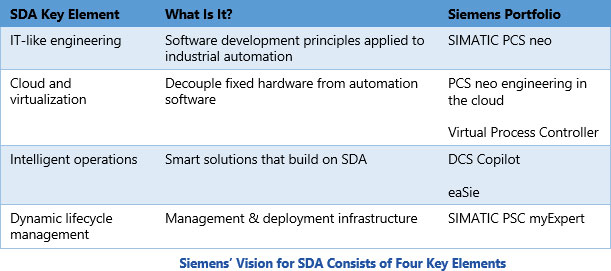
Engineering in the cloud was introduced in 2019 as the key feature of the new SIMATIC PCS neo process control system. The browser-based interface allows for a single version of projects to be worked on by multiple users in different locations in the same way that office workers share and edit documents simultaneously.
The Virtual Process Controller (VPC) is Siemens’ concept of a containerized DCS, first shown at the Hanover Fair in 2025. A virtual DCS offers levels of scalability and flexibility unknown in the world of classic DCS, and PA developers appear to be taking clues from colleagues who developed the S7-1500V, Siemens’ first virtual PLC. While virtual controllers are a key part of SDA, expect acceptance to be slow at first. Especially in the regulated industries, there are still many hurdles to surmount before software-defined architectures are common. Interesting fact: Siemens already offers a virtualized version of PCS 7 as an engineered solution known as the Industrial Automation Datacenter.
Of all the key technologies presented by Siemens PA, perhaps the faster value-add will come from the integration of AI in the form of DCS Copilot that deploys agents to assist users in engineering, process optimization, maintenance and operations. The market is just beginning to discover the enormous value these agents can provide in handling mundane tasks while giving users more time to focus on what is important. Expect to see enthusiastic acceptance of the use of Copilots in engineering, which is a lower hurdle than any changes or additions to process operations.
SIMATIC eaSie is Siemens’ new data assistant that uses generative AI to simplify communication for engineers, operators and maintenance staff in their information searches. With eaSie, information can be accessed from different systems by combining human machine interfaces with methods such as chat, QR codes and voice input. Generative AI and large language models are the enablers of this fascinating technology that claims to “speak the language of engineers.”
Finally, SIMATIC PCS myExpert is a web-based health and lifecycle dashboard for plants controlled by Siemens DCS systems. The tool is essentially a monitoring and maintenance center to manage firmware and software updates, conduct security audits, create support requests, and provide access for authorized users.
In today’s digital world, keeping both IT and operational technology (OT) secure is more important than ever. Over 80 percent of companies face cyberattacks each year, and about a quarter of ransomware attacks now affect production environments, often stopping work for days.
As businesses use more digital tools and face new regulations like CIRCIA and Europe’s NIS2, protecting data isn’t just for IT teams—it’s everyone’s responsibility. Siemens is leading the way by focusing on secure, automated production and defense-in-depth, which means using several layers of protection.
The journey to better OT security starts with key questions: What assets need protection? Where are the biggest risks? Companies should segment networks, control access, train staff, and keep improving their defenses. With help from Accenture, Siemens also offers managed security services around the clock.
At its core, Siemens’ Charter of Trust is about safeguarding data, building trust, and preparing for the future. Cybersecurity today is essential for safe, efficient, and smart industries.
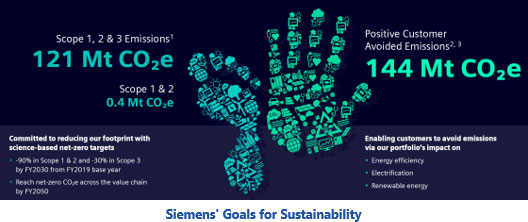
Siemens is helping its customers to avoid emissions along a company’s entire value chain -- a remarkable milestone in its journey toward sustainability. Siemens demonstrated several technologies that contribute to this achievement. The Siemens Energy Manager Suite (software and hardware) helps industrial and infrastructure customers improve transparency of their energy usage and unlock significant savings. In wastewater treatment, Siemens is using process simulation and advanced control systems to optimize operations, enabling industries to save millions of tons of groundwater annually, according to the company.
An example of “clever” engineering is the SITRANS FM 520, a magnetic flowmeter. The product has been redesigned for complete disassembly, making repairs and part replacements easier and extending its lifespan. According to Siemens, this improved version of the transmitter is just as reliable and no more expensive than the original.
Siemens’ vision for process automation is aligned with market needs. The emphasis on addressing problems over focusing on the technology used to solve the problem is vitally important. End users need to solve problems in the most efficient, least complex manner possible. From ISdA to AI implemented at all levels of process automation, Siemens is demonstrating its commitment to implement key technologies to address the critical challenges facing process industry users today and in the future.
ARC Advisory Group clients can view the complete report at the ARC Client Portal.
Contact Us if you would like to speak with the author.
Obtain more ARC In-depth Research Market Analysis.