Representative End User Clients







Representative Automation Clients







Representative Software Clients








In today's rapidly evolving industrial landscape, the shift from traditional hardware-centric control systems to more flexible and scalable software-defined architectures (SDA) can transform how manufacturers operate. Before the advent of SDA, process automation relied heavily on proprietary hardware-centric systems that were inflexible and difficult to scale. The transition, leveraging technologies such as virtualization and open standards, marked a significant shift, enabling more flexible deployment and limited analytics and control at the edge. The Open Process Automation (OPA) movement further advocated for open, secure, and interoperable architectures, emphasizing microservices-based control and the standardization of traditionally proprietary functions.
SDA revolutionizes industrial automation by decoupling software from hardware, allowing for flexible and scalable control systems on general-purpose computing platforms. This approach enhances flexibility, reduces costs, and supports modern workforce engagement through low-code/no-code environments and digital twin capabilities. SDA promises a more adaptable, cost-effective, and innovative future for industrial control systems.
Based on ARC research, here are four recommendations:
Envision What is Possible for Network Architecture.
Plan for Legacy System Integration.
Focus on Workforce Training and Development.
Continue to Invest in OT Cybersecurity.
Prior to the advent of software-defined architecture (SDA), process automation was dominated by proprietary, hardware-centric systems with limited flexibility, scalability, and interoperability. Traditional controller-centric designs, such as Distributed Control Systems (DCS) and Programmable Logic Controllers (PLC), were tightly coupled with vendor-specific hardware and software. This created monolithic systems where control logic, I/O, and HMI were bundled into proprietary platforms, resulting in vendor lock-in and hardware dependency. Communication protocols like Modbus, PROFIBUS, and DeviceNet were widely used (and will be for some time) but often lacked seamless interoperability, further fragmenting the ecosystem. In addition, legacy systems face lifecycle and maintenance issues, including aging infrastructure, workforce transitions, and cybersecurity vulnerabilities.
The move toward virtualization and open standards marked a significant industry shift. Early efforts introduced Edge Automation Controllers and Industrial PCs (IPCs), which began replacing proprietary controllers in certain applications, especially in discrete manufacturing. These advancements enabled more flexible deployment and basic analytics and control at the edge. The OPA movement, driven by end users, advocates for open, secure, and interoperable architectures. It emphasizes microservices-based control, where small edge devices can manage one or two loops, and the standardization of ISA-95 Level 1 and 2 functions traditionally handled by proprietary DCS/PLC systems.
SDA marks a significant evolution in industrial automation by separating software from hardware. This innovative approach enables the deployment of virtualized, adaptable, and interoperable automation systems on versatile computing platforms such as industrial PCs, edge servers, or cloud environments. Moving away from traditional proprietary control systems, SDA fosters a more flexible and responsive automation ecosystem by applying IT-based approaches to computing and software. This allows control logic to be easily modified and scaled without being tied to specific hardware constraints.
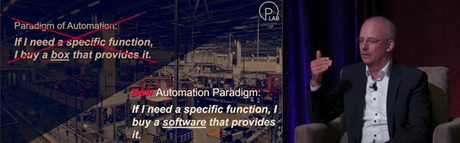
One of the primary promises of SDA is its ability to enhance flexibility and scalability in control system architectures. Traditional systems often demanded significant hardware investments and were limited in their ability to adapt to changing operational needs. In contrast, SDA enables rapid deployment and reconfiguration of virtual controllers across various hardware, supporting modular system design and reducing downtime. This flexibility is especially valuable in environments where production processes must be frequently adjusted or scaled to meet demand.
SDA also promises to reduce the total cost of ownership (TCO) for industrial automation systems. By minimizing hardware dependency, SDA reduces maintenance and upgrade costs, as well as energy consumption. The consolidation of multiple control functions onto fewer devices through virtualization further contributes to savings. Additionally, the use of open standards and interoperability across devices from different vendors reduces vendor lock-in, enabling manufacturers to choose the best solutions for their needs without being tied to a single supplier.
Furthermore, SDA supports enhanced workforce engagement and innovation. Modern engineers are increasingly drawn to low-code/no-code environments and IT-style workflows, which SDA readily supports. This alignment with contemporary development practices helps attract and retain talent, fostering a more innovative and agile workforce. Moreover, SDA's digital twin and simulation capabilities enable virtual testing and optimization of machines and processes before physical deployment, reducing errors and accelerating time-to-market. Overall, SDA promises to revolutionize control system architectures by making them more flexible, cost-effective, and aligned with modern technological and workforce trends.
However, SDA presents several challenges for manufacturers with existing control system architectures. One of the primary challenges is the integration of legacy systems. Many factories still rely on decades-old proprietary systems that are difficult to integrate with SDA. These systems were not designed with interoperability in mind, making it challenging to connect them with modern, software-defined platforms. The integration process can be complex and time-consuming, requiring significant investment of both time and resources.
Another major challenge is cybersecurity. The increased connectivity and virtualization introduced by SDA create new attack surfaces that demand robust security protocols. Traditional control systems were often isolated from external networks, but SDA's reliance on OT networked environments means manufacturers must implement advanced cybersecurity measures to protect their systems from potential threats. This includes not only securing the software and network infrastructure but also ensuring that all connected devices are protected. Even with strong cybersecurity measures in place, end users must continually revisit and review them in light of new technologies deployed.
Skill gaps and change management also pose challenges for manufacturers transitioning to SDA. The shift to software-defined systems requires new skill sets that may not be readily available within the existing workforce. Manufacturers need to invest in training and development to equip employees with the necessary skills to manage and maintain SDA systems. In addition, the transition to SDA requires organizational change, which can be difficult in traditional manufacturing environments. Resistance to change and adapting to new workflows and processes can slow adoption.
Finally, ensuring real-time performance in virtualized environments can be a technical hurdle depending on the architecture. Traditional control systems are designed to provide deterministic control with precise timing, which is critical for many industrial processes. Achieving comparable performance in a virtualized environment requires advanced infrastructure and careful resource management. Manufacturers must ensure their SDA systems can meet stringent performance requirements, which can be a complex and demanding task.
Some potential strategies and recommendations for manufacturers considering their control system lifecycle and deployment in light of the SDA trend are:
Envision What is Possible for Network Architecture: SDA enables different approaches to control system deployment. End users should consider space, power, and cable access, but its flexibility allows more locations and housing models than previously possible. Potential physical risks such as cable failures, power outages, and HVAC issues should also be evaluated, as they may vary with new deployment locations.
Plan for Legacy System Integration: Many manufacturers still rely on legacy systems that are difficult to integrate with SDA, but proper portfolio management will support integration and eventual migration. A phased approach can help mitigate these challenges. This may involve gradually replacing outdated hardware with flexible, software-defined solutions or implementing middleware to bridge gaps between old and new systems. Careful planning and investment in integration technologies can ensure a smoother transition. Manufacturers should also consider the risks involved. Many vendors now offer SDA-based migration schemes that mitigate production risks and preserve engineering IP, reducing costs and potential downtime. Be sure to include Process Safety Systems in planning. While options are limited today, ARC expects more to emerge.
Focus on Workforce Training and Development: The transition to SDA requires new skill sets that may not exist within the current workforce. Manufacturers should invest in training programs to equip employees with the necessary expertise to manage and maintain SDA systems. This includes training on new software platforms, virtualization technologies, and cybersecurity practices. Fostering a culture of continuous learning and innovation will also help attract and retain talent.
Continue to Invest in OT Cybersecurity: With the increased connectivity and virtualization introduced by SDA, robust cybersecurity measures are essential. Manufacturers should implement advanced protocols to protect systems from potential threats. This includes securing software, network infrastructure, and all connected devices. Regular security audits and updates are critical to maintaining a secure environment.
By adopting these strategies, manufacturers can effectively navigate SDA challenges and leverage its benefits to enhance control system architectures.