Representative End User Clients







Representative Automation Clients







Representative Software Clients








This ARC Industrial AI report provides an overview of AI initiatives, adoption, and use cases in the pharmaceutical and biotechnology industry, substantiated by selected data from ARC’s recent Industrial AI survey. This report provides an overview of AI initiatives, use cases, and adoption in pharmaceutical and biotechnology manufacturing, supported by selected data from ARC’s recent Industrial AI survey. It explores how the pharmaceutical and biotech industry compares in AI adoption versus other industries. It enables manufacturers to understand how to baseline their current state regarding AI and helps end users develop their own strategy to deploy AI technologies to gain a competitive edge. Manufacturing is a strategic and critical component of the pharmaceutical and biotech industry. The intelligent application of AI to pharmaceutical manufacturing processes can help end users gain market share and improve time to market.
This research identifies key stages and achievements of pharmaceutical and biotech manufacturers in Industrial AI, offering practical steps and recommendations to help organizations leverage AI for innovation and leadership in the industry.
Measurable results after implementation of AI in different areas include:
These outcomes demonstrate how AI is not only optimizing operations but also supporting workforce development and environmental goals while reducing costs. ARC conducted a global online survey in Q2 2025. A total of 510 respondents participated from all industries. Participants from the pharmaceutical and biotech industry are the focus of this report. The respondents were end users with influence/decision-making power and/or knowledge of their industrial organization’s usage and adoption of Industrial AI initiatives and technologies.
This report highlights important phases and characteristics that pharmaceutical and biotech manufacturers are achieving through Industrial AI. It offers guidance for organizations planning to excel in pharma and biotech manufacturing using AI, including steps to get started or to advance AI innovation.
Although there are some discernible differences, the pharmaceutical and biotech industry is generally aligned with other sectors in the development and use of AI within manufacturing plants. While companies in the pharmaceutical and biotech industry excel in certain areas, they also lag behind in other areas. To become global leaders in Industrial AI, the industry should focus on data technologies, and on expanding and scaling AI initiatives.
For organizations that have not yet started implementing AI, it is essential to establish a clear strategy and begin deployment to stay competitive. Those already on the AI journey should prioritize scaling successful initiatives across plants, sites, regions, and the enterprise to maximize value. It’s also important for individual pharma and biotech companies to benchmark their progress both against peers in their own industry as well as other industries. Taking proactive steps to lead in Industrial AI is crucial, as rapid technological change is reshaping manufacturing, and AI will have a significant impact on the future of the industry.
As noted, it is important that the strategy includes a focus on the organization and culture (e.g., people), processes and technologies so that AI is an enabler for production optimization and more autonomous operations. It should also include a plan for global implementation across facilities, plants and sites with the ability to compare, measure value and assess plant to plant, site to site and across the enterprise. The pharma and biotech industry is at a critical pivotal point for innovation. To stay competitive, organizations must innovate, hire skilled workers, boost productivity, and leverage quality data. AI, digital platforms, and other emerging technologies including robots, co-pilots and digital twins will be required to achieve these goals. To realize the full benefits of AI initiatives, companies must meet regulatory policies and requirements and scale across the enterprise.
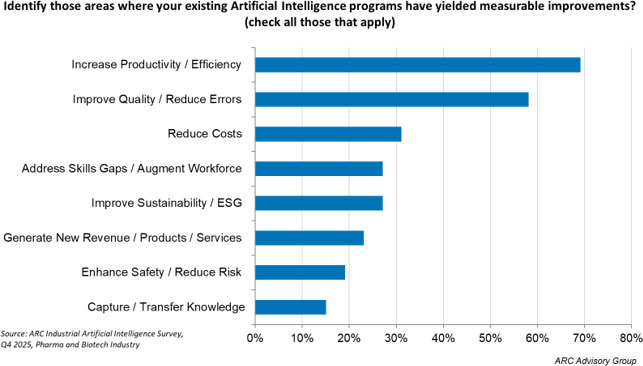
Table of Contents
ARC Advisory Group clients can view the complete report at the ARC Client Portal.
Contact Us if you would like to speak with the author.
Obtain more ARC In-depth Research Market Analysis.