Representative End User Clients







Representative Automation Clients







Representative Software Clients









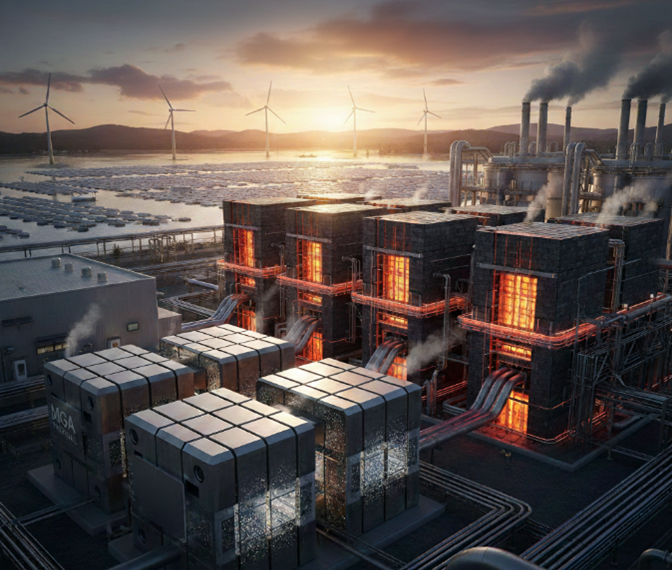
Industries worldwide are exploring ways to transform operations toward low-carbon and sustainable energy use. High-temperature industrial processes remain difficult to decarbonize due to their need for continuous, high-grade heat, particularly in sectors with extreme temperature requirements. While electric boilers and furnaces can provide high temperatures for specific processes, scaling their operation to meet continuous, large-scale heat demand from variable renewable sources can be costly and grid-intensive. Thermal batteries are emerging as a complementary solution, storing energy from renewable or low-carbon sources and releasing it as high-temperature heat on demand, helping to bridge the “industrial heat gap” and provide flexible, dispatchable energy for industrial applications.
Early progress can be seen in the Asia-Pacific region. In April 2025, MGA Thermal, an Australian company specializing in industrial heat storage, commissioned a 5 MWh steam-integrated latent heat Electro-Thermal Energy Storage (ETES) system at its Tomago facility in New South Wales. The demonstration unit provides continuous superheated steam over extended periods, supporting industrial applications such as mineral processing and heavy manufacturing. Building on this milestone, MGA Thermal is advancing plans for a 180 MWh commercial-scale project in Western Australia in collaboration with Western Australia-based global mining and energy company Tronox, designed to deliver steady industrial steam.
Closer to commercial deployment, in late 2025, SCG Cleanergy, in partnership with Rondo Energy, commissioned a 33 MWh modular heat battery at its cement plant in Saraburi, Thailand. This unit, Rondo’s first deployment in Southeast Asia, stores electricity from a floating solar farm and the grid as high-temperature heat in brick-based modules. The stored heat is then converted into high-pressure steam to drive a turbine and generate continuous electricity, marking one of the earliest real-world industrial applications of thermal batteries in Southeast Asia.
Thermal batteries, sometimes called heat batteries, store energy as heat rather than electricity. They capture energy from sources such as solar or wind power in the form of heat and release it as steam or hot air to meet industrial process needs. When energy is required, a working fluid circulates through the storage medium, transferring heat to generate high-pressure steam or hot air. Careful control of flow and temperature prevents thermal shock or equipment damage, while automated systems and heat-resistant materials help ensure even heating and cooling.
Practical implementations of thermal batteries vary depending on the storage medium and desired performance. For example, MGA Thermal’s system uses proprietary Miscibility Gap Alloy (MGA) blocks, which store energy as latent heat through melting and solidification, enabling high energy density at nearly constant temperature. In contrast, Rondo Energy relies on refractory bricks, which store energy as sensible heat, meaning temperature changes as energy is absorbed or released.
Thermal batteries provide several advantages for industrial applications. They can achieve very high round-trip efficiencies, with some systems reporting efficiencies above 95 percent when converting electricity into stored heat and delivering it for use. They use materials such as bricks, graphite, and phase-change alloys, which can be reused or recycled at end of life, reducing reliance on critical minerals such as lithium or cobalt required for many electrochemical batteries. By providing continuous high-temperature heat, thermal batteries are well suited to decarbonizing hard-to-abate sectors, directly replacing fossil-fuel-based boilers and furnaces in many industrial processes. They also allow energy from variable renewable sources to be stored and dispatched on demand, enabling large-scale, steady heat supply without placing constant demand on the grid. Compared with electrochemical storage solutions such as lithium-ion batteries, thermal systems are inherently safer: they do not contain volatile or flammable chemicals, the risk of thermal runaway is minimal, and failures generally result in localized overheating rather than fires or explosions.
While offering many advantages, thermal batteries also face practical challenges. Operating at high temperatures places demands on materials, insulation, and system design, requiring heat-resistant components to ensure durability and minimize thermal losses. Large installations can have a significant physical footprint, which may complicate retrofits or integration with existing industrial processes. Upfront capital costs can be relatively high due to the need for specialized materials and engineering. Routine inspections and maintenance are important to ensure long-term performance, although modular or replaceable components allow part-level servicing without shutting down the entire system.
Nonetheless, early deployments such as SCG’s heat battery in Thailand and MGA’s projects in Australia demonstrate that thermal batteries can be deployed at industrial scale. The technology remains in the early stages of adoption, but initiatives such as the Thermal Battery Alliance, formed in early 2025 to bring together leading companies and stakeholders, may help coordinate development, scale manufacturing, and encourage wider uptake. While adoption is still nascent, thermal batteries show promise for industrial heat processes and flexible renewable integration, opening new pathways for operational transformation and sustainability.