Representative End User Clients







Representative Automation Clients







Representative Software Clients








KEYWORDS: Data-Driven Manufacturing, Xcelerator, Industrial Operation X, Insights Hub, IT/OT Convergence, Artificial Intelligence, Generative AI, Copilot
Manufacturing processes have always produced valuable raw data - the problem was collecting and doing something meaningful with them. As manufacturers undergo their digital transformations, modern networks and analysis tools are helping manufacturers to unlock vast troves of raw data and make sense out of them. This concept is called data‑driven manufacturing.
The challenge for today’s manufacturers is to make this a continuous process of collecting and analyzing data, then using the results to guide decisions rather than relying on intuition or spreadsheets. This ARC View looks at Siemens’ vision for data‑driven manufacturing, and shows how Insights Hub, the Industrial Edge, and the Xcelerator ecosystem help manufacturers to continuously improve operational efficiency, sustainability, and IT/OT convergence. Siemens recently briefed ARC analysts on its solutions for data-driven manufacturing.
Across all industries, manufacturers are under pressure to improve. Top priorities include maximizing production performance, reducing operational costs, optimizing energy and carbon usage, and increasing flexibility. These priorities haven’t changed — but the tools to achieve them have. The shift now is toward using data as the engine for continuous improvement. Yet many still rely on manual processes and dis-connected systems.
Despite all the technology available, most continuous improvement processes are still run on pen and paper or spreadsheets. That means slow decisions, limited transparency, and inconsistent results. Data exist — but they’re not connected, contextualized, or actionable.
Siemens offers a suite of solutions around data-driven manufacturing that includes Insights Hub, Industrial Edge, and the Xcelerator ecosystem. These tools enable a closed‑loop improvement cycle that collects data from machines, sensors, MES, or ERP, then contextualizes it, analyzes it with AI, and helps teams take action. It’s a complete framework for continuous improvement, from the shopfloor to the cloud.
Industrial Operations X drives the convergence of IT and OT, enabling seamless integration between automation systems, edge computing, and cloud analytics. According to Siemens, customers benefit from faster decision making, shorter time-to-value, and an open ecosystem that supports customization and scalability.
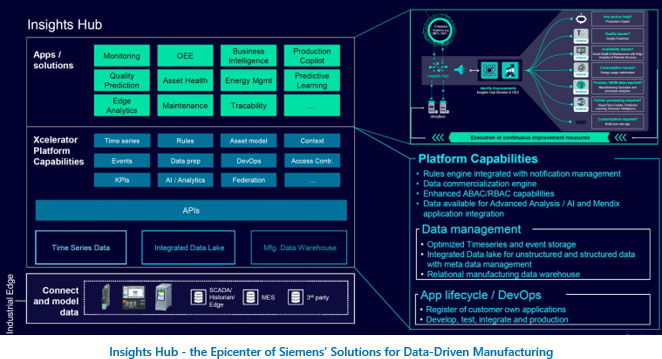
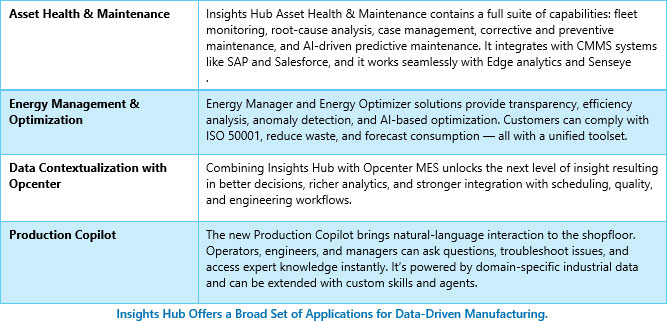
Insights Hub offers a broad set of applications: OEE monitoring, asset health and predictive maintenance, energy management and optimization, quality prediction, business intelligence, and the new Production Copilot. The platform provides time‑series storage, an integrated data lake, rules engines, DevOps tools, and secure access control – essentially a complete industrial data foundation.
This suite of solutions creates a continuous improvement workflow that works like a loop. It identifies issues such as quality, availability, energy, process, then analyzes them using contextualized data to predict what will happen next. Users can optimize operations using AI and automation, and execute improvements through MES, ERP, or custom apps. The goal is to achieve continuous improvement that is constantly driven by data.
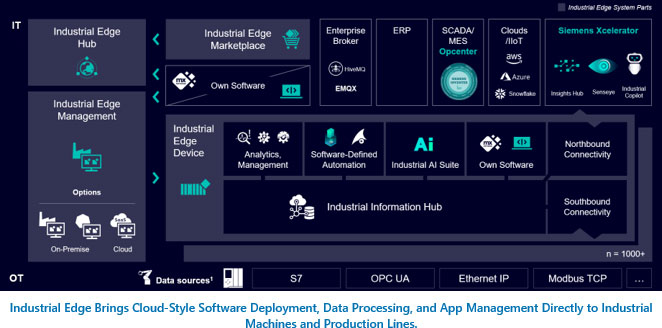
Siemens Industrial Edge is a key part of Industrial Operations X and works hand-in-hand with Insights Hub, Opcenter, and the Xcelerator ecosystem. Taken together, Siemens calls this the Edge‑to‑Cloud industrial architecture.
Industrial Edge is a factory‑level computing platform that brings cloud‑style software deployment, data processing, and app management directly to industrial machines and production lines. It acts as the bridge between OT equipment and IT/cloud systems, enabling secure, scalable, and low‑latency industrial data processing. It enables manufacturers to run apps, analytics, AI models, and connectivity services directly at the machine or line level. This reduces latency, increases reliability, and keeps sensitive data on‑premise when needed. Another important function is using Industrial Edge as a local data integration layer to create an asset model that IT/cloud systems can tap into to further process data without additional data engineering.
The Siemens Xcelerator is a curated portfolio of software, hardware, and digital services that all follow a common set of principles: open APIs, modular design, cloud readiness, and interoperability. It brings together Siemens products, partner solutions, and developer tools into one unified ecosystem. The ecosystem is designed to help companies accelerate digital transformation without getting locked into rigid, monolithic systems.
Looking ahead, Siemens is building toward agentic AI, deeper contextualization, and the industrial metaverse. The company’s edge‑to‑cloud architecture ensures that customers can scale globally while keeping control of their data and operations.
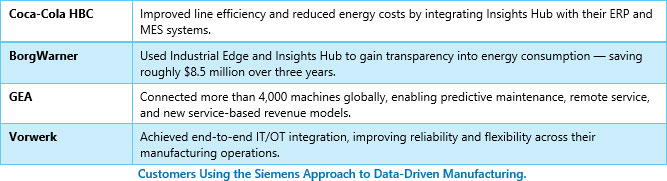
To sum it up: data‑driven manufacturing isn’t just about collecting data — it’s about turning it into continuous improvement. As manufacturing companies undergo their digital transformations, most are putting into place the architectures necessary to support the process of collecting and processing data and turning the results into action items in a never-ending cycle of continuous improvement. Siemens has developed the architecture, the tools, the applications, and the AI necessary to support these efforts while embracing the spirit of openness.
ARC Advisory Group clients can view the complete report at the ARC Client Portal.
Contact Us if you would like to speak with the author.
Obtain more ARC In-depth Research Market Analysis.