Representative End User Clients







Representative Automation Clients







Representative Software Clients








In many industrial environments, measurement technologies have traditionally been viewed as operational necessities—tools that monitor process variables such as flow and level to ensure systems function as intended. These instruments were often selected based on technical specifications, installation constraints, and immediate process requirements. However, this perspective is rapidly evolving.
Today, the role of measurement technology extends far beyond basic monitoring. Flow and level measurement decisions are increasingly shaping broader business outcomes, influencing operational efficiency, cost management, safety, and long-term performance. What was once a purely engineering decision is now becoming a strategic consideration at the organizational level.
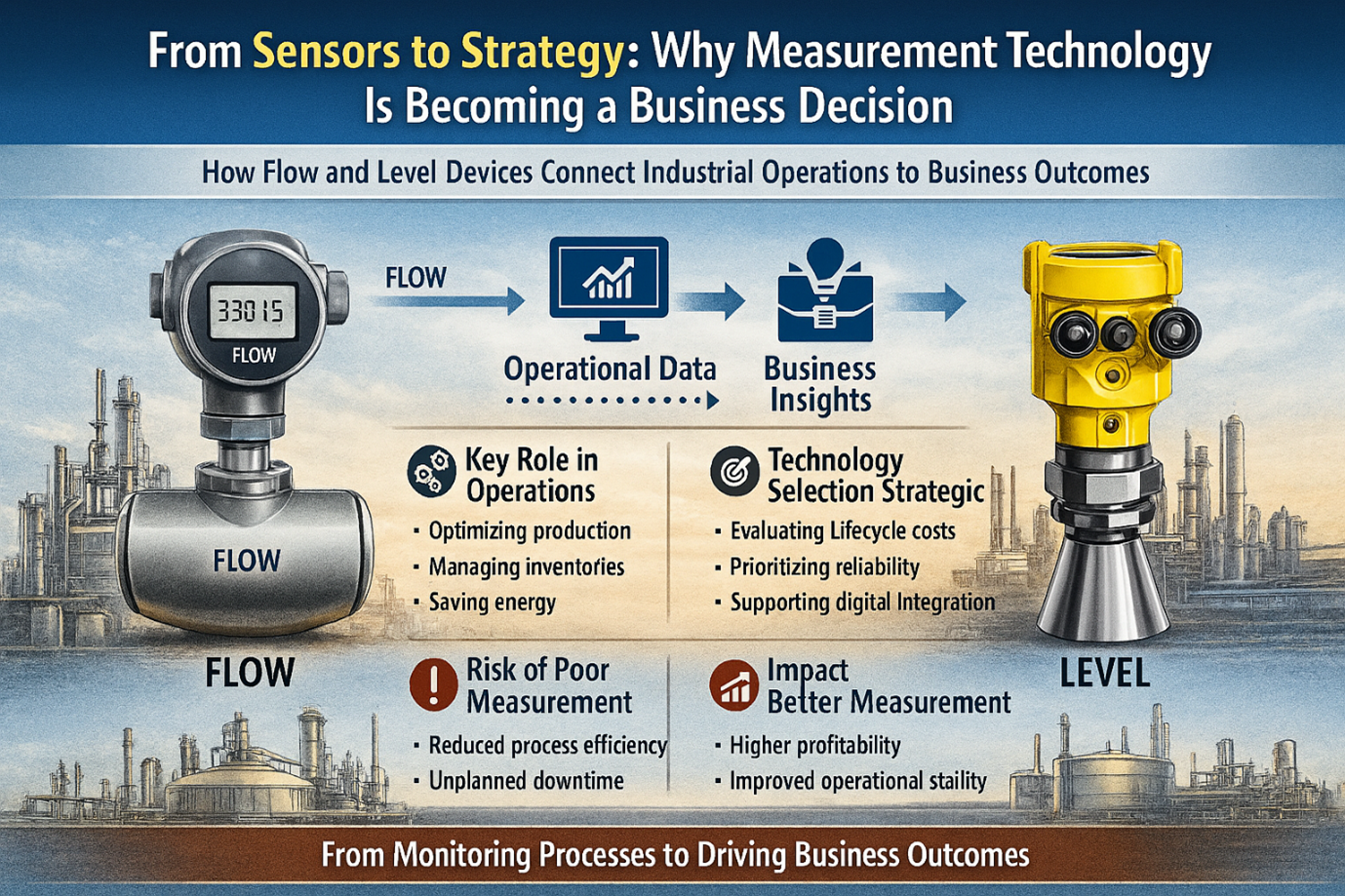
At the core of every industrial process lies a set of measurable variables that define how materials move, react, and are stored. Flow measurement determines the movement and dosing of materials, while level measurement ensures proper containment, inventory control, and process continuity.
While these functions remain fundamental, their impact is no longer limited to process stability. Measurement accuracy and reliability now directly influence:
Production efficiency.
Resource utilization.
Energy consumption.
Maintenance planning.
Regulatory compliance.
As industries pursue higher efficiency and tighter control over operations, the importance of accurate and reliable measurement continues to grow.
One of the most overlooked aspects of industrial operations is the cost of inaccurate or unreliable measurement. Unlike mechanical failures, which are often immediately visible, measurement errors can persist unnoticed while gradually affecting performance.
In flow measurement, even small inaccuracies can lead to:
Incorrect dosing of raw materials.
Product quality deviations.
Increased energy usage in pumping and processing systems.
In level measurement, unreliable readings can result in:
Overfilling and material loss.
Dry running of pumps and equipment.
Disruptions in continuous processes.
These issues are not isolated technical problems—they translate into financial losses, reduced productivity, and increased operational risk. As a result, measurement quality is now being recognized as a key factor in overall business performance.
Traditionally, measurement technologies were evaluated primarily on accuracy. While accuracy remains important, it is no longer the sole criterion. In many applications, long-term stability, consistency, and resistance to process disturbances are equally critical.
For example:
A highly accurate flow meter that requires frequent maintenance may introduce more risk than a slightly less precise but more stable alternative.
A level sensor that performs well under ideal conditions but fails in the presence of foam or vapor can lead to operational uncertainty.
This shift highlights a broader realization: measurement reliability is just as important as measurement precision. Organizations are increasingly prioritizing technologies that deliver consistent performance under real-world conditions.
Efficient operations depend on reliable data. Inaccurate measurements force operators to rely on assumptions, manual adjustments, or safety margins that reduce efficiency.
For instance:
Overestimating flow may lead to overfeeding or excess energy use.
Underestimating tank levels may result in underutilized storage capacity.
Unstable readings may trigger unnecessary alarms or shutdowns.
By contrast, consistent and accurate measurement allows for:
Optimized process control.
Reduced waste and rework.
Improved energy efficiency.
Better utilization of assets.
In this context, measurement technologies serve not only as monitoring tools, but also as enablers of operational excellence.
Modern industrial environments are increasingly driven by digital platforms that collect, analyze, and act on process data. Flow and level devices are no longer standalone instruments—they are data sources within a connected ecosystem.
This integration enables:
Real-time process visibility.
Remote monitoring of assets.
Data-driven decision-making.
Early identification of anomalies.
However, the effectiveness of these systems depends on the quality of the input data. Poor measurement accuracy or reliability at the sensor level propagates errors throughout the system, reducing the value of digital initiatives.
As a result, selecting the right measurement technology is becoming a critical step in enabling successful digital transformation.
For management and operations teams, the implications are clear. Measurement technology decisions are no longer confined to instrumentation teams—they influence overall business outcomes.
This shift requires a broader perspective when selecting flow and level technologies. Decision-makers must consider:
Lifecycle cost, not just initial investment.
Maintenance and reliability over time.
Impact on process stability and safety.
Compatibility with digital systems and future expansion.
In this context, investing in the right measurement technology is not an expense—it is a strategic decision that supports long-term performance and resilience.
The evolving role of measurement technologies reflects a larger transition in industrial thinking. Instead of selecting individual devices in isolation, organizations are beginning to design comprehensive measurement strategies.
This approach involves:
Evaluating process requirements holistically.
Combining multiple technologies where appropriate.
Aligning measurement choices with operational and business objectives.
By treating measurement as an integrated system rather than a set of components, organizations can achieve greater consistency, reliability, and efficiency.
The transition from sensors to strategy marks a significant shift in how measurement technologies are viewed within industrial operations. Flow and level instruments are no longer just tools for monitoring—they are critical contributors to performance, efficiency, and decision-making.
Recognizing measurement technology as a business decision allows organizations to move beyond short-term considerations and focus on long-term value. By selecting technologies that align with process realities and strategic goals, companies can build more reliable systems, reduce operational risk, and improve overall performance.
In modern process plants, success is no longer defined by the presence of advanced instruments, but by how effectively measurement is integrated into the broader operational and business strategy.