Representative End User Clients







Representative Automation Clients







Representative Software Clients









ARC Advisory Group has initiated a new MarketMap research study focused on drones for process industries. This study will deliver a rigorous, evidence-based assessment of suppliers that design and manufacture industrial drone systems specifically engineered for asset-intensive environments. It is designed to help end users systematically evaluate solution capabilities, differentiate between deployment-ready platforms and emerging technologies, and make defensible supplier and investment decisions. Suppliers will gain an independent, analyst-led perspective on competitive positioning and strategic direction as the market transitions from pilot projects to scaled operational deployment.
The research addresses a critical decision-making gap for both end users and technology suppliers as industrial drone adoption moves beyond experimentation toward standardized, repeatable operational use within process industry environments.
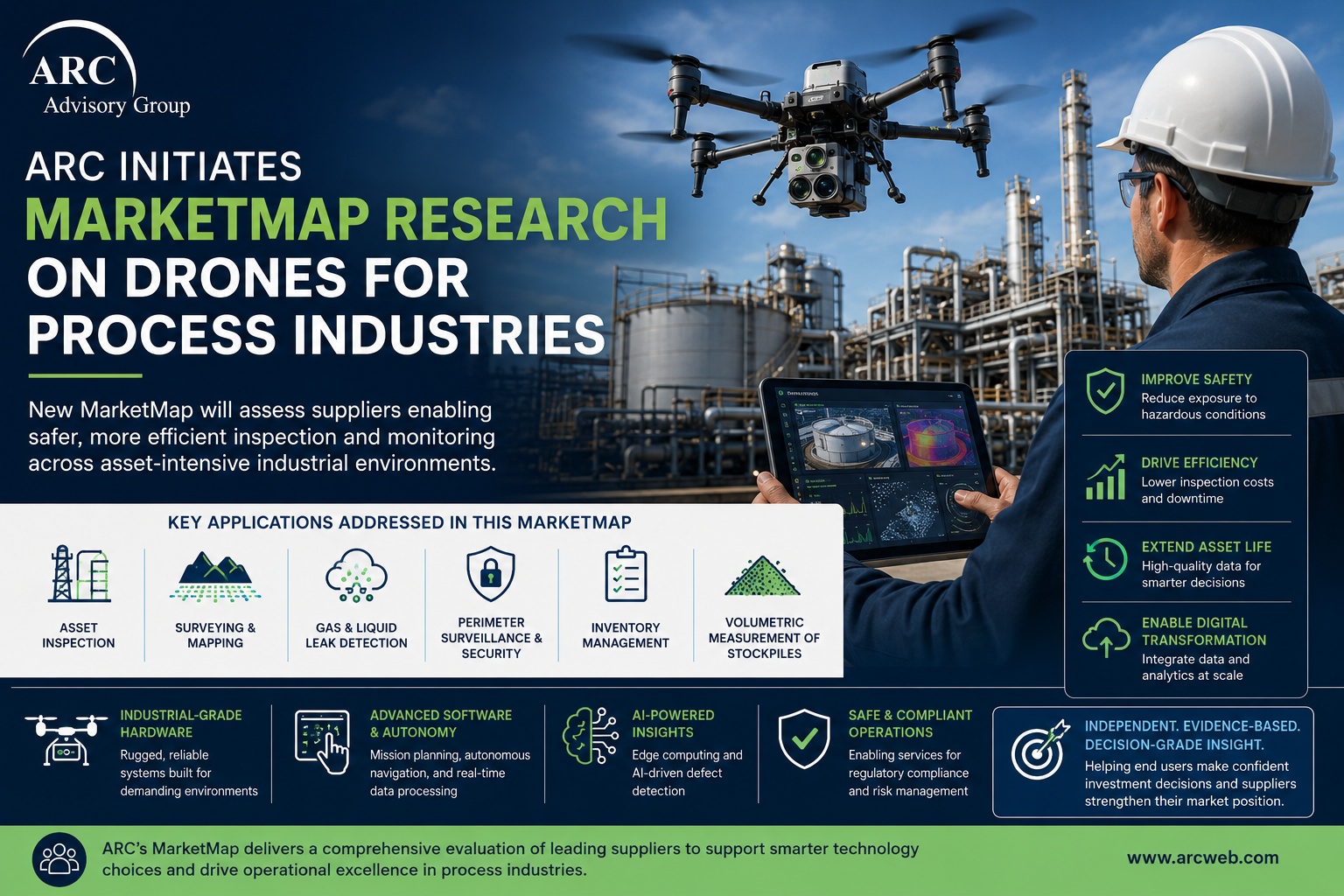
Process industries, including oil and gas, chemicals, refining, electric power generation and transmission, mining, and pulp and paper, operate large, distributed, and often aging asset bases where traditional inspection, monitoring, and data collection activities expose personnel to hazardous conditions and difficult-to-access locations. Escalating safety imperatives, coupled with intensifying pressure to improve operational efficiency and extend asset life, are prompting organizations to fundamentally reassess legacy inspection and maintenance practices.
Concurrently, enterprise-wide digital transformation programs are creating demand for higher-quality, higher-frequency asset data to enable predictive maintenance, integrity management, and performance optimization at scale. These converging pressures are accelerating adoption of industrial drone technologies across sectors where safety, reliability, and operational continuity are non-negotiable.
For the purposes of this MarketMap, ARC defines drones for the process industries as unmanned aerial systems specifically designed and ruggedized to operate in hard-to-reach, hazardous, or confined industrial environments. These systems are deployed to materially improve worker safety, minimize unplanned downtime, and reduce total inspection and maintenance costs, while enabling operational efficiency gains through automation and data integration with enterprise asset management platforms.
Recent advancements in sensor payloads, onboard edge computing, and artificial intelligence have significantly expanded industrial drone capabilities beyond simple visual data collection. Leading platforms now support autonomous navigation, real-time onboard data processing, and AI-driven defect detection, positioning them as intelligent inspection platforms rather than remotely piloted cameras.
This research targets key applications across geographically dispersed or structurally complex facilities, focusing on:
Asset Inspection: Structural integrity monitoring and detailed visual assessment of industrial infrastructure, including tanks, vessels, pipelines, flare stacks, and transmission towers.
Surveying and Mapping: High-precision geographic modeling and topographic documentation of complex facility footprints and brownfield sites.
Gas and Liquid Leak Detection: Automated fugitive emission tracking, regulatory compliance verification, and hazardous leak identification using thermal and optical gas imaging sensors.
Perimeter Surveillance and Security Monitoring: Continuous autonomous patrol, threat detection, and facility boundary protection across large industrial sites.
Inventory Management: Real-time tracking and verification of materials, equipment, and assets across expansive industrial yards and laydown areas.
Volumetric Measurement of Stockpiles: High-accuracy bulk material volume estimation for operational accounting and inventory reconciliation.
The evaluation focuses on suppliers that design and manufacture proprietary drone hardware integrated with purpose-built software for flight control, autonomous navigation, mission planning, data acquisition, and analytics. Enabling services that facilitate safe and compliant operation in demanding industrial environments are included within scope. Suppliers offering only third-party application software, drone-as-a-service without proprietary hardware, or consumer-grade platforms are explicitly excluded.
Multiple interdependent factors are accelerating industrial drone adoption within process industries. From a technology perspective, step-change improvements in autonomy, AI-powered analytics, and edge computing architectures are enabling drones to execute increasingly complex inspection tasks with substantially reduced human supervision. From an economic standpoint, organizations are targeting measurable reductions in inspection costs and maintenance cycle times, while simultaneously improving data consistency, inspection coverage, and defect detection rates compared to manual methods.
Despite growing adoption momentum, structural barriers persist. Regulatory frameworks, particularly concerning beyond visual line of sight (BVLOS) operations, continue to shape deployment strategies and operational scope, though the FAA's proposed Part 108 regulations introduced in August 2025 signal a clear pathway toward broader operational authorization. Integration requirements with incumbent asset management systems and enterprise digital platforms remain a critical evaluation criterion. Equally important, buyers are prioritizing demonstrated reliability and performance validation in harsh industrial operating conditions before committing to scaled deployment.
ARC's MarketMap for drones for process industries will evaluate suppliers using a structured analytical framework that assesses functional capabilities, deployment maturity, ecosystem strength, and long-term strategic positioning. The analysis emphasizes real-world industrial applicability and commercialization readiness rather than experimental features or consumer-oriented solutions, delivering decision-grade intelligence for senior executives, operations leaders, and technology planners evaluating strategic investments.
"Industrial drone technology is evolving rapidly, and while innovation is widespread, the competitive hardware landscape at a global level shows meaningful consolidation, with a small number of suppliers accounting for a significant share of deployments," said Siddhartha Maiti, Senior Analyst, ARC Advisory Group. "This MarketMap will help end users distinguish between solutions that have been proven in demanding industrial environments and those still maturing beyond pilot-stage deployment. For suppliers, it provides independent, comparative insight into competitive positioning and future technology direction as the market professionalizes and scales."
ARC invites qualified suppliers of industrial drone systems to participate in this MarketMap study. Participation includes structured data submission, in-depth analyst briefings, and the opportunity to be independently evaluated and positioned within ARC's MarketMap analytical framework. Suppliers interested in participating are encouraged to contact ARC Advisory Group directly to initiate engagement in the research process.
ARC Advisory Group is the leading technology research and advisory firm for industry, infrastructure, and cities. ARC analysts combine deep industry knowledge with direct operational experience to help clients navigate complex business and technology decisions. ARC provides technology suppliers with strategic positioning advice and market development support to guide product strategy and go-to-market execution. ARC advises end user clients on technology selection, vendor evaluation, operational performance improvement, and digital transformation strategy.