Representative End User Clients







Representative Automation Clients







Representative Software Clients








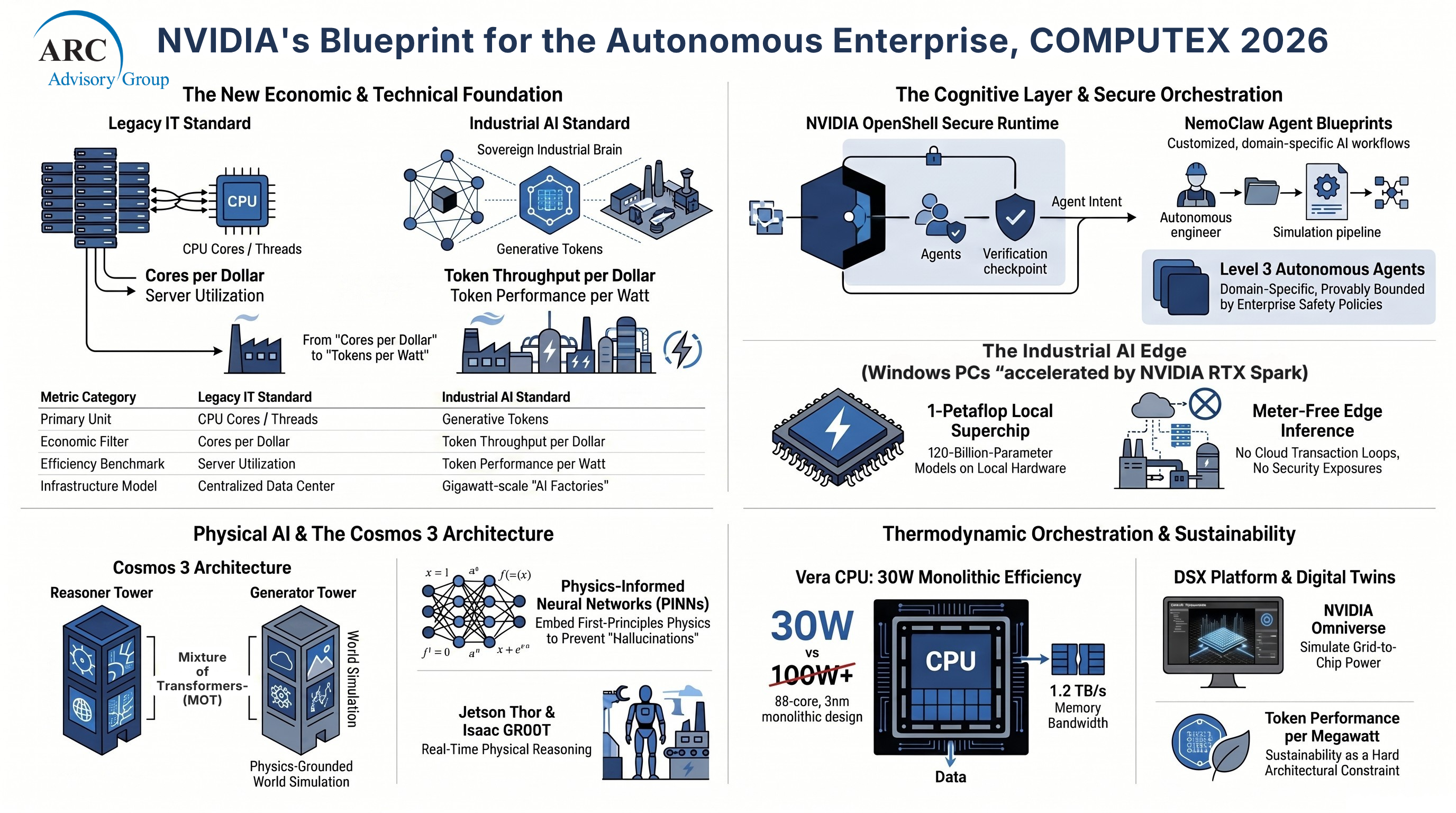
Over the past few days, since the absolute deluge of technology announcements emerged from Taipei, Detroit, and Redmond, I have been flooded with questions and concerns from across our network about the future trajectory of Industrial AI. Many of you are trying to make sense of what feels like a sudden and massive shift in vendor positioning. Looking closely at the data, these anxieties are being driven primarily by two structural realities: significant corporate pivots to support the industrial edge, and a intense industry focus on reducing the extreme energy cost of AI execution.
We are no longer talking about conversational chat boxes drafting emails or summarizing internal spreadsheets. What transpired across NVIDIA COMPUTEX 2026, Microsoft BUILD 2026, and Siemens Realize LIVE Americas 2026 represents a coordinated technological realignment designed to build true cyber-physical autonomy.
I’ll do my best over the next couple of weeks to explain myself, lay out the new battlefronts in the Industrial AI Wars, and explain why I’m more optimistic about the Industrial AI (R)Evolution than I have ever been. To kick off this sequence, we must go straight to the hardware and infrastructure foundations established in Taipei.
To provide immediate context for the technical analysis detailed throughout this blog, readers can reference ARC Advisory Group's specific analytical updates on these developments:
ARCwire: NVIDIA Expands Physical AI Stack with Cosmos 3 Omnimodel Architecture
ARCwire: Red Hat Device Edge Natively Supports NVIDIA Jetson Orin Primitives
ARCwire: Siemens and NVIDIA Partner on Purpose-Built Industrial AI Data Centers
At COMPUTEX 2026, the traditional rules of data center layout were systematically rewritten. For decades, enterprise technology teams evaluated processing hardware through the clear, linear lenses of "cores per dollar"—a metric optimized for the predictable, thread-heavy workloads, web hosting, and database queries of legacy corporate IT. NVIDIA has decisively dismantled that framework.
The industrial sector is entering a phase defined by gigawatt-scale computational infrastructure, now widely classified as "AI Factories," where worldwide IT spending is accelerating past the $6 trillion threshold. In this new landscape, the foundational currency of industrial systems is the token—the discrete unit of localized processing, algorithmic reasoning, and multi-modal interaction. Consequently, the defining economic and thermodynamic benchmark for industrial technology design has shifted from standard processing capacity to maximizing token throughput per dollar and optimizing token performance per watt.
The primary hurdle for industrial enterprises is that physical operations cannot undergo a mandatory, immediate hardware rip-and-replace. Ripping out multi-million-dollar distributed control systems (DCS), supervisory control networks, and programmable logic controllers (PLCs) just to run neural networks is financially impossible. NVIDIA’s strategy at COMPUTEX was to prove that the company is no longer just an acceleration chip vendor. It is delivering the full-stack infrastructure blueprint and edge operating system that allows industrial organizations to overlay a software-defined "Sovereign Industrial Brain" directly onto existing physical assets, separating the market into pacesetters running localized, continuous reasoning and followers tethered to general-purpose cloud models.
For the software engineers and data scientists tasked with deploying models next to physical machinery, the greatest challenge has always been the structural unpredictability of probabilistic neural networks. In a control-room or manufacturing assembly sequence, an unconstrained algorithmic hallucination does not result in a simple typo; it can result in immediate material scrap, mechanical asset destruction, or an existential functional safety hazard.
To bridge this operational divide, NVIDIA introduced a highly structured software orchestration layer spearheaded by the NVIDIA Agent Toolkit. This environment productizes the concept of digital coworkers through two core components:
NVIDIA NemoClaw Blueprints: Customized, domain-specific AI workflows and developer templates designed to build autonomous AI engineers that integrate directly into existing enterprise simulation and verification pipelines.
NVIDIA OpenShell Secure Runtime: An open-source, hardware-agnostic containerized environment providing an isolated security perimeter around the autonomous agent.
Rather than letting an agent directly interact with a live plant network or database, the OpenShell runtime serves as a strict checkpoint. It intercepts the agent's intent, translates it through a policy-enforcement layer, and verifies permissions before issuing a secure token to execute an action.
When evaluated against the ARC Advisory Group 3-Axis Industrial AI Models Taxonomy, OpenShell is a significant milestone. It gives software developers the architectural tools to elevate generic systems out of basic Level 2 (Industry-Aware) conversational assistance and lock them into Level 3 (Domain-Specific) Autonomous Agents that are provably bounded by enterprise safety policies. The industry traction for this containment runtime is already scaling at the enterprise core: software leaders are actively integrating this capability, as demonstrated by SAP embedding NVIDIA OpenShell directly into its Joule Studio runtime to govern autonomous multi-vendor agent portfolios within critical corporate and financial systems.
To distribute this intense computational load away from strained data center campuses, the edge computing story at COMPUTEX extended directly to primary desktop and station interfaces. In a landmark alliance engineered to put local processing front and center for our industrial AI audience, NVIDIA and Microsoft unveiled NVIDIA RTX Spark. This 1-petaflop Windows superchip is co-designed with MediaTek and co-developed with Microsoft to reinvent the personal computer for on-device personal AI agents, shifting hardware from a passive application tool into an active autonomous teammate.
Architecturally, the RTX Spark platform pairs a high-performance, 20-core NVIDIA Grace CPU with a Blackwell RTX GPU containing 6,144 CUDA cores and fifth-generation Tensor Cores running on high-efficiency FP4 precision. Connected via the ultra-fast NVIDIA NVLink-C2C chip-to-chip interconnect and supporting up to 128 GB of unified memory, this edge canvas allows technical teams to run 120-billion-parameter models with up to 1 million tokens of context entirely on local iron.
By collaborating directly with Microsoft, this architecture introduces native Windows security primitives integrated with NVIDIA OpenShell. This design allows on-device agents to safely execute cross-app workflows, semantically search local files, and interact with enterprise software securely, privately, and completely meter-free on the edge. For our industrial audience, RTX Spark serves as a critical agentic relief valve, giving operators and engineers the power to run continuous contextual inference right at the source of data creation without introducing external public cloud transaction loops or security exposures.
While enterprise software agents operate smoothly within databases, an entirely different class of model architecture is required to interact with physical matter and move autonomous machinery. To capture this frontier, NVIDIA launched NVIDIA Cosmos 3, which it explicitly positions as an open physical AI world foundation model engineered entirely for Physical AI. Unlike traditional multimodal models that simply bolt computer vision layers onto a text-based model, Cosmos 3 utilizes a Mixture-of-Transformers architecture. This advanced setup intricately couples a reasoning transformer with an expert generation transformer, enabling the system to natively understand, reason, and generate across multiple modalities simultaneously: text, images, video, ambient sound, and physical action trajectories.
The architecture is explicitly split into two operational towers:
The Reasoner Tower: A vision-language engine built on a high-throughput serving framework, designed to process complex multimodal observations (images, video, text) to perform real-time spatial analytics, defect inspections, and alert logging.
The Generator Tower: A physics-grounded world simulator that tokenizes physical interactions and spatial-temporal relationships, allowing the model to generate accurate synthetic video datasets and calculate numerical downstream action trajectories—such as specific joint angles, gripper positions, and robotic trajectory points.
To rapidly accelerate the adoption of Cosmos 3 and solve the persistent generalization challenges in robotics, NVIDIA established the Cosmos Coalition, bringing together leading AI labs and robotics pioneers such as Agile Robots, Black Forest Labs, Generalist, LTX, Runway, and Skild AI to advance open-world model development collaboratively. The family currently scales from a compact Cosmos 3 Nano (16-billion-parameter) model optimized for local workstation-grade execution on cards like the NVIDIA RTX PRO 6000, up to a massive Cosmos 3 Super (64-billion-parameter) model built for data center synthetic data generation and advanced spatial reasoning workloads.
By conditioning on visual observations from cameras and hand poses, Cosmos 3 can roll out simulated future videos, allowing autonomous agents to preview the outcomes of their physical actions in a virtual sandbox before ever executing them on the factory floor. This capability directly addresses the requirement for Physics-Informed Neural Networks (PINNs) in safety-critical environments, which mathematically embed first-principles physics to prevent hallucinatory recommendations.
To give this physical intelligence a localized edge chassis, NVIDIA showcased the NVIDIA Jetson Thor edge supercomputer as the primary computing engine for the NVIDIA Isaac GR00T Reference Humanoid Robot. Operating within strict power design profiles configurable between 40 W and 130 W, Jetson Thor packs the localized processing muscle required to adapt pre-learned behaviors to dynamic, unseen factory environments in real time. This zero-latency edge compute ensures that when an embodied robot encounters an unmodeled obstruction on a factory floor, it executes physical reasoning and action gating locally in milliseconds, bypassing cloud-tethered network jitter completely.
This execution paradigm extends directly to heavy industrial mobility, where the NVIDIA DRIVE Hyperion platform utilizes Alpamayo 2 open reasoning models running on the safety-certified NVIDIA Halos operating system to ground robotic logistics in absolute physical safety.
For the facility directors, sustainability executives, and data center architects who must manage the massive compute clusters required to run these industrial agents at enterprise scale, the disclosures at COMPUTEX 2026 demand immediate strategic attention. Training and executing advanced physical AI architectures creates an unprecedented thermal and electricity demand that traditional enterprise grid infrastructure is fundamentally unequipped to handle. To prevent these localized "AI Factories" from threatening corporate net-zero carbon mandates and creating volatile utility expenses, NVIDIA has shifted its infrastructure focus away from raw hardware capability toward structural thermodynamic orchestration.
This efficiency strategy begins directly at the silicon level with the custom-designed NVIDIA Vera CPU. Traditional, multi-chiplet server designs generate significant power waste simply moving data back and forth across internal components. The Vera CPU resolves this bottleneck by utilizing an 88-core monolithic design built on a single 3nm compute die, paired with an ultra-dense memory subsystem packaged via SOCAMM2 modules. By delivering a substantial 1.2 TB/s of peak memory bandwidth while slashing internal data-transfer latency by 40 percent, this architecture drives high-frequency agentic work streams while drawing less than 30 W of power—a dramatic drop compared with the 100 W+ consumed by standard commodity server architectures.
At system scale, these efficiency gains are combined within the high-density, liquid-cooled NVIDIA Vera Rubin NVL72 platform. To help our largest clients integrate these high-density racks safely into their existing physical facility envelopes, server infrastructure partners like Supermicro are rolling out Data Center Building Block Solutions (DCBBS). These modular blueprints allow enterprises to predictably scale power deployment from a 5 MW footprint up to a massive 1 GW threshold using advanced direct liquid cooling (DLC-2) to maximize thermal dissipation while minimizing water and electricity overhead.
The final layer connecting this heavy infrastructure back to corporate sustainability objectives is the DSX Platform. Led by specialized management tools like DSX MaxLPS, this software layer is engineered specifically to maximize Token Performance per Megawatt, allowing corporate energy managers to monitor and optimize the direct environmental and financial cost per generated token. Backed by high-fidelity facility digital twins running on NVIDIA Omniverse, the system allows engineering teams to simulate grid-to-chip power requirements and fluid cooling dynamics in a virtual environment before laying a single physical brick. This integrated approach ensures that the large-scale computing infrastructure required to drive global industrial foundation models can scale predictably, safely, and sustainably under strict corporate environmental governance.
NVIDIA's COMPUTEX announcements represent a comprehensive framework built to dominate the hardware infrastructure and low-level runtime layers of the autonomous enterprise. To guide industrial technology procurement teams beyond vendor-specific marketing, I’ll have more analysis on its impact on the Industrial AI (R)Evolution in the remainder of this blog series, but here’s ARC Advisory Group’s initial evaluation of NVIDIA’s latest strategic moves, with an explicit emphasis on the newly fortified Industrial AI Edge:
Core Infrastructure Advantage and Edge Convergence: The deep integration of heterogeneous custom silicon architectures (Vera + Rubin) is now tightly coupled with an omnipresent on-device edge canvas. By pairing localized machine-face hardware (Jetson Thor) and the Microsoft Windows desktop alliance (RTX Spark) with open physical simulation frameworks (Cosmos 3), NVIDIA allows manufacturers to run continuous reasoning entirely on local iron. These models execute inside secure, policy-gated container layers (OpenShell) to achieve deterministic setpoint writes without introducing external cloud network latency, security exposure, or volatile transaction loops.
Systemic Risk Profiles and Deployment Friction: Severe single-source exposure to advanced lithography fabrication nodes (TSMC 3nm) remains an industry-wide vulnerability. Furthermore, from an analytical perspective, open-sourcing agent skills blueprints and Cosmos 3 datasets can be evaluated as a strategic maneuver for ecosystem capture, potentially locking developers into its broader physical AI stack before these workflows encounter the messy complexity of real-world operational testing across legacy plant networks.
The Thermodynamic and Sustainability Mandate: Energy efficiency has transitioned from a passive corporate compliance checkbox into a hard, ground-level architectural constraint. Deploying always-on physical AI at scale requires a fundamental shift in how we audit system overhead. By evaluating computational footprints based on Token Performance per Megawatt and leveraging ultra-efficient monolithic silicon—like the sub-30W Vera CPU—pacesetting enterprises can scale localized reasoning loops aggressively without blowing out local thermal boundaries, overloading plant utility feeds, or violating corporate net-zero carbon mandates.
Operational Impact and the Capital Asset Strategy: This stack elevates data center and edge design from a series of commoditized IT hardware line items into a highly coordinated capital asset strategy (CapEx). By processing multi-modal arrays completely locally, the unit economics of an autonomous factory are determined entirely by token generation efficiency rather than recurring public cloud operational expenses (OpEx).
Pivot Procurement Metrics from Raw FLOPS to Token Efficiency: Information and engineering technology executives should evaluate hardware assets through the lens of token processing velocity, memory subsystem bandwidth, and token-per-watt efficiency to optimize their architecture for the realities of active reasoning.
Aggressively Deploy Inference to Hardened Edge Runtimes: To insulate your corporate balance sheet from the variable cost loops of cloud-metered computing, establish a definitive edge-native infrastructure strategy. Standardize on ruggedized edge workstations and industrial PCs running containerized agent sandboxes—fully secured by primitives like Red Hat Device Edge—to execute domain-specific models straight at the machine face, ensuring total financial, operational, and data sovereignty.
Ground Algorithmic Tokens in Physical Constraints: Avoid the deployment of general-purpose, horizontal language models for safety-critical plant floor operations. Ensure that your automated planning and predictive systems are driven by geometry-native, physical foundation models like Cosmos 3 that implicitly comprehend thermodynamic, mechanical, and kinetic differential laws, establishing the rigorous mathematical validation required where errors present real-world safety hazards.
Enforce Sustainable Scale via High-Fidelity Simulation: When constructing or expanding enterprise computing facilities to handle heavy AI workloads, utilize purpose-built reference architectures and multi-physics digital twins. Simulating thermal profiles, grid-to-chip power requirements, and liquid cooling configurations upfront eliminates operational risk, protects capital investments, and ensures your heavy infrastructure scales under predictable, sustainable efficiency parameters.
Our NVIDIA COMPUTEX 2026 event teardown has established the new accelerated compute primitives, memory bandwidth breakthroughs, and token efficiency metrics defining the infrastructure foundations for Agentic AI, and it should be clear that NVIDIA has fired some major shots in the Industrial AI Wars. By anchoring this release cycle in high-performance local client hardware like RTX Spark and low-latency orchestration silicon like the Vera CPU, NVIDIA is doing its part to systematically dismantle the edge data and execution barriers I have commented on frequently over the years. In doing so, they are not just defending their hardware footprint; they are significantly expanding their total addressable market opportunity straight into active plant-floor operations.
To construct a truly scalable cyber-physical architecture, however, this raw computational muscle from NVIDIA must be connected to an adaptive enterprise data canvas and a secure operating system directory boundary.
Up Next in the Series, Blog 2: "The Enterprise Agent Canvas: Microsoft Re-Architects the Operating System and Cloud Infrastructure for Governed Autonomy (BUILD 2026)." We will pivot from the hardware factories of Taipei to Redmond, analyzing how Microsoft is re-engineering Windows and Azure via the Microsoft IQ context layer and Agent 365 governance primitives to establish the definitive enterprise operating software stack for the agentic era. Stay tuned.
The Industrial AI (R)Evolution is moving faster than ever. To dive deeper into the frameworks and data shaping the future of the industrial sector, explore my latest research:
Navigating the AI Wars and the escalating Industrial Robot Wars
Closing the Digital Divide by Embracing Industrial AI
Assembling your Industrial-Grade Data Fabric
Charting the new frontier of Physical Intelligence and transitioning to a Cyber-Physical Industrial Architecture (CPIA)
Mapping your maturity and strategy with ARC's 3-Axis Industrial AI Models Taxonomy
Take our Industrial AI Assessment to benchmark your organization's maturity, identify critical gaps in your IT/OT/ET convergence, and get actionable recommendations to accelerate your path to becoming an Industrial AI Pacesetter.
Don't guess what your global operations or prospective customers need. Use empirical data to align your stakeholders and de-hype the market with ARC Advisory Group's Voice of Market Service.
For tailored recommendations on governing and guiding major people, process, and technology decisions across the enterprise, cloud, industrial edge, and AI, please contact Colin Masson at [email protected].
Or, set up a meeting with my fellow Analysts and I at ARC Advisory Group to find out more about our Executive Insights Service for Industrial organizations and our Industrial AI Insights Service for Vendors.