Representative End User Clients







Representative Automation Clients







Representative Software Clients








For a long time, Coriolis flowmeters have been associated primarily with one defining strength: precise flow measurement under demanding process conditions. That reputation still holds. However, the role of Coriolis technology is beginning to expand.
The industry conversation is shifting beyond measurement accuracy alone toward a broader value proposition built around diagnostics, digital communication, and suitability for increasingly complex process applications.
This shift matters because flow measurement is no longer just about reporting a number. In many process environments, the quality of the measurement signal, and the insight that can be derived from it, has become just as important as the reading itself.
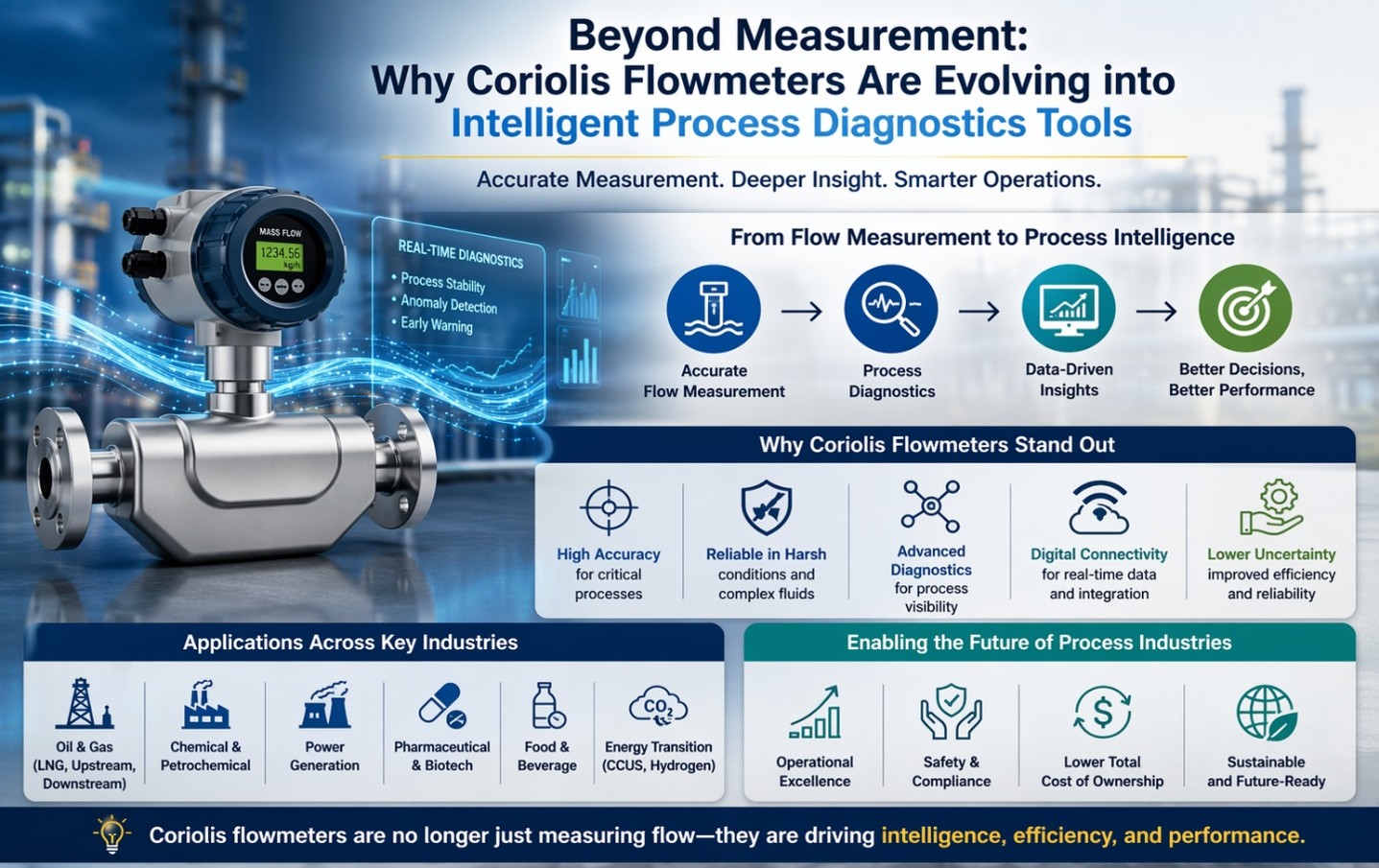
Coriolis flowmeters have always been well positioned in applications where precision and stability are critical. What is changing is how that capability is being used.
There is growing emphasis on process measurement diagnostics and analytics. Instead of focusing only on flow rate, users increasingly expect flowmeters to help identify process variability, detect anomalies, and support operational decision-making.
In modern plants, this reflects a broader transition in which measurement technologies increasingly contribute to efficiency, cost performance, and operational visibility, as explored in ARC’s blog on why measurement technology is becoming a business decision.
Coriolis technology is no longer limited to traditional process measurement roles. Its application base continues to expand because of its ability to deliver reliable performance across a wide range of conditions.
Growth is visible across:
Stable industries such as food processing and pharmaceuticals.
Process-intensive sectors such as chemicals and power.
Energy-related applications, including LNG, gas processing, and emerging clean energy value chains.
This widening application scope reflects the broader move toward application-driven technology selection, where decisions depend on process conditions rather than standardization, as discussed in ARC’s blog on choosing the right flow and level technology.
One of the most significant shifts is the increasing importance of diagnostics. Coriolis flowmeters are now expected to provide insight into process stability, indicate abnormal flow conditions, and help identify early signs of operational issues.
This evolution reflects a broader perspective in process industries, where measurement systems play a key role in reducing uncertainty and improving reliability. Reliable measurement under varying conditions remains an essential requirement across technologies.
Modern industrial environments increasingly depend on connected instrumentation. Coriolis flowmeters are evolving to integrate with digital architectures through advanced communication capabilities, enabling real-time data access and improved system visibility.
Across process industries, this integration supports remote monitoring, centralized diagnostics, and improved operational awareness. Even mature technologies are adapting to these requirements while maintaining simplicity and scalability.
As measurement systems become more interconnected, expectations for instrumentation continue to evolve. Flowmeters are no longer viewed only as measurement devices, but as integral elements within a broader process intelligence framework.
Coriolis flowmeters increasingly support:
High-quality measurement.
Real-time diagnostics.
Data integration into control and analytics systems.
Improved visibility into process behavior.
This reflects a transition toward measurement architectures in which multiple technologies, including flow and level, work together to support process stability and operational performance.
Coriolis flowmeters are no longer defined solely by measurement accuracy. Their role is expanding to include diagnostics, connectivity, and adaptability across a wide range of applications.
These developments build on their traditional strengths while aligning with the broader shift in industrial operations toward data-driven decision-making and integrated process systems.
In modern process plants, the value of measurement technology is increasingly determined by how effectively it contributes to understanding, managing, and improving the process.