Representative End User Clients







Representative Automation Clients







Representative Software Clients








Magnetic flowmeters have long been regarded as one of the most stable and widely deployed technologies for measuring conductive liquids in process industries. Their underlying principle has remained largely unchanged, and their reputation for reliability in applications such as chemical processing, food production, and pharmaceutical manufacturing continues to hold strong.
However, the broader context in which these devices operate is evolving. The role of magnetic flowmeters is no longer defined solely by their ability to measure flow accurately. Instead, they are becoming part of a larger, digitally connected process environment where data, diagnostics, and integration play increasingly important roles.
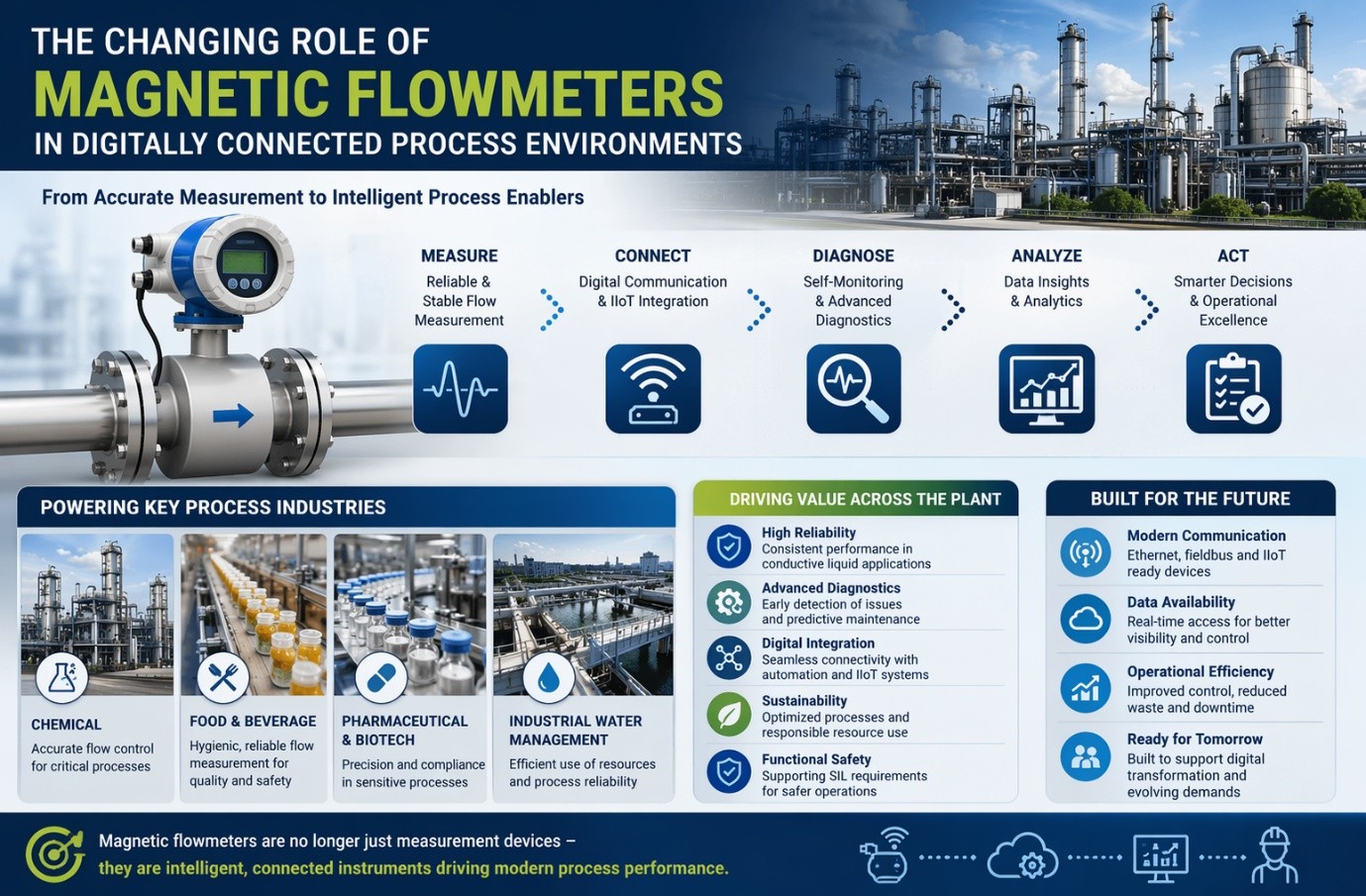
Magnetic flowmeters have traditionally been chosen for applications where stable, repeatable measurement is required under relatively well-defined operating conditions. This remains true. But as process industries adopt more connected and automated environments, expectations for instrumentation are expanding.
Modern process plants require not just measurement, but continuous access to data, improved visibility across operations, and the ability to integrate seamlessly into automation systems. As a result, magnetic flowmeters are evolving from standalone devices into connected instruments capable of supporting broader operational objectives.
This shift reflects a larger trend in process industries where measurement technologies are increasingly expected to contribute to system-level performance rather than operate in isolation.
One of the most visible changes is the increasing importance of digital communication capabilities in field instruments. Magnetic flowmeters are being designed to support modern communication protocols, enabling:
Real-time data transmission.
Integration with plant-wide automation systems.
Remote configuration and monitoring.
Improved data availability for analytics platforms.
These capabilities are becoming essential as process plants move toward more connected and data-driven operations. The ability to access and share high-quality measurement data across systems enhances both operational control and decision-making.
Digital communication is no longer an optional feature; it is becoming a core requirement for instrumentation deployed in modern process environments.
Another significant development is the growing emphasis on diagnostics and self-monitoring. Magnetic flowmeters are increasingly equipped with advanced diagnostic capabilities that allow them to:
Monitor internal health and performance.
Detect abnormal operating conditions.
Provide early indications of potential issues.
Support predictive maintenance strategies.
These features add a new dimension to flow measurement. Instead of providing only process values, the instrument can offer insight into both measurement quality and surrounding process conditions.
This evolution supports a shift toward proactive maintenance and improved operational reliability, reducing the need for reactive intervention.
The changing role of magnetic flowmeters is closely aligned with the requirements of major process industries. Applications remain concentrated in areas such as:
Chemical processing.
Food and beverage production.
Pharmaceutical and biotechnology manufacturing.
Industrial water management within process plants.
These industries share common priorities:
High reliability and repeatability.
Hygienic or corrosion-resistant measurement solutions.
Compliance with safety and regulatory requirements.
An increasing need for automation and digital integration.
Magnetic flowmeters continue to meet these needs while also adapting to the growing demand for connectivity and diagnostics.
Process industries are increasingly influenced by sustainability goals and resource efficiency requirements. Magnetic flow measurement plays a direct role in enabling better control over process fluids, reducing waste, and improving resource utilization.
This is particularly relevant in:
Water-intensive processes.
Chemical production with strict material balances.
Food and pharmaceutical applications where precision affects yield.
Accurate and stable flow measurement supports optimized resource use, while digital monitoring enables better visibility into consumption and process performance.
As sustainability initiatives gain importance, the role of reliable flow measurement becomes even more critical.
Modern process plants are operating under increasingly dynamic conditions. Variability in raw materials, changing production requirements, and global economic factors all contribute to shifts in operating conditions.
Magnetic flowmeters offer stability in such environments due to their non-intrusive measurement principle and low sensitivity to fluid properties such as density and viscosity. This stability remains a key advantage.
However, maintaining process stability now depends not only on individual device performance, but also on how well measurement data is integrated, validated, and used within the broader system.
The transition toward connected and diagnostic-enabled flow measurement reflects this requirement.
The most significant transformation is conceptual. Magnetic flowmeters are no longer viewed simply as devices that measure flow. They are increasingly considered contributors to:
Process visibility.
Operational efficiency.
Maintenance optimization.
Data-driven decision-making.
This transition is consistent with the broader movement toward integrated measurement systems and digital transformation across process industries.
As plants adopt more advanced control strategies and data-driven operations, the role of instrumentation expands accordingly.
Magnetic flowmeters have not undergone a fundamental change in their measurement principle, yet their role within process plants continues to evolve. Advances in digital communication, diagnostics, and integration capabilities are redefining how these instruments contribute to plant performance.
In digitally connected process environments, the value of magnetic flowmeters is determined not only by measurement accuracy, but also by their ability to provide reliable data, support diagnostics, and integrate into larger systems.
This evolution demonstrates a broader trend across industrial automation: technologies remain relevant not just by sustaining performance, but by adapting to the changing needs of modern process operations.