Representative End User Clients







Representative Automation Clients







Representative Software Clients










At Automate 2026, one topic dominated discussions across the show floor: humanoid robots. From eye-catching demonstrations to high-profile investments, humanoid systems are capturing attention across industrial markets.
But behind the excitement lies a more important question:
Do industrial companies actually need humanoid robots, or do they need something else?
Humanoid robots are compelling. They look familiar, intelligent, and capable. That’s not accidental.
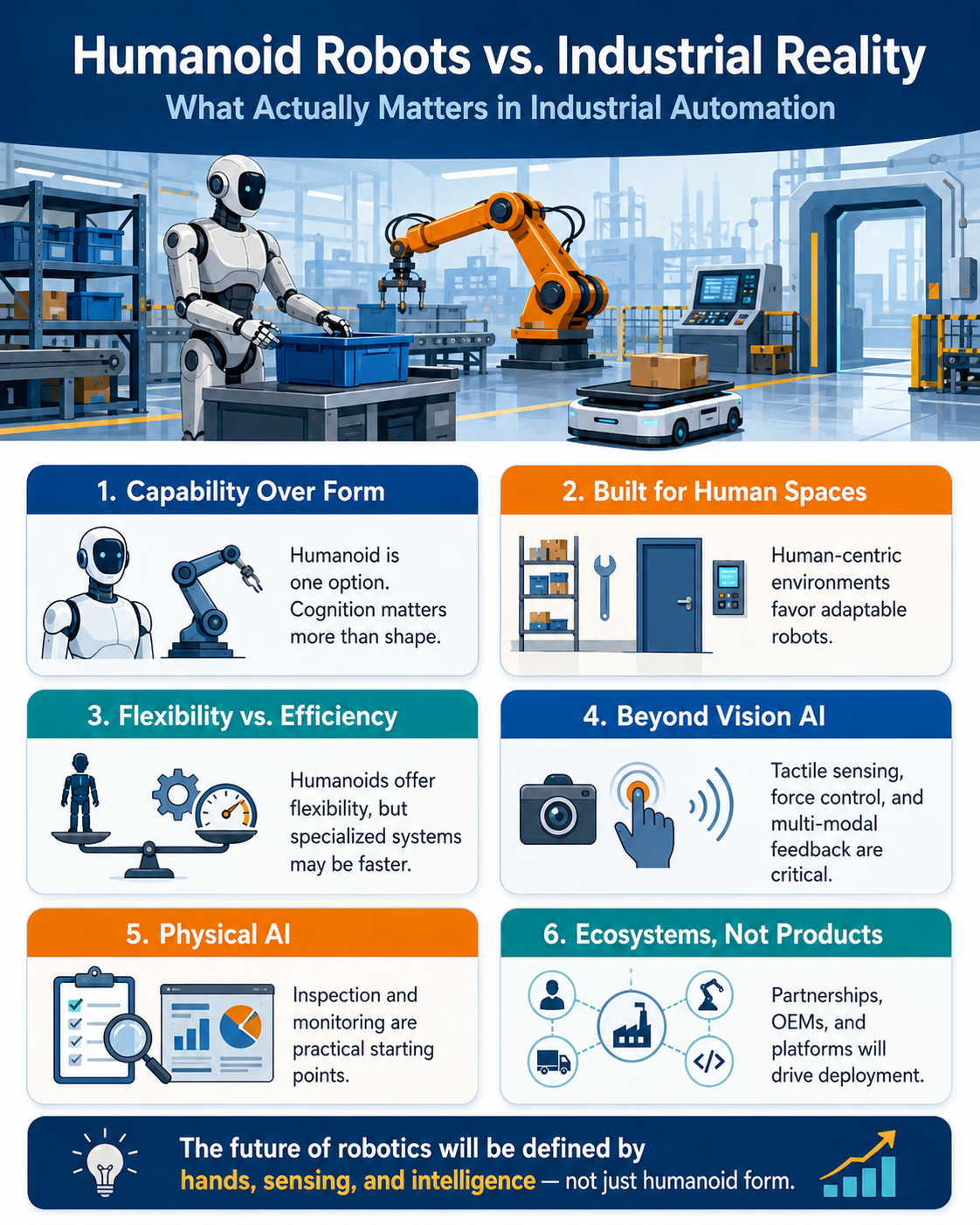
Humans naturally project intelligence onto humanoid forms. This makes them highly effective:
As demonstration platforms.
As marketing tools.
As conversation starters.
However, once the initial engagement happens, the discussion quickly shifts:
What matters is not the form factor; it’s cognition.
A “cognitive robot” can take many forms:
Wheeled mobile systems.
Stationary robotic cells.
Single-arm or multi-arm systems.
The humanoid form helps initiate the conversation, but it is not always the optimal solution.
Despite the hype, humanoid robots do offer real advantages in industrial environments:
Industrial environments are designed around people:
Shelves are placed at human height.
Buttons and interfaces are human-accessible.
Doors, tools, and workflows assume human interaction.
A humanoid robot can operate in these environments without requiring significant modification.
In traditional automation:
A human task is often decomposed into multiple steps:
A mobile robot handles logistics.
A stationary robot performs assembly.
This fragmentation introduces complexity.
In contrast, humanoid robots can:
Perform multi-step tasks end-to-end.
Maintain existing workflows.
This is particularly important in regulated industries, such as automotive, where:
Changing a process requires revalidation and certification.
Humanoid robots are highly flexible, but:
They are rarely the most efficient solution.
Specialized systems often outperform them in targeted tasks.
Humanoids represent maximum flexibility, not maximum efficiency.
A key takeaway from multiple discussions:
Industrial robotics cannot rely on vision alone.
Many current systems are based on:
However, real-world industrial tasks involve:
Force control, Material variability and Tactile interaction.
For example:
Grasping an object requires sensing pressure and slip.
Detecting slip visually is too late; the object has already fallen.
This is why next-generation systems are moving toward:
Perception + Language + Action (PLA)
Vision.
Tactile sensing.
Multi-modal feedback.
Robots increasingly include:
Tactile sensors in fingertips.
Feedback in grippers.
Supplemental sensors, such as force and temperature sensors.
The broader trend emerging at Automate:
Robotics is becoming a “Physical AI” problem, not just a hardware problem.
Key characteristics:
Closed-loop learning: data → model → deployment → feedback.
Integration of real-world telemetry and simulation.
Multi-modal AI models.
Importantly, the most practical entry point is:
Inspection and monitoring:
Low risk.
High data generation.
Immediate ROI.
That’s where transformation is starting.
Another major shift is in go-to-market strategy.
Leading robotics companies are:
Partner-driven.
Increasingly embedded inside larger ecosystems.
In many cases:
Robots are white-labeled.
Technology providers operate behind the scenes.
Large OEMs provide scale and global reach.
This model enables:
Faster adoption.
Broader deployment.
Shared risk across partners.
Much of the public conversation is focused on:
Walking, Running, Backflips.
These are impressive, but largely irrelevant.
There are very few industrial use cases for acrobatics.
The real challenge is:
Manipulation.
Dexterity.
Reliable interaction with the physical world.
In other words:
The future of robotics will be defined by hands, not legs.
Humanoids are one option, not the end state.
Vision alone will not be sufficient. Tactile and physical intelligence are becoming critical.
Start with inspection, monitoring, and data collection. Build the data foundation first.
Partnerships will dominate. Platforms will outperform point solutions.
Physical AI could have an impact comparable to generative AI, but for operations.
The excitement around humanoid robots is real, but the real transformation lies deeper.
The future of industrial automation is not about building robots that look like humans. It’s about building robots that understand and interact with the physical world as effectively as humans do.