Representative End User Clients







Representative Automation Clients







Representative Software Clients








This blog is part of a three-part series on industrial humanoid robots. To view the other parts, see below:
This is only a peek at the industrial humanoid robot market. For a fully comprehensive view, participate in ARC’s MarketMap effort.
In the first entry of this series, we argued why humanoid robots are emerging now and why they signal a new paradigm in industrial automation. We made the case that humanoid robots powered by “physical intelligence”—the fusion of AI “brains” with robotic “bodies” and the edge compute and connectivity “nervous system” uniting them—are poised to take on tasks in factories and warehouses that traditional automation has long struggled with. Now, in Part 2, we pivot to the who and how: mapping the rapidly forming ecosystem of companies and partnerships behind industrial humanoid robots.
After the disappointing launches and quiet sunsets of the last 10 years, the new humanoid robot space hosts a mix of startup pioneers, tech giants, industrial automation leaders, and future-minded end users. Together, these players are beginning to push humanoid robots out of R&D labs and into real operations. We’ve seen some early breakout successes, but make no mistake: this market is still in its infancy, and suppliers will struggle to create solutions that can meet the incredible hype and demand.
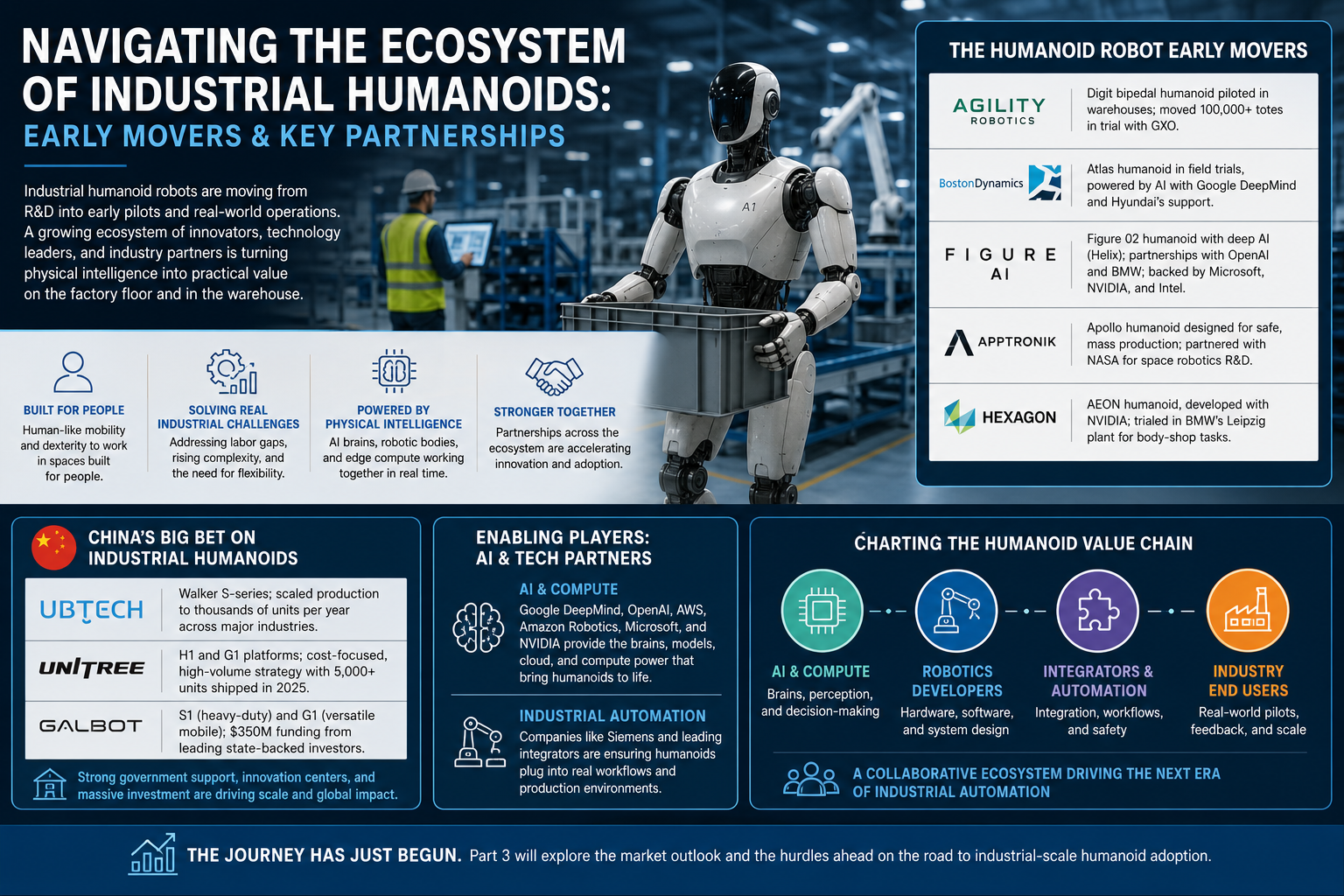
At the heart of the humanoid robotics push is a group of developers determined to build general-purpose, human-like machines for industrial work. Several are startups or new ventures backed by hefty investments and rooted in academia or Big Tech:
Agility Robotics: Maker of the bipedal humanoid Digit, Agility is one of the early commercial pioneers with a track record to back it up. Supported by Amazon and others, Digit has been piloted in real supply chain environments. By late 2025, Agility reported that Digit had moved more than 100,000 warehouse totes in a trial with logistics provider GXO. Agility zeroes in on last-50-feet tasks in warehouses and factories, where Digit’s human-like mobility and dexterity can help address chronic labor gaps without forcing facilities to overhaul their layouts.
Boston Dynamics: The historic robotics outfit Boston Dynamics, now part of Hyundai Motor Group, has thrust its Atlas humanoid out of the lab and into initial field trials. Atlas has captured global attention, especially after Boston Dynamics teamed up with Google DeepMind to infuse the platform with advanced AI. With Hyundai’s manufacturing muscle and DeepMind’s AI capabilities, Boston Dynamics is hoping to assemble a powerhouse coalition to eventually bring Atlas to industries such as automotive and logistics.
Figure AI: Silicon Valley startup Figure AI, founded by former Google and Tesla engineers, has quickly risen as a serious contender with its forthcoming humanoid, Figure 02. Early on, Figure partnered with OpenAI to embed language and reasoning capabilities into its robot, and it struck a pilot collaboration with BMW to test humanoids in automotive production. Those moves signaled Figure’s intent to blend deep AI into practical manufacturing roles from the outset. Since then, the company has developed its own AI “brain,” called Helix, and raised money from tech backers including Microsoft, Nvidia, and Intel. Figure is explicitly marrying mass manufacturing ambition with deep AI prowess, building a dedicated robot production facility to prove it can scale where many robotics startups falter.
Apptronik: Texas-based Apptronik, a venture spun out of university robotics labs, created Apollo, a humanoid engineered for efficient mass production and safe operation around people. From day one, Apptronik emphasized industrial safety and heavy-duty design. It has also secured an agreement with NASA to develop its robots for space exploration, giving it a marquee partner for R&D.
Hexagon: The industrial tech vendor’s AEON made waves after being recognized as a CES 2026 Innovation Awards honoree in the robotics category. Developed in collaboration with NVIDIA, AEON leverages NVIDIA’s full-stack robotics platform, spanning simulation-first training to high-performance edge AI computing. Earlier this year, the robot was trialed in BMW’s Leipzig plant, where it performed repeatable body-shop tasks within a highly automated environment, generating insights around safety zoning, connectivity, and human-robot interaction.
Crucially, these early movers are not trying to go it alone. Each is forging partnerships to accelerate development and de-risk the leap into real-world operations. They are also buoyed by serious capital after attracting investor interest.
No discussion of humanoid robotics would be complete without acknowledging China’s enormous investment and surging cohort of suppliers. China has made humanoid robotics a strategic priority at the state level, driven by a push for manufacturing modernization and ambitions in global AI leadership. Government and private capital alike are pouring into Chinese “physical AI” companies, with the surge heavily skewed toward embodied AI and humanoid projects. This reflects a national conviction that intelligent robots will underpin the next wave of industrial innovation.
China’s approach is coordinated and very well funded. Cities such as Beijing, Shanghai, Zhejiang, and Guangdong have set up official “Humanoid Robot Innovation Centers” to standardize and industrialize the technology, and the Ministry of Industry and Information Technology has issued national guidance on developing humanoid robots, laying out clear goals and timelines.
Several major players are riding the top of this funding wave:
UBTECH: Founded in 2012, UBTECH Robotics is one of China’s foremost humanoid robot companies, with total funding of roughly $1.3 billion to $1.4 billion, including a landmark $1 billion injection in 2025. UBTECH’s humanoid Walker S-series is the flagship industrial platform. Originally known for consumer and service robots, UBTECH has scaled up industrial humanoid production to thousands of units per year, targeting automotive, electronics manufacturing, logistics, and other high-labor sectors.
Unitree: The Hangzhou-based Unitree Robotics has been driven by strategic investments from China’s leading tech companies, including Tencent, Alibaba, and ByteDance, in mid-2025. Unitree’s humanoid portfolio prioritizes affordable, high-volume platforms: its full-size H1 is aimed at industrial pilots, while the smaller G1 is a lower-cost biped for R&D, education, and light-duty tasks. This cost-focused, mass-production strategy allowed Unitree to ship more than 5,000 humanoids in 2025, far outpacing most competitors.
Galbot: After capturing attention with its $350 million funding round in early 2026 from prominent state-backed investors such as China’s National AI Industry Fund, Sinopec, and CITIC, Galbot’s product lineup features two complementary humanoid designs: the Galbot S1, a heavy-duty wheeled humanoid robot designed for high-throughput manufacturing tasks, and the Galbot G1, a slimmer, human-scale mobile platform built for versatile roles in retail, logistics, and service environments. Despite its relative youth, Galbot’s strong financial backing positions it as a significant new player in China’s embodied AI robotics sector.
Notably, Chinese humanoid ventures are racing not just to innovate, but also to scale and drive down costs, which could give them a leading edge in a market with high capital investment requirements. Several are constructing dedicated manufacturing facilities and leveraging China’s vast supply chain to rapidly lower unit costs. China’s strengths in scaled production and supply chain integration could allow its humanoid makers to accelerate timelines and undercut global prices, which would shift the balance of worldwide industrial humanoid adoption.
No humanoid robot is an island. It takes an ecosystem of enabling technologies to truly make these machines work in practice, and a number of heavyweights are providing the brains, components, and integration needed to turn humanoid prototypes into productive systems.
AI and Compute: Advanced AI is the lifeblood of humanoid robots. It is what lets them interpret sensor data, learn tasks, and make autonomous decisions on the fly. Unsurprisingly, tech giants such as Google DeepMind, OpenAI, AWS and Amazon Robotics, and Microsoft have become key allies to humanoid developers, contributing algorithms, large language models, and cloud AI services. Meanwhile, NVIDIA dominates the robotics computing space, supplying many humanoid designs with powerful Jetson edge AI modules for real-time perception and control. Nearly every serious humanoid project today runs on these chips, or similar ones from Intel or Qualcomm, forming a de facto standard for the robot’s onboard “brain.”
Industrial Automation: Like many historic tech trends, humanoids will need to bridge into the traditional automation world to be taken seriously on the factory floor. Established industrial players such as Siemens are dipping their toes into humanoid robotics to ensure these new machines can plug into existing production lines and workflows. For example, Siemens partnered with a humanoid startup to test a robot performing autonomous internal logistics tasks at one of its electronics factories in Germany. Systems integrators and automation solution providers are also starting to explore how humanoids can complement their offerings.
It is notable that most of the early deployments of the last few months are partnerships: a robotics company working shoulder to shoulder with an industrial end user, often along with an integrator or tech partner, to fine-tune the robot for real operations. The industry is not at a point where users can simply buy a humanoid off a catalog and let it loose on the floor. Instead, every installation is essentially a co-development effort because industrial humanoids are still learning by doing.
We are witnessing a market ecosystem taking shape before our very eyes. For industrial executives and technology strategists, looking at the landscape from an ecosystem perspective is highly instructive. It highlights who the key players are, where they are concentrating their efforts, and how the puzzle pieces of this new value chain might fit together. It is also a reminder that industrial humanoids are still a long way from being a plug-and-play technology. For the market to build legitimacy, stakeholders must engage with the ecosystem of vendors and partners.
As ARC’s ongoing “physical intelligence” research and industry coverage have shown, barely a month goes by without new collaborations, funding deals, or pilot announcements making headlines. But remain clear-eyed. Many of the technologies and companies in this space will not survive the jump from prototype to proven product.
That is why, in Part 3 of this series, we will tackle the market outlook and analyze the hurdles humanoids must clear before they can become a full-fledged industrial-grade technology. We will explore how to evaluate humanoid robot offerings critically and what strategies to adopt to prepare for the coming wave of physical AI on the factory floor.
For discussions on physical intelligence and the new wave of industrial robotics, or to offer feedback on this article, contact Patrick Arnold at [email protected].
Set up a meeting with Patrick Arnold and ARC Advisory Group analysts to find out more about ARC’s Executive Insights Service for industrial organizations, MarketMap efforts, and more.