Representative End User Clients







Representative Automation Clients







Representative Software Clients










The robotics industry has spent years focused on improving mobility, manipulation, autonomy, and task execution. But during a discussion with the team from OpenMind at Automate 2026, a different theme emerged:
The future of robotics may depend as much on understanding people as it does on understanding the physical world.
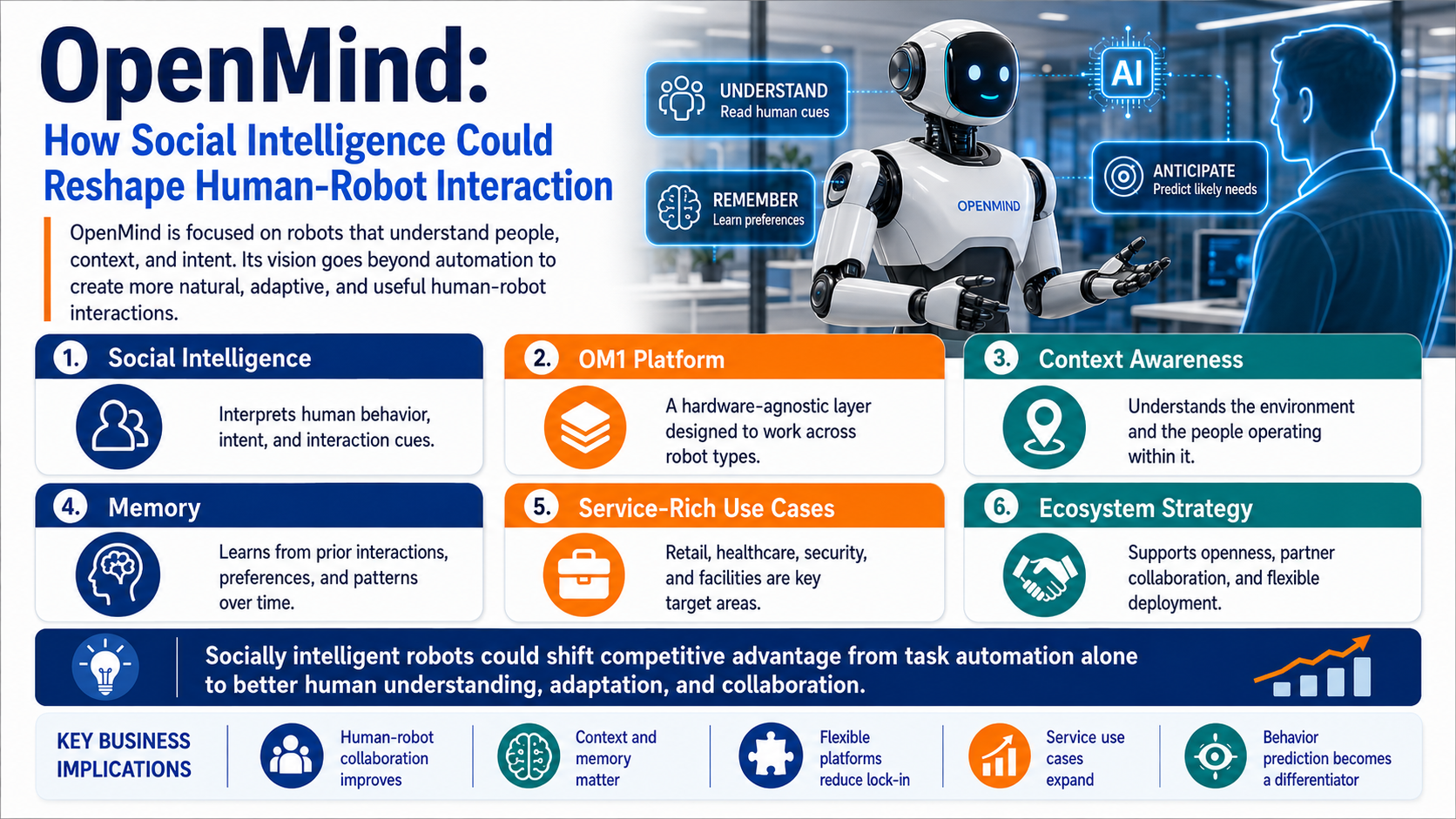
While much of today’s robotics innovation centers on locomotion, grasping, perception, and autonomous operation, OpenMind is focused on a different challenge: social intelligence. Its goal is to enable robots not only to perform tasks, but also to understand human intentions, preferences, and behaviors in ways that make interactions more natural and useful.
According to the OpenMind team, current AI systems and large language models excel at generating text and answering questions, but they struggle to understand human intent in physical environments.
For example:
Is a person approaching the robot to engage?
Are they preparing to walk away?
Are they requesting assistance?
What is their likely next action?
These are not language problems; they are behavioral and contextual problems.
OpenMind defines social intelligence as a robot’s ability to interpret human behavior, understand context, remember prior interactions, and respond appropriately. Rather than simply reacting to commands, robots should be capable of anticipating and adapting to human needs. This includes maintaining memory of preferences, past interactions, and behavioral patterns over time.
At the center of OpenMind’s strategy is OM1, a hardware abstraction layer designed to serve as a common intelligence platform across multiple robot types. The company describes OM1 as an open-source platform capable of running on humanoids, quadrupeds, robotic arms, and mobile robots from different manufacturers.
This approach reflects a broader trend occurring across industry.
For decades, industrial automation was dominated by vertically integrated systems in which hardware and software were tightly coupled. Today, organizations increasingly seek flexibility, interoperability, and protection from vendor lock-in.
OpenMind’s vision is to provide:
One software stack across multiple robot platforms.
A common intelligence layer regardless of hardware provider.
Open-source architecture for developers and partners.
Premium intelligence services layered on top of the core platform.
According to the company, customers can deploy a complete OpenMind robot solution or run OM1 on robots they already own.
One of the more interesting concepts discussed during the conversation was the idea of a world model for human behavior.
The company’s long-term objective is not simply robot control. Instead, OpenMind is working toward systems that can predict human actions and intentions before they occur.
If successful, this capability could enable robots to:
Adjust behavior dynamically during human interaction.
Deliver personalized customer experiences.
Improve safety in shared workspaces.
Enhance collaboration between humans and machines.
For industrial companies evaluating Physical AI and Embodied AI, this represents a significant shift.
Much of today’s robotics industry is focused on vision-language-action (VLA) architectures and task execution. OpenMind is extending the problem to include the human element, understanding not only the environment but also the people operating within it.
While many robotics companies begin with manufacturing and material movement, OpenMind sees opportunities across a broader range of applications.
The team described several target markets, including:
Recognizing returning customers.
Remembering customer preferences.
Personalized interactions.
Integrated payment experiences.
Autonomous patrol.
Access management.
Facility monitoring.
Context-aware interaction.
Patient monitoring.
Fall detection.
Assisted living support.
Safety monitoring during off-hours.
Progress reporting.
Operational monitoring.
Workflow visibility.
Asset and parcel management.
In many of these environments, the value comes not simply from automation but from a robot’s ability to engage with people and adapt to changing situations.
OpenMind is pursuing a collaborative ecosystem strategy rather than building a closed robotics stack.
The company participates in the NVIDIA Inception Program and leverages NVIDIA-based computing platforms for local AI execution. At the same time, it works with hardware providers and OEMs, enabling its intelligence platform to operate across different robotic systems.
This reflects a growing debate in robotics:
Should vendors provide end-to-end, vertically integrated platforms?
Or should software and hardware evolve as separate layers?
OpenMind appears to be pursuing a hybrid approach, supporting openness while also offering complete robot solutions for customers that prefer a turnkey deployment model.
The discussion highlighted a broader shift occurring across the robotics industry.
Historically, robots were evaluated based on:
Payload.
Reach.
Speed.
Accuracy.
Increasingly, they may also be evaluated based on:
Context awareness.
Memory.
Personalization.
Human interaction quality.
As Physical AI and Embodied AI continue to evolve, the most successful robots may not necessarily be those that move the fastest or lift the heaviest loads. Instead, they may be the systems that can best understand and collaborate with humans.
For industrial companies, particularly those in service-intensive environments, this raises an important question:
Will competitive advantage come from automating tasks, or from creating machines that can understand the people performing them?
The robotics industry often focuses on physical intelligence: navigation, manipulation, and autonomy. OpenMind is betting that the next frontier is social intelligence.
By combining memory, contextual understanding, behavioral prediction, and hardware-agnostic deployment, the company is working to create robots that are not only capable of acting in the world but also capable of understanding the humans around them.
If the vision succeeds, the future of robotics may be defined not merely by what robots can do, but by how well they understand the people they serve.
The robotics landscape is evolving quickly, with Physical AI, Embodied AI, cognitive robotics, and human-machine collaboration reshaping how industrial organizations think about automation. To dive deeper into the technologies and market shifts shaping the next generation of robotics, explore ARC’s related coverage:
Humanoid Robots vs. Industrial Reality: What Actually Matters?
Standard Bots: How AI-Native Robotics Is Redefining Industrial Automation
thyssenkrupp and GlobalLogic Partner to Advance Physical AI in Heavy Industry
Google DeepMind’s Gemini Robotics Brings AI into the Physical World
Together, these pieces provide a broader view of how robotics, AI, and industrial automation are converging into a new generation of intelligent, adaptive, and collaborative systems.