Representative End User Clients







Representative Automation Clients







Representative Software Clients








In the first article in this series, The Future of High-Pressure Regulators and Valves: From Pressure Control to Operational Intelligence, ARC examined how competitive differentiation in the high-pressure regulator and valve market is evolving beyond pressure ratings, flow capacity, materials of construction, leak integrity, product breadth, and certifications. These remain essential, but customers are placing greater emphasis on reliability, safety, sustainability, operational performance, digital readiness, lifecycle value, lifecycle economics, and total cost of ownership (TCO).
Reliability is becoming the defining differentiator because it connects engineering performance with business performance. In automated, interconnected, and continuously operating production environments, pressure-control failures can directly affect uptime, process integrity, asset utilization, production throughput, maintenance cost, product quality, workforce safety, customer commitments, and business continuity.
Across hydrogen infrastructure, semiconductor manufacturing, industrial gases, specialty chemicals, refining, life sciences, biotechnology, power generation, aerospace, defense, advanced manufacturing, and offshore energy, customers increasingly evaluate high-pressure regulators and valves by their ability to protect production, preserve pressure stability, prevent leakage and contamination, improve safety, and reduce operational risk.
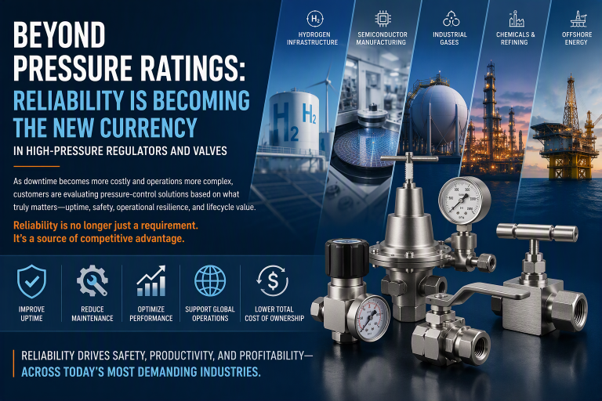
Reliability is no longer only an engineering or maintenance KPI; it is an executive-level metric influencing mean time between failures (MTBF), mean time to repair (MTTR), asset utilization, production throughput, maintenance expenditure, workforce productivity, environmental performance, safety outcomes, and return on invested capital (ROIC). Unexpected pressure-control failure can cause lost production, emergency maintenance, leakage, contamination, process recovery, quality losses, delayed deliveries, downstream equipment damage, and safety or environmental incidents.
As a result, the industry’s central question is changing. Customers are no longer asking only whether a regulator or valve meets pressure rating, flow coefficient, certification, material compatibility, or sealing requirements; they are asking whether it can support uninterrupted operations, reduce lifecycle cost, strengthen operational resilience, improve capital productivity, and lower business risk.
The high-pressure regulator and valve industry is entering a strategic inflection point in which supplier selection is no longer driven primarily by pressure capability, availability, lead time, or acquisition price. Market leadership is increasingly shaped by uptime, process stability, contamination control, maintainability, serviceability, installed-base performance, technical support, lifecycle services, application expertise, and measurable business outcomes.
Two competitive models are emerging. One competes through technical specifications, portfolio breadth, availability, lead times, and price. The other competes through reliability, application knowledge, contamination control, serviceability, lifecycle support, operational performance, digital readiness, and measurable customer outcomes. Both will remain relevant, but the fastest-growing and highest-value applications increasingly favor the second model.
Hydrogen infrastructure, semiconductor manufacturing, industrial gases, life sciences, biotechnology, aerospace, advanced manufacturing, specialty chemicals, and clean industrial environments place a premium on ultra-high purity, pressure accuracy, repeatable performance, sealing performance, leak prevention, material compatibility, process stability, operational continuity, contamination resistance, durability, and long-term asset performance.
In these markets, customers are purchasing confidence as much as equipment. The strategic issue for manufacturers is whether their engineering capabilities, service models, application expertise, digital investments, technology roadmaps, and lifecycle service offerings align with the expectations of tomorrow’s most valuable applications and future profit pools.
Reliability is therefore evolving from a product differentiator into an entry requirement and growth gateway. Hydrogen applications require leak integrity, sealing performance, pressure stability, material compatibility, contamination resistance, and durability. Semiconductor manufacturing demands ultra-high purity, repeatable performance, pressure accuracy, contamination prevention, and process consistency. Industrial gas networks depend on uninterrupted supply, while life sciences and biotechnology require dependable performance in tightly controlled production environments.
ARC views this emerging environment as a downtime economy, where customers assess equipment by the operational and financial consequences it can help prevent. The lowest-priced product may not represent the lowest lifecycle cost or lowest-risk solution. Regulators and valves that deliver longer service life, stable pressure control, improved sealing, reduced maintenance, easier serviceability, stronger lifecycle support, and better lifecycle performance can create greater value over their operating lives.
Manufacturers are therefore competing not only against alternative products, but against the cost of failure. The strategic discussion is shifting from “What does the product cost?” to “What is the financial and operational consequence if it does not perform?” This shift affects product development, value propositions, pricing strategies, customer engagement, procurement criteria, supplier qualification, and sustainable competitive advantage.
Reliability is also converging with asset performance management (APM), condition monitoring, predictive maintenance, diagnostics, advanced analytics, artificial intelligence (AI), Industrial IoT, digital capabilities, and operational intelligence. Customers increasingly seek visibility into equipment condition, maintenance requirements, process stability, asset health, abnormal behavior, developing risks, and performance insights at the system level.
Pressure and performance data, combined with analytics, diagnostics, application expertise, service infrastructure, lifecycle services, and installed-base knowledge, can help operators improve maintenance planning, reduce unnecessary intervention, prevent production disruption, and make industrial operations more predictable. Suppliers that combine dependable hardware with digital readiness and lifecycle value may create stronger and more enduring customer relationships.
Pressure capability will remain essential, but suppliers that can document, communicate, and convert reliability into customer value, stronger market access, predictable maintenance, application-specific reliability, process stability, maintainability, serviceability, safety, sustainability, business continuity, measurable operational value, and long-term growth may be best positioned to capture future opportunities.
In many respects, reliability is becoming the currency through which customers measure trust, performance, and long-term value. Suppliers that accumulate this currency may be best positioned to access the market’s fastest-growing opportunities, participate in attractive profit pools, and define the next generation of leadership in high-pressure regulators, valves, and broader pressure-control technologies.
Reliability is no longer simply a technical requirement. It is the foundation for growth, the gateway to future opportunity, and one of the industry’s most important sources of competitive advantage.
The next blog, Hydrogen's Hidden Challenge: Pressure Control, will examine how hydrogen production, transportation, storage, and fueling infrastructure are creating new requirements for materials, sealing technologies, contamination control, leak prevention, pressure stability, safety, sustainability, and lifecycle performance, and why these requirements may influence the next major innovation cycle in the high-pressure regulator and valve market.