Representative End User Clients







Representative Automation Clients







Representative Software Clients








For decades, the high-pressure regulator and valve market was largely defined by basic performance parameters such as pressure rating, flow capacity, and material selection. While these metrics remain important, today's industrial buyers are increasingly evaluating suppliers based on a broader set of business and operational performance indicators.
As industrial organizations pursue digital transformation, operational resilience, sustainability, hydrogen adoption, and higher levels of automation, manufacturers of high-pressure regulators and valves are being challenged to deliver more than just pressure control. End users are seeking solutions that improve reliability, reduce lifecycle costs, enhance safety, support decarbonization initiatives, and provide measurable operational value.
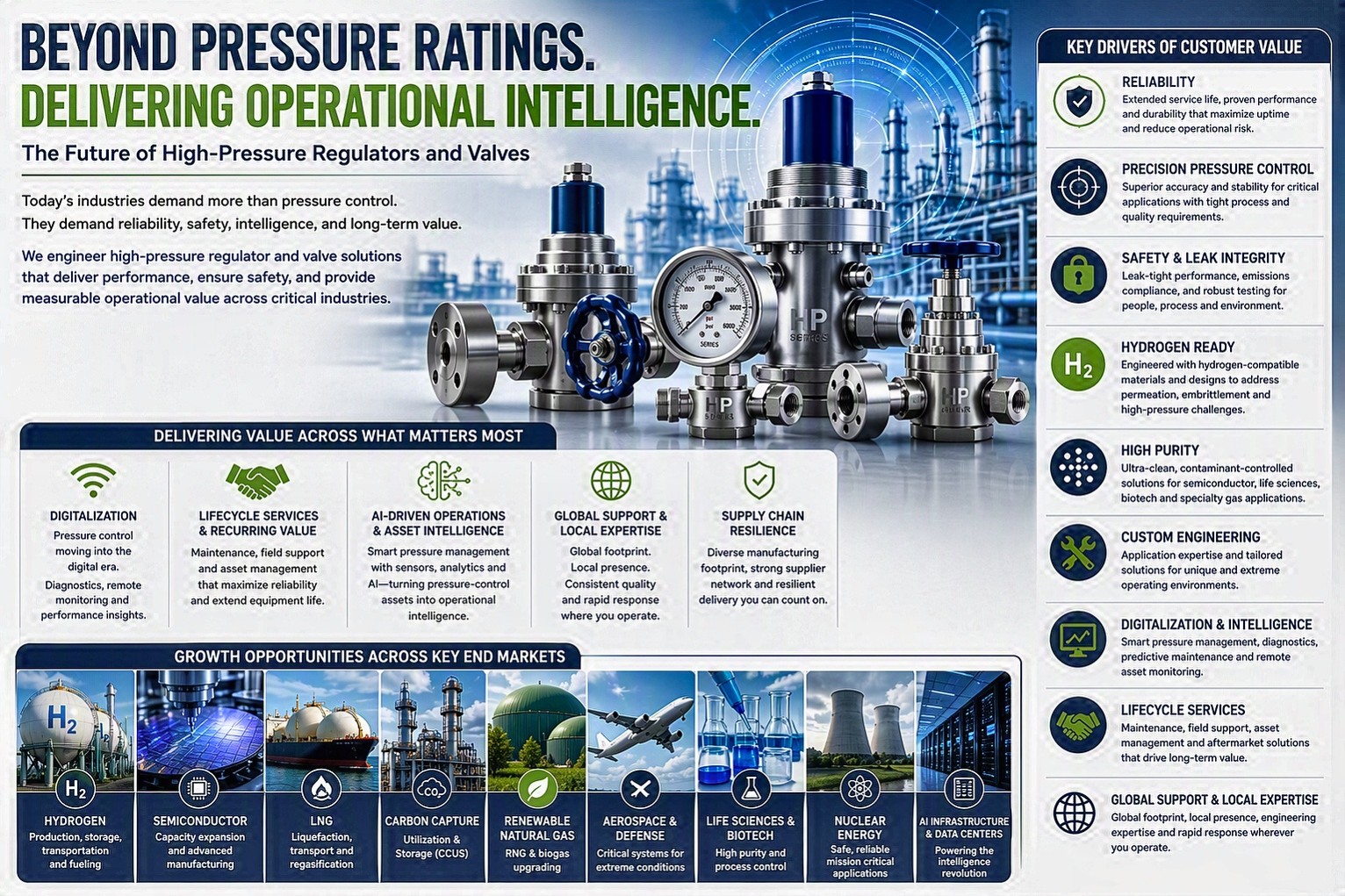
As ARC continues its research into the global high-pressure regulator and valve market, discussions with suppliers increasingly center on several key performance indicators (KPIs) that have emerged as the primary drivers of competitive differentiation.
In today's operating environment, unplanned downtime can have a significantly greater financial impact than the initial cost of a valve or regulator. Consequently, reliability has become one of the most important factors influencing supplier selection.
Manufacturers are focusing on extended service life, reduced maintenance requirements, improved sealing technologies, and enhanced product durability to help customers maximize asset availability. Whether in hydrogen fueling stations, semiconductor manufacturing facilities, chemical plants, or offshore production platforms, operators increasingly prioritize solutions that improve uptime and reduce operational risk. Suppliers that can demonstrate long-term field performance, proven installed bases, and lifecycle value are often better positioned than those competing solely on technical specifications.
As industrial processes become more automated and quality requirements continue to tighten, pressure stability and control accuracy are emerging as major purchasing criteria.
Applications such as semiconductor gas delivery, specialty gas management, laboratory operations, hydrogen fuel systems, and advanced manufacturing often require extremely stable outlet pressure regardless of fluctuations in inlet pressure or process demand. Manufacturers are investing in improved sensing technologies, advanced regulator designs, and intelligent pressure management capabilities to meet these requirements. As a result, pressure control accuracy is becoming as important as maximum pressure capability in many applications.
The growing use of hydrogen, specialty gases, toxic chemicals, and high-value process fluids is elevating the importance of leak-tight performance.
Regulatory requirements, environmental initiatives, and corporate sustainability programs are increasing scrutiny around fugitive emissions and process safety. End users are placing greater emphasis on sealing performance, emissions compliance, material compatibility, and product testing procedures. Manufacturers that can demonstrate exceptional leak integrity, robust testing protocols, and proven performance in hazardous applications are seeing increased interest across multiple industries.
Few market trends are generating as much attention as hydrogen. Investments in hydrogen production, storage, transportation, and fueling infrastructure are creating new requirements for pressure control technologies.
Unlike traditional industrial gases, hydrogen introduces unique challenges related to permeation, embrittlement, sealing integrity, and high-pressure operation. As a result, suppliers are accelerating investments in hydrogen-compatible materials, specialized regulator designs, and safety-focused engineering practices. Many industry participants now see hydrogen readiness as a strategic differentiator, not just another application area.
Historically associated with semiconductor manufacturing, high-purity requirements are increasingly appearing across life sciences, biotechnology, specialty chemicals, energy, and advanced industrial gas applications.
Customers are paying closer attention to particle generation, surface finish quality, contamination control, cleanroom manufacturing practices, and material traceability. These factors are becoming essential considerations during supplier selection. As advanced manufacturing industries continue to expand globally, demand for high-purity pressure control solutions is expected to increase significantly over the next decade.
Although many industrial customers seek standardized solutions, a growing number of applications require highly specialized products.
Hydrogen fueling systems, aerospace platforms, defense applications, subsea installations, specialty gas systems, and research facilities often present operating conditions that cannot be addressed through standard catalog offerings. Manufacturers that combine strong engineering resources with application expertise are increasingly differentiating themselves through customized solutions. In many cases, engineering support and application knowledge have become as valuable as the hardware itself.
Industrial facilities continue to advance their digital transformation initiatives, creating new opportunities for pressure control suppliers.
Customers are beginning to evaluate how regulators and valves can contribute to broader operational objectives such as predictive maintenance, remote asset monitoring, diagnostics, and performance optimization. While digital adoption remains in the early stages for much of the regulator market, suppliers that develop intelligent pressure management capabilities may gain a meaningful competitive advantage as industrial connectivity expands.
Leading suppliers are using aftermarket services, maintenance agreements, field support, and asset lifecycle management to strengthen customer relationships and create recurring revenue streams. These offerings are shifting supplier differentiation beyond equipment performance and toward long-term service value and customer support.
Manufacturers are also exploring smart pressure management solutions that combine sensors, diagnostics, connectivity, and analytics. Over time, AI-enabled monitoring can help operators make better maintenance decisions, improve safety, optimize equipment utilization, and transform pressure-control assets into sources of operational intelligence.
Growth opportunities are expanding across end markets that require higher levels of purity, reliability, precision, and safety. AI infrastructure, semiconductor capacity expansion, LNG, carbon capture, renewable natural gas, sustainable aviation fuel, industrial gases, aerospace and defense, nuclear energy, and advanced manufacturing are all creating new demand for advanced pressure-control solutions.
Technical performance alone does not guarantee market success. End users increasingly value suppliers that can provide strong engineering support, rapid response times, application expertise, and global service capabilities. As manufacturing operations become increasingly globalized, customers often prefer suppliers capable of supporting projects consistently across multiple regions. This trend favors manufacturers with extensive technical resources, established distribution networks, and strong customer support organizations.
The ability to provide local expertise while maintaining global consistency is becoming an important market differentiator. Customers are increasingly evaluating suppliers based on manufacturing footprint diversity, supply chain resilience, and the ability to support regional sourcing initiatives.
Across these applications, the market is moving toward suppliers that can combine engineering depth, proven reliability, digital capabilities, and strong application support. This shift will influence how manufacturers position their portfolios, differentiate their offerings, and prioritize investment over the next decade.
ARC's upcoming High-Pressure Regulators Market Research will examine which end markets are driving demand, how competitive differentiation is evolving, where suppliers are investing for growth, and which technologies are reshaping the industry's competitive landscape.
The next blog in this series will take a closer look at reliability as an increasingly important performance metric for high-pressure regulators and valves and explore a critical question for suppliers and end users alike: How much is downtime worth?
ARC has also examined developments in hydrogen production, pressure control, gas management, and emerging energy infrastructure that are relevant to the evolving high-pressure regulator market:
Sustainable Hydrogen Applications Spur the Market for Control Equipment
Emerson to Automate Korea's Largest Commercial Hydrogen Refueling Station
These insights provide additional perspective on the growth of hydrogen applications, the need for stable and reliable pressure management, and the expanding role of pressure-control technologies in emerging energy and industrial markets.