Industrial Networks

Industrial networks form the foundational infrastructure that connects machines, control systems, sensors, and enterprise platforms across manufacturing plants, energy assets, and critical infrastructure. As industrial operations become more automated, data driven, and AI enabled, secure, resilient, and deterministic networking is no longer optional—it is mission critical. ARC Advisory Group helps industrial organizations and technology providers navigate this rapidly evolving landscape with independent insight and practical guidance.

How Industrial Networks Help Industrial Companies

Industrial Networks

Industrial networks enable reliable, real-time communication between operational technology (OT) assets and IT systems, supporting safe, efficient, and scalable operations.

Key business and operational benefits include:

  • Improved productivity: Deterministic, low latency communications support advanced automation, robotics, and coordinated control.
  • Higher asset reliability: Continuous data flow enables condition monitoring, diagnostics, and predictive maintenance.
  • Enhanced safety and resilience: Segmented, secure networks reduce cyber risk while supporting safety critical systems.
  • Operational agility: Standardized Ethernet and IP based architectures simplify system expansion and modernization.
  • Sustainability outcomes: Better visibility into energy use and process performance supports efficiency and emissions reduction initiatives.

Industrial networks are no longer just “connectivity”—they are a strategic enabler of operational excellence.

Top Industrial Use Cases

Industrial networking technologies are applied across a wide range of real world environments:

  • Smart manufacturing: High performance Ethernet networks supporting PLCs, motion control, robotics, vision systems, and MES integration.
  • Process industries: Reliable field and control networks enabling continuous operations in chemicals, oil & gas, pharmaceuticals, and food & beverage.
  • Energy and utilities: Secure, wide area networks connecting substations, generation assets, pipelines, and renewable energy installations.
  • Industrial edge computing: Networked edge platforms aggregating and processing OT data close to the source.
  • Remote operations and maintenance: Industrial wireless, private 5G, and secure remote access for distributed assets.
  • Brownfield modernization: Incremental upgrades from legacy fieldbuses to Industrial Ethernet and converged IT/OT architectures.

Why AI Increases the Importance of Industrial Networks

AI Increases Importance of Industrial Networks

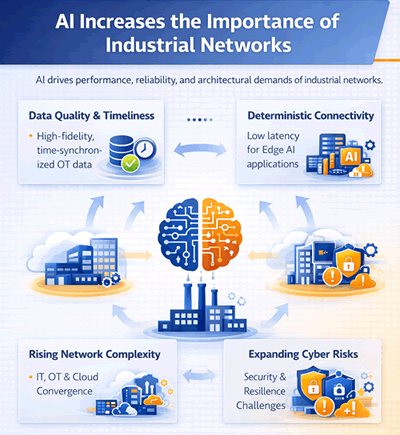
AI dramatically raises the performance, reliability, and architectural requirements of industrial networks.

Why this matters now:

  • AI depends on data quality and timeliness. Advanced analytics, machine learning, and digital twins require high fidelity, time synchronized OT data.
  • Edge and distributed AI need deterministic connectivity. Many AI use cases—such as machine vision or anomaly detection—run at the edge and rely on low latency networks.
  • Network complexity is increasing. AI accelerates the convergence of IT, OT, cloud, and edge systems, making network design and governance more critical.
  • Cyber risk expands with intelligence. As AI systems influence perational decisions, network security, segmentation, and resilience become central to risk management.

Industrial companies that underinvest in networking will struggle to scale AI initiatives beyond pilots.

The Digital Backbone of Modern Industrial Operations

Industrial networks are the backbone of digital operations—and the foundation for AI driven industrial transformation. ARC Advisory Group provides the insight, frameworks, and practical guidance industrial organizations need to design, deploy, and evolve networks that deliver real business value.

How ARC Helps Manufacturing and Industrial Companies Succeed

ARC works directly with industrial end users to improve outcomes from networking investments:

  • Strategy development: Define future proof industrial network architectures aligned with business goals
  • Technology evaluation: Independent assessment of networking technologies, standards, and suppliers
  • IT/OT convergence guidance: Best practices for governance, security, and organizational alignment
  • Modernization roadmaps: Practical migration paths from legacy networks to Ethernet  and IP based systems
  • Risk reduction: Improve cybersecurity posture and operational resilience through informed design decisions

ARC helps clients move from connectivity challenges to competitive advantage.

Why Technology Providers Work with ARC

Industrial networking suppliers partner with ARC to strengthen strategy, messaging, and market alignment:

  • Deep insight into end user requirements and buying behavior
  • Credible, independent validation of technology direction and positioning
  • Access to ARC’s global ecosystem of manufacturers, utilities, EPCs, and system integrators
  • Support for go to market strategy, thought leadership, and market education

ARC’s independence and industry credibility make it a trusted advisor to both suppliers and users.

ARC Advisory Group’s Research and Expertise

ARC Advisory Group is a recognized authority on industrial networking, digital transformation, and OT architectures.

Relevant ARC research and offerings include:

  • Global market data services on Industrial Ethernet, fieldbus systems, industrial wireless, and private networks
  • ARC’s Industrial Network Reference Architectures and IT/OT convergence frameworks
  • Research on secure industrial networking, zero trust in OT, and IEC 62443 alignment
  • Coverage of private 5G, Time Sensitive Networking (TSN), OPC UA over Ethernet, and emerging standards
  • End user case studies and technology provider competitive analysis

ARC’s research is vendor neutral, practitioner focused, and grounded in real industrial deployments. Contact us todat to learn how ARC can support your industrial networking strategy.

Representative Automation Clients
Representative End User Clients
Representative Software Clients