Representative End User Clients







Representative Automation Clients







Representative Software Clients








Summary
Process automation end users have made it clear that they want to eliminate unnecessary customization-related cost and effort from process automation project engineering, installation, and lifecycle management. This applies not only for greenfield installations, but also for migration and modernization projects.
 A new generation of intelligent, single-point I/O and new approaches to system installation and engineering have emerged over the past few years that strive to automate many of the steps involved with designing, installing, commissioning, and operating distributed control systems.
Siemens is the latest supplier to introduce these new process automation system concepts to the marketplace with the recent release of Version 9.0 of the Simatic PCS 7 DCS. The latest release includes extremely small footprint, software-configurable, single-point I/O called SIMATIC Compact Field Unit (CFU). A new line of SIMATIC ET 200SP HA (High-Availability) remote I/O is also included in the release. Both offerings incorporate the Ethernet-based standard PROFINET as the control network.
Version 9.0 separates I/O hardware from software to support the “late binding” concepts outlined in both ExxonMobil’s “It Just Happens” initiative and ARC Advisory Group’s own collaborative process automation system (CPAS) vision. The DCS itself can be developed in a virtual environment and paired with the system hardware at the last possible moment, allowing for parallel development of the system and installation and testing of the associated hardware. Version 9.0 also provides tools that simplify field device commissioning, including direct integration with PROFIBUS PA and a whole new set of PROFIBUS PA features. The latter include device profiles that can significantly reduce the time needed to commission field devices and allow for auto configuration of devices in parallel with process automation system engineering, before the actual process automation system is fully installed.
New Simatic PCS 7 Version 9.0 I/O Offers Software Configurability and an Extremely Small Footprint
Reducing the cost, complexity, and customization typically associated with conventional process I/O is a key concern for end users, but reduced footprint is often just as important. The new Compact Field Unit (CFU) I/O offers significantly reduced footprint to save valuable plant space. The single-channel I/O is assigned its type through software configuration, independent of any hardware or wiring.
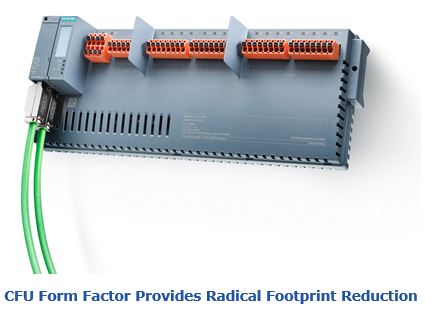 CFU also communicates directly via PROFINET, an open industry-standard network supported by a wide range of suppliers in both the process and discrete worlds. Standard PROFINET integration eliminates the need for marshalling cabinets, multi-core master cables, and other elements of the conventional DCS hardware infrastructure. Combined with the already small footprint of the CFU, this provides a solution with an extremely low overall physical footprint. End users can now realize a new decentralized, modular approach and bring digitalization to the field level PROFINET. This increases flexibility, especially in brownfield projects.
Small physical footprint may be more important than many realize. “Real estate” is at a premium, and not just in industries such as upstream oil & gas for applications like offshore platforms. The process industries are undergoing huge migration and modernization efforts in which new systems must often be installed in parallel with old. Lack of space can be a crucial limiting factor. Many plants in the chemical, life sciences, and even the refining industry are being built in a more modular fashion, with controls embedded on skids or in pieces of equipment. Smaller size and increased modularity is a better “fit” for all industries.
PROFINET support at the control network level also provides an added level of openness, since PROFINET is an open standard, rather than a proprietary control network protocol that utilizes an Ethernet physical layer. Native PROFINET control network support also brings seamless integration with a wide range of PROFINET-compliant products and components from multiple suppliers. These include remote I/O, drives, network components, and other devices.
CFU supports full redundancy, including redundant PROFINET connectivity and power supplies. Standard CFU modules support 16  channels of software-configurable I/O, but prewired cabinets with up to 96 channels are available and can be installed up to Zone 2 Ex environments in a temperature range from -40 °C to +70 °C.
Direct PROFIBUS PA Integration and Support of Advanced PROFIBUS PA Features
Compact Field Unit (CFU) also comes with features that can drastically reduce the amount of time required to both commission new devices in the field and replace existing devices. Siemens has done this by focusing on purely digital field devices compatible with the standard PROFIBUS PA digital protocol for process field devices. CFU can support both PROFIBUS PA digital fieldbus devices and conventional digital signals in the same I/O. Each 16-channel standard CFU I/O module can support up to 8 channels of PROFIBUS PA. The CFU also includes several enhancements for PROFIBUS PA integration and functionality, such as automatic detection and integration of devices.
This auto-detect/auto-integrate feature is done using standard PROFIBUS PA device profiles. These provide the system with all the basic device information as well as the process value (PV). Transmitters are connected to CFU using push-in terminals, eliminating the need for tools. The Ethernet-based field distributor then starts an initialization process in which the device is automatically addressed. Simatic CFU automatically carries out the addressing procedure and the integration based on standard profiles, depending on the type of device used (pressure or temperature transmitter, magnetic flowmeter, etc.). These communication and device profiles are standard features of PROFIBUS PA, which is supported by all the major field device suppliers. The device is then integrated in the control system and ready to operate. Siemens refers to this process as “plug-and-produce,” terminology similar to that used in process modularization approaches.
This takes significant time out of installation and can make it even easier to commission digital fieldbus devices than it would be to replace conventional analog devices. Siemens claims that device installation time drops from 30 minutes or more for conventional devices down to one minute for PROFIBUS PA devices. Siemens is unique among the process automation suppliers in that it has targeted this specific functionality for standard PROFIBUS PA field devices. ARC believes this could breathe some new life into the installed base of PROFIBUS PA devices. The CFU represents a major step forward in digital field device integration.
New High-Availability Remote I/O on PROFINET
Simatic ET 200SP HA, the new (high-availability) remote I/O offering for Simatic PCS 7 V 9.0, features PROFINET connections to high-availability controllers through two fully independent networks. The modular I/O system can be expanded in small increments to scale up as needed. As with the CFU, small footprint provides a major advantage. The new ET 200SP HA is about half the size of Siemens’ existing remote I/O offerings, making it possible to increase the number of modules per station from 12 to 56.
Each module can use up to 32 channels. The new I/O features an expanded working temperature range of -40 °C to +70 °C. The new I/O components also feature a special conformal coating for additional protection from the environment. Simatic ET 200SP HA can be used in Ex-Zone 2 environments.
Many features of the new remote I/O specifically target requirements for the heavy process industries. These include the extremely small footprint, multiple levels of redundancy, and hot swap and online expansion capabilities. In addition to supporting redundant PROFINET networks, a terminal block for integrated I/O redundancy allows use of redundant I/O modules for high-availability applications with no changes to wiring. Independent wiring means that stations can be pre-wired without any I/O modules.
Standardization of Cabinets and Enclosures
Standard I/O and control system infrastructure make it possible to develop and standardize the build-up of control cabinets, another big part of the V9.0 release. Standardized cabinets and enclosures represent “low hanging fruit” for reducing automation project cost and complexity. These new hardware features are a major requirement in the ExxonMobil “It Just Happens” initiative, which aims to increase modularity, reduce cost and footprint, and automate many of the functions in the design and application of process systems that were previously highly customized.
New Functions Focus on Usability, Flexibility
Version 9.0 comes with several new software upgrades focused on usability, flexibility, and increased productivity. The new version of Simatic Process Device Manager (PDM) provides complete PROFINET support and new methods for processing bulk data. These include parallel upload and download of device parameters or selective parameter transfer from device to device to further speed field device commissioning. Simatic PDM now also supports the new Field Device Integration (FDI) standard, making it easier to integrate and manage diagnostic data from many different suppliers’ intelligent field devices.
The new version of Simatic Batch released with Version 9.0 allows for more flexible planning of batches. Recipe creation and modeling of the equipment have been decoupled. This facilitates centralized recipe lifecycle management and makes it easier to standardize recipes across multiple plants. It also increases the flexibility for the operator.
ARC sees the roles of maintenance and operations changing, with increasing overlap between the two disciplines, requiring better coordination. The new version of the SIMATIC Maintenance Station supports this with cycled read-out and export of parameters, improving integration with enterprise asset management systems and creates possibilities for improved analytics. The operator can now trigger maintenance requests related to defective devices, which maintenance personnel can acknowledge when completed.
Conclusion
Simatic PCS 7 V 9.0 creates many opportunities for end users to reduce the effort and cost associated with implementing both new greenfield projects and migration and modernization projects. Using the PROFINET industrial Ethernet standard brings digitalization down to the field level. The combination of the extremely small footprint and software configurability of the CFU and ET 200 SP HA help reduce complexity and cost and provide a good fit for the increasingly modular nature of process plants and the skid-mounted equipment widely used in the process industries.
The native PROFIBUS PA integration is unique to Siemens, as most suppliers have targeted their new I/O solutions for use with purely analog technologies. This will support the digital transformation taking place across the process industries. Overall, ARC anticipates that these latest enhancements to Simatic PCS 7 should provide users with reduced CapEx, reduced time to operational readiness, and improved reliability.
ARC Advisory Group clients can view the complete report at ARC Client Portal on Office 365 or Box.com or New Client Portal on this website
If you would like to buy this report or obtain information about how to become a client, please Contact Us
Keywords: DCS, I/O Footprint, Process Automation, Standardization, Brownfield, Digitalization, Decentralization, ARC Advisory Group.