Representative End User Clients







Representative Automation Clients







Representative Software Clients








In today’s cost- and resource-constrained environment, it’s critical for process automation end users to minimize customization and the associated cost and effort over the entire lifecycle of a process automation project. This applies equally when implementing a new automation system or modernizing/migrating an existing system.
A previous ARC Advisory Services report discussed how Siemens’ new SIMATIC PCS 7 V9 I/O and PROFINET contribute to this goal. Siemens also recently briefed ARC on the company’s latest Version 9.1 release of the SIMIT Simulation Platform for control engineering, virtual commissioning, and operator training. We learned how this can help end users further reduce engineering, operations, and maintenance costs, improve productivity, reduce errors, and reduce operational risk.
 Siemens designed this latest SIMIT V9.1 Simulation Platform to efficiently reuse engineering information. The simulation can be used with virtual controllers (PLCSIM Advanced or SIMIT Virtual Controller, depending on the target control system), or with a real controller connected via PROFIBUS or PROFINET. Interfaces such as OPC enable connection to other emulated or real control systems.
The SIMIT portfolio refresh includes updates in both plant modeling capability and the simulation of controllers, often referred to as emulation. The SIMIT Virtual Controllers for emulating SIMATIC S7-300/400 controllers have been updated to be consistent with the recent PCS 7 V9.0 release. The new release couples the SIMIT V9.1 Simulation Platform with PLCSIM Advanced to emulate the SIMATIC S7-1500 software controller. Several other enhancements widen the scope of control scenarios and improve ease of use and productivity for engineering, commissioning, and operator training.
The former Simulation Unit has been rebranded as the SIMIT Unit, which has been integrated more tightly with the SIMIT Simulation Platform. SIMIT Unit integrates the platform with the SIMATIC PCS 7 distributed control systems via PROFINET or PROFIBUS networks.
The SIMIT Simulation Platform also offers productivity enhancements. For example, the platform can be primed with engineering information from COMOS or PCS 7, and can access Siemens instrument and actuator libraries as well as a new library for process behavior in chemical and pharmaceutical plants.
The SIMIT Simulation Platform enables plant simulation using a graphical modeling approach of process flow diagrams (PFDs) and piping & instrumentation diagrams (P&IDs). SIMIT also supports import of schematics from the COMOS engineering package and SIMATIC PCS 7. Models of equipment and process behaviors must be coupled with the graphics to create a simulation model. These models are available from standard libraries (see below).
The SIMIT plant simulation mimics the plant’s process equipment, instruments, actuators, and behaviors and can stimulate either virtual or real controllers to evaluate control configurations or train operators. SIMIT virtual controllers can be regarded as a digital twin of a Siemens process automation configuration and can simulate the execution of control programs. Siemens provides PLCSIM Advanced to simulate SIMATIC S7-1500 controllers and the SIMIT Virtual Controller for SIMATIC S7-300/400. Stimulated by the plant simulation, virtual controllers mimic the behavior of real controllers such as control actions, alarms etc. This is ideal for control engineering and testing process automation during design and configuration stages.
A second possible application is to stimulate a real control system with a simulated plant. The control system would run the validated control configuration and programs, providing an additional level of validation by checking the consistency between the modeled and real hardware configuration. This requires use of the SIMIT Unit (formerly called “Simulation Unit”), a piece of hardware that provides the connectivity between the simulation running on a PC and PROFINET or PROFIBUS DP protocols that the controller uses to connect with real I/O and field equipment. Beyond commissioning, the setup can be used for training purposes.

For modernization projects in an existing plant, the solution enables systematic testing of the upgraded system without disturbing the process. After validation, the process can be switched to the upgraded control system. In a new greenfield plant, controls can be tested and commissioned before plant construction is completed, to speed startup and commissioning.
The SIMIT Simulation Platform enhancements help improve productivity. To further integrate engineering and operations, the platform can be primed with engineering information from COMOS or PCS 7, providing the process and control layout (PFD and P&ID) and identifying controller input and output (I/O) signals.
Product libraries can provide the platform with up-to-date information on Siemens’ sensors and actuators, while process libraries provide information on the behavior of various process equipment. The new version has been enriched with the CHEM BASIC library for chemical and pharmaceutical plant simulation.

The models are simplified for testing, commissioning, and training purposes, and correspond to the behavior of water in liquid and/or vapor phases. Process temperatures can be manipulated mathematically, if needed. If desired, experts can export simulation information (by level of hierarchy of the process) to Excel spreadsheets. This can improve efficiency when multiple changes need to be made. If higher precision is required, customer- specific libraries can be incorporated into the SIMIT Simulation Platform. If needed, Siemens engineers could develop these on a custom basis. Further, SIMIT can interface with existing rigorous or hybrid simulators by standardized interfaces. The latter can be controlled from and synchronized with the platform via OPC, OPC-UA, or Microsoft memory sharing; and a dedicated remote control interface.
The virtual controllers are updated to be consistent with the new PCS 7 V9.0, with updates of the SIMIT Virtual Controller and the addition of a PLCSIM Advanced interface. The latter adds the emulation of SIMATIC S7-1500, with similar functional scope as the SIMIT Virtual Controller. The software can be primed with information on the controller configuration and programming from TIA portal. SIMIT Virtual Controller emulates S7-300/400 controllers for both factory process automation within a PCS 7 configuration. This includes new devices released with PCS 7 V9.0, such as CFU and ET 200SP HA.
SIMIT Virtual Controller features improve productivity and effectiveness in commissioning and operator training. The runtime environment is independent of the engineering system. The user has options to run in virtual time to slow down or speed up a simulation. Users can also create snapshots for analysis of simulation results and efficient system setup to a saved controller and plant state.
The recently rebranded SIMIT Unit has been integrated more tightly with the SIMIT Simulation Platform, which now handles administration and configuration of the Unit. This allows the user to switch easily between stimulating a real control system and emulating a control system in a single environment, another productivity enhancing benefit. SIMIT Unit is updated for PCS 7 V9.0 and supports ET 200SP HA, CFU, R1 redundancy and PROFINET hardware interrupt.
ARC’s vision stresses the importance of consistency between the models used for plant, process, and control simulations for both engineering and operations. For example, a refinery process simulation should be consistent with the higher-level refinery model used for planning and scheduling. Since it can interface with rigorous dynamic or transient simulators to help ensure consistency between the simulated plant and other simulation models, SIMIT supports this vision.
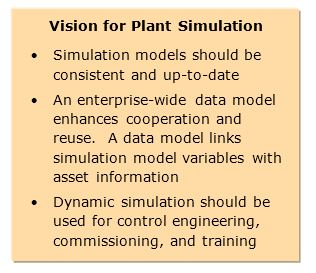 The identification of variables in a model should be consistent with any enterprise data model. This enables consistency between a simulation model and asset information management, simplifying process or asset analytics to a significant degree. By starting out with consistent model content and asset identification in a greenfield plant (or making these consistent in brownfield installations), the consistency can be maintained across the asset lifecycle.
Plant simulation should be used for real-time, short-term, and mid-term optimization. In other words, process and supply chain optimization form a continuum in which the time horizon varies from a few minutes to a year or longer. The modeling should begin during the initial engineering phase and continue throughout the asset lifecycle. This enables the simulations to support online, open-loop decision making; operator training; online closed-loop optimization; and supply chain planning.
Dynamic simulation should be used in control engineering to verify the effectiveness of control designs and study the non-linear transient process behavior often found in chemicals, pharmaceutical and polymer processes. Dynamic process simulation could be used to prime advanced or model-based process control (APC or MPC) models, and can be used to identify starting values for tuning these models to reduce the implementation cost, reduce the threshold to using these applications, and improve plant performance. Transient simulation also can be used for virtual commissioning, and operator training. Since PCS7 integrates MPC, the combination of SIMIT appears to fulfill many of these requirements.
Other elements of this vision include the (semi-)automated or assisted update of steady-state simulations with plant changes made over time, similar to the way that COMOS can be updated to reflect the changes in the control system. This would be an additional step towards systematic reuse and consistency of engineering and asset information, referred to as “integrated engineering and operations,” in Siemens’ parlance. Ultimately, information of transient continuous and batch process simulation should be easily reusable in control engineering applications as well.
SIMIT V9.1 consolidates and integrates the components of the solution further to reduce the effort and cost associated with control engineering and commissioning of both new plants and for migration or modernization projects in existing plants. The solution can help train operators before a migration project or new plant is commissioned. The solution reduces iterations and errors of control system engineering and programming and helps shorten the time to operational readiness.
Importing project information from COMOS or PCS 7 into the SIMIT Simulation Platform should save considerable time in the early phases of engineering projects. At the same time, the recent updating of the virtual controllers with new PCS 7 features and the tighter integration of the SIMIT Unit should increase user comfort and further improve productivity.
ARC Advisory Group clients can view the complete report at ARC Client Portal on Office 365 or Box.com or New Client Portal on this website
If you would like to buy this report or obtain information about how to become a client, please Contact Us
Keywords; Control Engineering, Virtual Commissioning, Operator Training, Virtual Controller, Plant Simulation, Siemens, SIMIT Simulation Platform, ARC Advisory Group.