Representative End User Clients







Representative Automation Clients







Representative Software Clients








 Often, Kaizen teams for Lean Six Sigma lack the data and corresponding analysis needed to drive consensus and convince others to adopt a project's recommendations. Industrial IoT (IIoT) facilitates fact-based decisions, a fundamental theme of both Six Sigma and Lean Manufacturing. IIoT provides data and analytics that improve the effectiveness of Lean Six Sigma programs and Kaizen teams. Consider Six Sigma and IIoT throughout the DMAIC process.
A fundamental process for a Lean program is value stream mapping (VSM). Often, the value stream can be made more efficient by adopting a new technology. Applying IIoT enables appropriate new methods for removing waste and reducing defects.
Usually, Lean Six Sigma Kaizen teams start by creating a value stream map of the process they want to improve. The VSM methodology drives consensus for the current state of the process among those who actually do the work (vs. a manager or support engineer), and helps them identify sources of waste. When a “defect” is found to be the source, the Six Sigma DMAIC (define, measure, analyze, improve, and control) process comes into play. This involves:
Kaizen teams can be thwarted by impediments that block progress. Common causes of project failure include:
IIoT can provide a means to overcome each of these impediments.
The measure phase involves data acquisition and numerical studies using parameters for the previously defined defect. This activity involves validating the measurement system, including the instrument’s accuracy, and understanding the potential sources of variation. Obtaining this fidelity requires a lot of data points – certainly hundreds, and maybe even millions of samples.
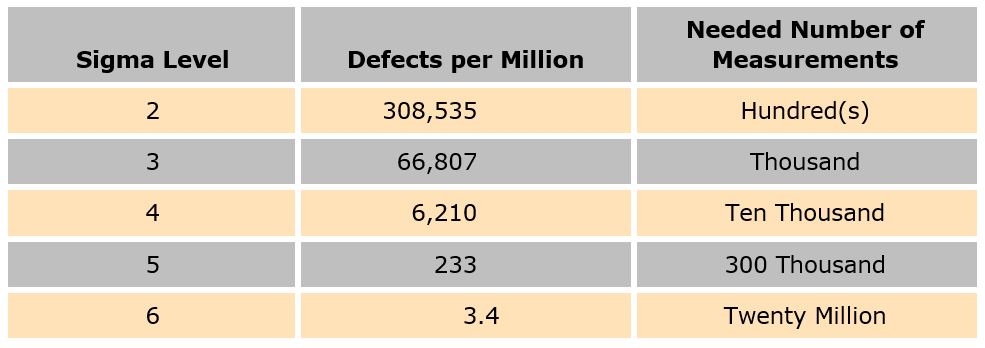
In the early days of Six Sigma (late 1980s and 1990s), teams could easily find processes running at the two-sigma quality level. Here, a hundred measurements should contain 31 defects, which was often enough to guide the team to the root cause of the defect. Moving beyond three sigma – a need for today’s teams - requires much larger data sets i.e., ten thousand to millions.
With the higher sigma quality levels, it becomes impractical to obtain the needed measurements manually because:
Manual meter reading, writing on a form, and then entering into a computer is problematic. Automated data acquisition is more effective, and IIoT fills this need. Also, IIoT can go beyond process data, and add often previously unavailable equipment data that can have significant impact on defect rates.

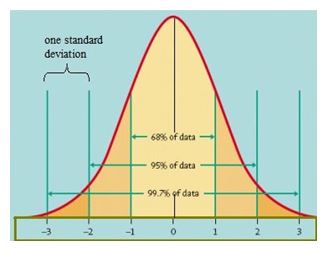
Training programs for Six Sigma nearly always use statistical analysis that assumes a normal distribution curve. This may be acceptable for the typical two and some three sigma projects. Unfortunately, the real-world environment often has patterns that do not follow a normal distribution curve. For example, none of the equipment failure patterns used to determine an asset’s maintenance strategy follow the normal curve.
Particularly with higher sigma levels, the analysis needs to move beyond assuming a normal distribution curve. IIoT platforms provide a broad set of analytics. Some also have a means to quickly identify associations within a data set that contains many parameters (i.e., various I/O measurements over time). This becomes necessary to determine the true source of the problem rather than a parallel effect (causation vs. correlation).
The improve phase uses a plethora of methods to reduce defects – limited mainly by the team’s imagination and process knowledge. IIoT offers a means to continuously monitor the health of a process or equipment, and generate an alert when it deteriorates. The most common application of IIoT involves monitoring an asset’s condition for predictive maintenance to prevent unplanned downtime.
IIoT can be used to help assure that the improvement “sticks,” and prevent people from going back to the old way of doing things. The continuous monitoring using IIoT can be programmed to generate an alert when things start deteriorating – early enough so that preventive measures can be taken before defects occur. Ad hoc communications (phone call or hallway conversation) with people that can fix the problem are often lost – humans tend to forget. In the case of predictive maintenance, the recommended automated business process has the alerts sent directly to the maintenance planner who can assess, set priorities, and schedule a repair in the enterprise asset management (EAM) system.
Lean Six Sigma programs have advanced beyond traditional manual data collection and simple statistical analysis assuming a normal distribution curve. IIoT offers a means to take these programs to a new level of effectiveness. Those involved in Lean Six Sigma programs should consider the following steps: