Representative End User Clients







Representative Automation Clients







Representative Software Clients








An open digital ecosystem is an architecture and operating model in which digital solutions—such as digital twins, engineering tools, operations systems, and analytics applications—work together through open standards, open interfaces, and shared data, rather than being locked into proprietary, vendor-specific platforms.
The Open Digital Ecosystem Working Group—formerly known as the Open Asset Digital Twin Working Group—is an ARC Advisory Group–moderated, end user–led industry consortium created to address persistent structural barriers limiting the value of digital twins across the asset lifecycle. Established in 2023 at the request of several large asset owners, the working group brings together operators from energy, chemicals, manufacturing, and infrastructure to develop a shared, pragmatic vision for an open, interoperable digital ecosystem. The group operates under antitrust rules, meets regularly (virtual and in person), and focuses on peer-to-peer exchange of real-world experiences rather than vendor-driven narratives.
The evolution from a narrowly defined “open asset digital twin” focus to a broader open digital ecosystem reflects a key industry insight: sustainable digital twins cannot succeed in isolation. Instead, they must exist within an ecosystem that supports interoperability, data reuse, and long-term scalability across engineering, operations, and maintenance environments.
The charter of the Open Digital Ecosystem Working Group is centered on creating a collective, asset owner voice that can clearly articulate requirements, priorities, and gaps to the vendor and standards communities. The working group’s purpose is not to define a single architecture or endorse specific technologies, but to align the industry on what “good” looks like for scalable, cost-effective digital twin delivery.
Key elements of the charter include:
Articulating asset owner needs related to digital twins and lifecycle asset data and communicating those needs consistently to solution providers and standards organizations.
Focusing initially on the sustainable use of 3D data, including engineering models and reality capture, while building toward process digital twins and a connected digital thread.
Reducing inefficiencies and risk in digital twin programs by addressing data silos, point solutions, and poor interoperability that drive high integration cost and technical debt.
Influencing data standards and best practices, enabling vendors and service providers to participate profitably in an open, standards-based ecosystem rather than proprietary, closed stacks.
ARC’s role is to moderate the group, consolidate outcomes, and amplify the message through forums, publications, and industry events, ensuring that lessons learned and best practices extend beyond the membership to the broader market.
A major milestone for the working group is the formalization and adoption of the Principles of Open Asset Digital Twins, which serve as foundational “table stakes” for any credible digital twin initiative. These principles define the non-negotiable characteristics required to enable interoperability, longevity, and value creation.
The adopted principles emphasize that:
Data must be decoupled from applications. Digital twins are built on data-agnostic architectures capable of handling multiple data sources and formats without fundamental reconfiguration.
Open standards and open interfaces are mandatory. Digital twins must avoid proprietary lock-in by using publicly available standards, vendor-neutral file formats, and non-proprietary interfaces.
Interoperability is a core requirement, not an afterthought. Systems must be able to access, exchange, and cooperatively use data across vendors and platforms, with data separated from consuming applications.
Data ownership and control remain with the asset owner. Owners must control access at the data layer, supported by consistent security models and modern authentication across third-party applications.
Transferability and reuse are essential. Data and metadata must be exportable without loss of information, enabling reuse across environments and replacement of applications over time.
Value must extend across the full asset lifecycle. Open asset digital twins are expected to deliver measurable business benefits not only during design and build, but throughout the much longer operations and maintenance phase.
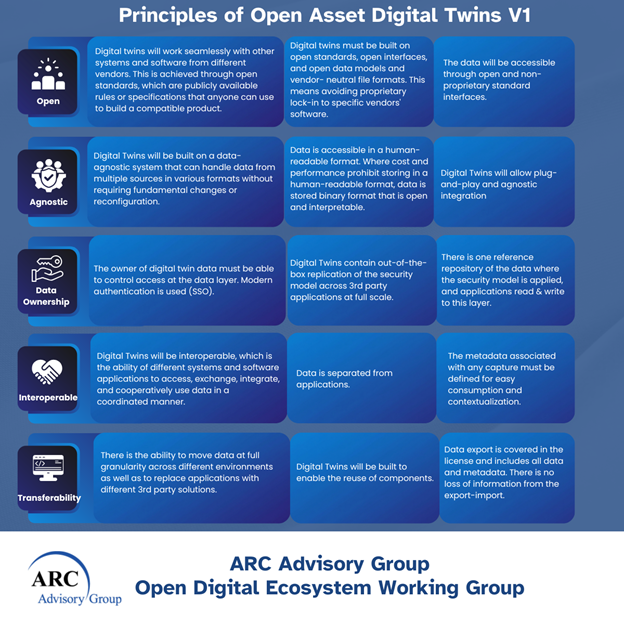
Collectively, these principles reframe digital twins as systems of systems within an open digital ecosystem—capable of evolving as assets, vendors, and technologies change.
The Open Digital Ecosystem Working Group has moved beyond theory to alignment. The next phase requires action.
Adopt digital twins as long-term, enterprise capabilities—not one-off projects. Demand open standards, data ownership, and interoperability from your suppliers. Actively participate in collaborative efforts like the Open Digital Ecosystem Working Group to shape best practices, influence standards, and reduce program risk through shared learning.
Reorient offerings toward open, data-centric architectures. Success in this market will be defined by the ability to integrate, interoperate, and coexist within heterogeneous customer environments. Engage with asset owners early, align with openly stated principles, and innovate within an ecosystem model rather than closed platforms.
Accelerating the open digital ecosystem is no longer optional. It is the enabling condition for scalable digital twins, sustainable value creation, and credible digital transformation across the industrial asset lifecycle. For more information about how to be involved, please check out our pages at: https://www.arcweb.com/products-services-technology-users/open-digital-ecosystem-ode-working-group