Representative End User Clients







Representative Automation Clients







Representative Software Clients








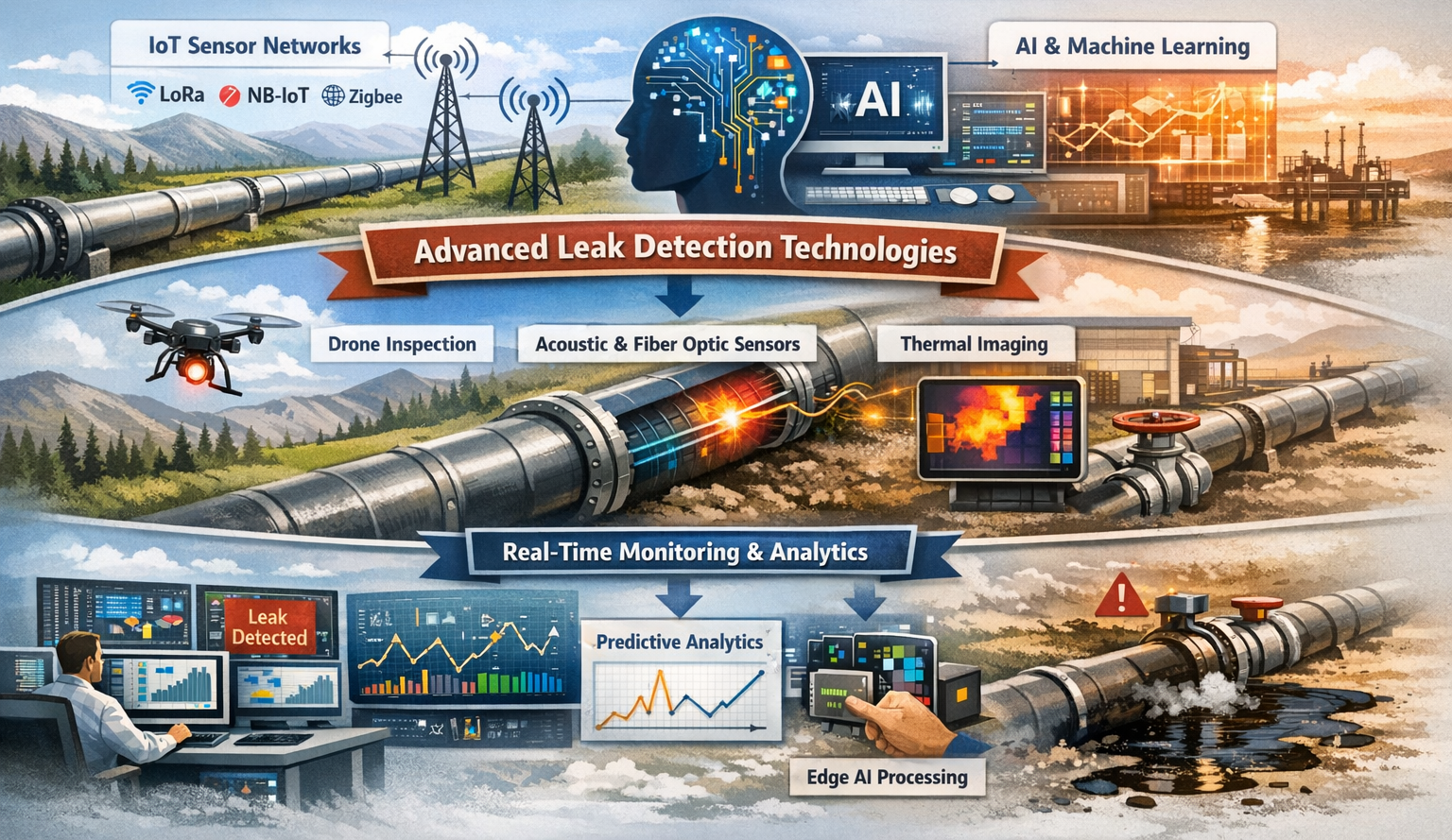
The oil and gas industry operates a vast and complex infrastructure where maintaining pipeline integrity is critical. Leaks caused by corrosion, mechanical failure, or external interference pose serious risks to environmental compliance, personnel safety, and financial stability. Historically, operators relied heavily on manual visual inspections and scheduled maintenance, approaches limited by human error, intermittent monitoring, and the logistical challenges of covering remote terrain.
Today, the sector is undergoing a digital transformation. By integrating the Internet of Things (IoT), advanced sensor hardware, and Artificial Intelligence (AI), operators are shifting from reactive containment toward proactive, real-time leak detection and prevention.
Modern leak detection systems increasingly rely on the Internet of Things (IoT), which transforms pipelines from passive assets into interconnected digital infrastructure. IoT architectures use Wireless Sensor Networks (WSN) to transmit operational data continuously from field locations to centralized control systems.
Because pipelines often run through remote areas with limited cellular coverage, operators increasingly deploy low-power wide-area network protocols such as Long Range Wide Area Network (LoRaWAN), Narrowband Internet of Things (NB-IoT), and Zigbee. These technologies enable mesh network topologies that relay data across long distances. As a result, pressure, temperature, and flow data can reach monitoring systems in near real time without extensive communication infrastructure.
To support these digital networks, operators deploy a range of advanced sensing technologies beyond traditional pressure monitoring.
Acoustic and Ultrasonic Monitoring: Leaks generate identifiable acoustic signatures. Acoustic Emission (AE) sensors and ultrasonic detectors detect high-frequency sounds associated with escaping fluids or gases while filtering background noise. Advanced implementations include Distributed Acoustic Sensing (DAS), which uses underground fiber optic cables as continuous sensors capable of identifying micro-leaks through vibration patterns.
Thermal and Infrared Imaging: Many gas leaks are invisible to the naked eye but detectable in the infrared spectrum. IoT-enabled thermal cameras detect temperature anomalies associated with escaping hydrocarbons. These systems enable automated visual inspection, operating day or night while identifying leaks through changes in thermal radiation in the surrounding environment.
Robotics and Drones: For hazardous or difficult-to-access areas, Unmanned Aerial Vehicles (UAVs) equipped with thermal cameras and gas detection sensors conduct automated inspections. Inside pipelines, robotic inspection tools known as “smart pigs” travel through the line using magnetic sensors and other technologies to detect corrosion, deformation, and structural weaknesses.
Several technology providers are deploying integrated sensing and analytics solutions to improve pipeline monitoring and integrity management.
Emerson Automation Solutions leverages its Plantweb digital ecosystem to support pipeline monitoring and operational visibility. Its Rosemount 928 Wireless Gas Monitor enables operators to extend leak detection into previously inaccessible areas using WirelessHART connectivity. Combined with Pipeline Manager software, Emerson applies statistical volume balance and Real-Time Transient Modeling (RTTM) to detect leaks while reducing false alarms common in traditional systems.
Atmos International focuses on advanced monitoring technologies such as the Atmos Wave Flow system. This solution combines the Negative Pressure Wave (NPW) method with volume balance analysis to detect both small leaks and major ruptures while providing accurate location identification. Atmos also introduced the Atmos Eclipse, a non-intrusive IoT device that attaches to the outside of a pipeline to measure pressure, flow, and temperature without drilling into the line.
Baker Hughes emphasizes the convergence of digital twins and physical sensing through its Cordant platform. The platform aggregates operational data and applies AI-driven analytics to manage pipeline health and integrity. Baker Hughes also integrates inspection technologies from its Waygate Technologies portfolio, including high-fidelity ultrasonic testing and industrial radiography, to identify micro-flaws and corrosion before they develop into leaks.
SLB (formerly Schlumberger) addresses leak detection through its Sensia joint venture and digital midstream solutions. SLB deploys Distributed Fiber Optic Sensing (DFOS), which converts fiber optic cables along pipelines into continuous sensing systems capable of detecting small temperature changes or acoustic vibrations associated with leaks. These sensing inputs feed into cloud-based AI environments that enable real-time visualization and automated response.
Artificial intelligence (AI) and machine learning (ML) are critical for interpreting the large datasets generated by IoT sensors. These technologies help filter false alarms caused by environmental noise while identifying subtle leak patterns.
Computer Vision with CNNs: Convolutional Neural Networks (CNNs), a deep learning approach, analyze video streams from surveillance cameras to identify visual indicators such as oil spills or gas plumes with high accuracy.
Predictive Maintenance: AI models analyze historical data related to vibration, pressure, and temperature to identify early signs of equipment degradation. This supports condition-based maintenance and helps operators address integrity risks before leaks occur.
Algorithmic Approaches: Algorithms such as Support Vector Machines (SVM) and Random Forest models are used to classify normal versus abnormal pipeline behavior. These approaches can identify leak intensity and location even in complex industrial environments.
An emerging advancement in pipeline monitoring is the convergence of Artificial Intelligence of Things (AIoT), which embeds AI capabilities directly into edge devices such as sensors and cameras rather than relying entirely on cloud processing.
Local processing reduces data latency and enables faster operational response. AIoT-enabled devices can verify fugitive emissions and trigger automated shut-off protocols, reducing the time between leak detection and mitigation.
The integration of IoT connectivity, advanced sensing technologies, and AI-driven analytics is reshaping pipeline monitoring in the oil and gas industry. These systems address the limitations of traditional inspection methods by enabling continuous, automated monitoring. As adoption expands, these technologies can reduce product loss, improve operational reliability, and minimize environmental risks associated with pipeline leaks.