Representative End User Clients







Representative Automation Clients







Representative Software Clients








For decades, hydrostatic level sensors have been the unsung heroes of process engineering and water management. Installed in boreholes, mounted in chemical tanks, or submerged in wastewater reservoirs, they quietly perform one of the industry’s most essential measurement tasks.
However, hydrostatic technology has not stopped evolving. Driven by Industry 4.0 and growing digitalization initiatives, these reliable instruments are becoming intelligent devices that deliver far more than simple level measurements. Today, hydrostatic sensors are evolving into connected assets that support predictive maintenance, remote monitoring, and smarter operational decision-making.
Before examining the latest trends, it is helpful to understand why hydrostatic technology continues to maintain a strong presence across industrial and environmental applications.
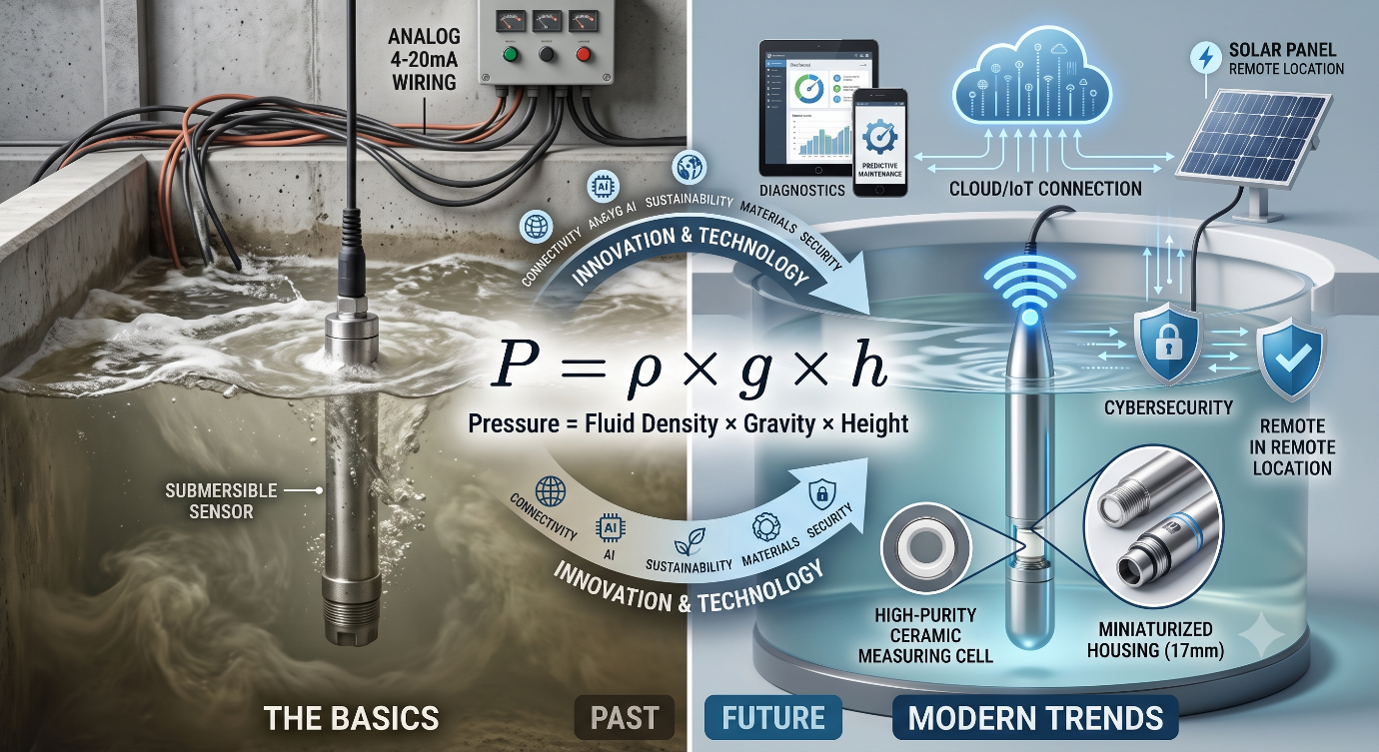
Hydrostatic sensors measure the pressure exerted by a static liquid column, which directly correlates with the liquid level. The principle relies on a straightforward equation:
P = ρ × g × h
Where:
P = Pressure.
ρ = Fluid density.
g = Gravitational acceleration.
h = Height of the liquid column.
Because hydrostatic measurement relies on pressure rather than reflected signals, it is largely unaffected by surface foam, vapor, turbulence, and internal tank obstructions. Its simplicity, robustness, and proven reliability have made it one of the most widely adopted level measurement technologies across industries ranging from chemicals and mining to food & beverage and water & wastewater.
As discussed in the previous ARC Advisory Group blog, Hydrostatic Level Measurement: The Most Reliable Solution Where Process Conditions Demand Contact-Based Measurement, hydrostatic technology continues to be a preferred choice in applications where process conditions challenge noncontact alternatives. The article examines its operating principle, key advantages, and the application scenarios that continue to drive adoption across the process industries and water infrastructure projects.
The physics behind hydrostatic measurement have not changed. What is changing is the intelligence being built around the measurement.
Historically, hydrostatic transmitters communicated primarily through traditional 4–20 mA analog signals. While reliable, these systems often required extensive wiring and manual configuration.
Today, manufacturers are increasingly integrating IoT capabilities through technologies such as Bluetooth, Wi-Fi, LoRaWAN, and cloud-connected communication platforms. This allows operators to configure instruments remotely, access diagnostics, and monitor process conditions from mobile devices or centralized control systems.
For remote reservoirs, pumping stations, groundwater wells, and distributed infrastructure, wireless connectivity can significantly reduce installation costs while improving visibility into operational performance.
In the past, maintenance teams often discovered sensor problems only after measurement accuracy began to deteriorate.
Modern hydrostatic instruments increasingly incorporate advanced diagnostics, adaptive filtering, and intelligent monitoring functions that continuously assess device health. Diagnostic algorithms can identify abnormal operating conditions, sensor drift, or developing performance issues and notify operators before process reliability is affected.
When integrated with asset management platforms, these capabilities support predictive maintenance strategies that help reduce downtime, optimize maintenance schedules, and improve overall plant reliability.
As water scarcity, climate resilience, and environmental compliance become higher priorities, demand for accurate and reliable level monitoring continues to grow.
Hydrostatic sensors are widely used to monitor groundwater resources, reservoirs, wastewater lift stations, stormwater systems, and municipal treatment facilities. Accurate level information helps operators reduce water losses, prevent overflows, optimize pumping operations, and improve resource management.
To support remote and environmentally sensitive applications, many modern hydrostatic probes are designed for ultra-low power consumption and can operate using battery- or solar-powered installations. Advanced temperature compensation also helps maintain measurement accuracy under varying environmental conditions.
While digitalization attracts much of the attention, significant innovation is also occurring at the sensor level.
Manufacturers are increasingly adopting high-performance ceramic measuring cells and specialized corrosion-resistant materials to meet the demands of aggressive process environments. Ceramic sensing elements offer strong resistance to abrasion, chemical attack, and long-term mechanical stress while maintaining stable measurement performance.
At the same time, ongoing miniaturization is enabling compact probes to be installed in increasingly confined spaces. Some modern submersible devices can be deployed in narrow monitoring wells, small-diameter boreholes, and compact process equipment where conventional instruments may not fit.
As hydrostatic devices become more connected, protecting field data and device integrity is becoming increasingly important.
Modern smart sensors are no longer isolated field instruments. They are often connected to plant networks, cloud platforms, and mobile applications. As a result, manufacturers are incorporating encrypted communications, secure Bluetooth connectivity, user authentication, and role-based access controls into their device architectures.
Cybersecurity is rapidly becoming an important selection criterion, particularly in critical infrastructure sectors such as water & wastewater, chemicals, energy, and environmental monitoring. Organizations are increasingly seeking instrumentation that not only delivers measurement accuracy but also supports secure and reliable digital operations.
Hydrostatic level measurement is no longer only about monitoring liquid levels. It is increasingly about turning measurement data into actionable intelligence that supports operational efficiency, sustainability, and reliability.
By combining the proven physics of hydrostatic pressure measurement with IoT connectivity, advanced diagnostics, predictive maintenance capabilities, secure communications, and next-generation sensor materials, today’s hydrostatic devices are delivering greater value than ever before.
The technology may be built on a simple principle, but its future is becoming increasingly intelligent, connected, and indispensable to modern industrial operations. In an era of digital transformation, hydrostatic measurement continues to demonstrate how even one of the industry’s most established technologies can evolve to meet the changing needs of industrial and infrastructure operators.
These ARC insights provide additional perspectives on smart pressure measurement, connected instrumentation, predictive maintenance, and the digitalization of field devices.
How AI Is Transforming Pressure Transmitters in Industrial Automation
Smart Pressure Transmitters Are Critical for Process Control and Optimization
Together, these ARC insights show how smart sensors, analytics, connectivity, and predictive maintenance are expanding the role of process instrumentation from basic measurement to broader operational intelligence.