Representative End User Clients







Representative Automation Clients







Representative Software Clients









Last week, I joined the Imubit team and a room filled with world-class operators and plant managers in Houston, Texas, for the Imubit Transcend event. My objective was to contextualize the current state of the "Industrial AI Wars" and share ARC Advisory Group’s latest research on how industry leaders are escaping pilot purgatory.
What unfolded across my Fireside Chat with Imubit CEO Gil Cohen, the roadmap sessions presented by Hieu Bui and Nadav Cohen, and a highly revealing afternoon hackathon was a masterclass in modern industrial architecture. It reinforced a core ARC thesis: the future of the autonomous plant will not be won by monolithic walled gardens, but by open, interoperable ecosystems powered by highly specialized, deterministic agents.
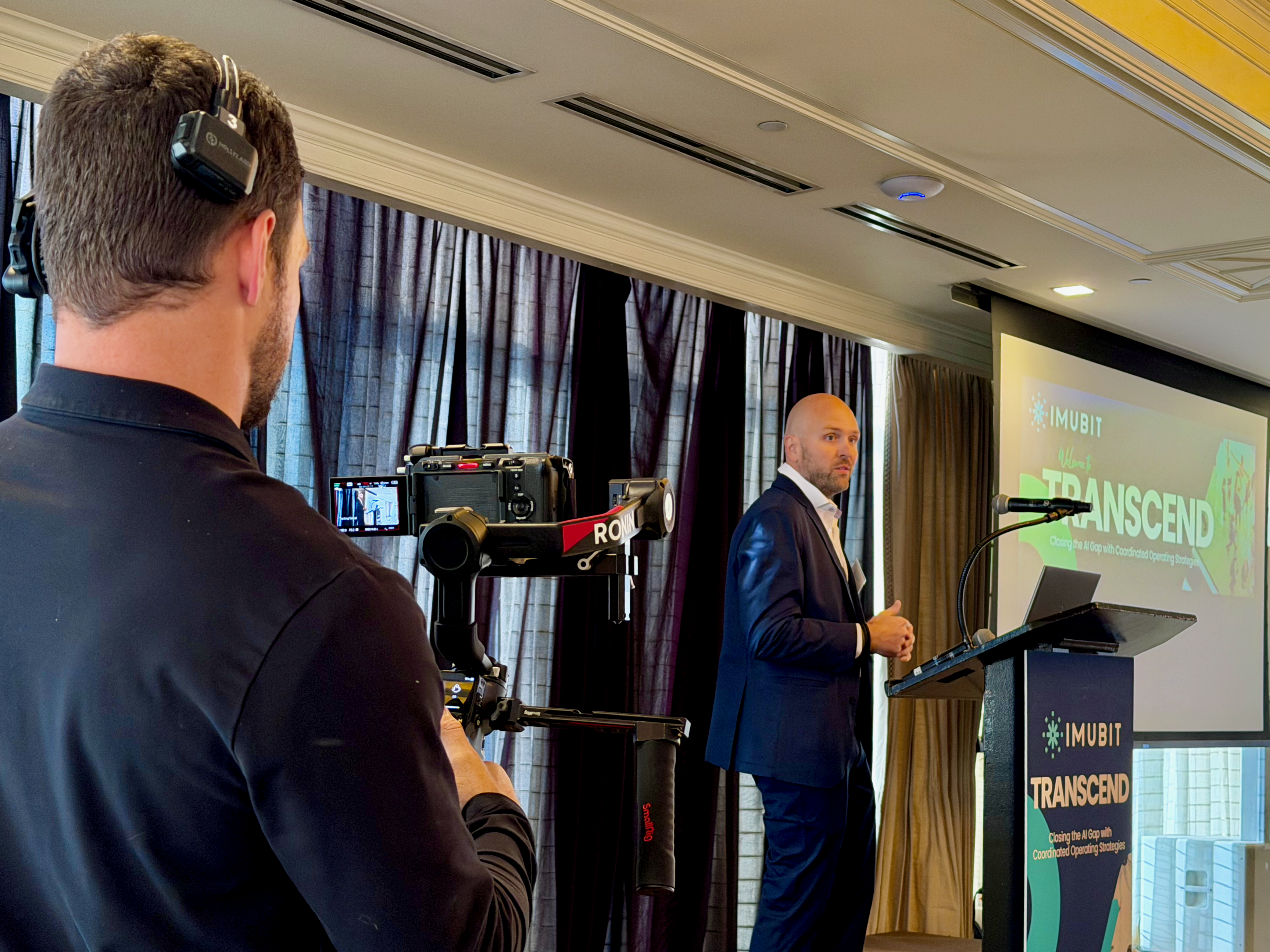
I opened my session by sharing a stark reality from our Q4 2025 Industrial AI Survey: the market has fractured into a profound Digital Divide. A select group of Industrial AI Pacesetters are scaling exponentially across all their facilities, while the vast majority (roughly 87 percent of the market) remains trapped in perpetual "pilot purgatory," constrained by basic connectivity issues and low-risk, incremental efficiency goals.
The primary culprit for this stagnation is the legacy "Software 2.0" mindset—the outdated belief that an industrial enterprise must buy an all-encompassing, proprietary "black box" suite that attempts to own the entire plant ontology and data layer. Pacesetters have realized that this architecture creates severe operational bottlenecks and stifles agility. In fact, our data shows that 63 percent of industrial respondents now consider decoupling data from software to be "critically important" to unlock scalable AI and avoid vendor lock-in.
In our Fireside Chat, Gil Cohen and I tackled this architectural tension head-on. Gil was emphatic about the risks of the closed-platform approach, arguing that legacy mega-vendors frequently attempt to build over-engineered, all-encompassing ontologies that force customers to surrender their entire data architecture to a single platform. Gil’s position aligns perfectly with ARC's interoperability research: no single vendor can be the best at everything, and industrial operators require true composability to succeed.
We also addressed the terminology confusion currently clouding the market. The generative AI hype cycle has completely hijacked the phrase "Foundation Model." Today, when executives hear that term, they immediately picture a non-deterministic large language model (LLM) scraping unstructured text to power a conversational chatbot.
Gil used our discussion to set the record straight. While the tech world obsesses over generic text-based engines, Imubit focuses on highly specialized, deterministic AI models that are trained on the customer's own operational data.
Unlike a generic LLM, Imubit's architecture is grounded entirely in structured, numerical telemetry—such as time-series tags, laboratory results, thermodynamic limits, and physical process constraints. It does not guess the next word in a sentence; it mathematically solves the physical state of a highly complex, non-linear chemical process.
This technical distinction underpins how we map the market using the ARC 3-Axis Industrial AI Models Taxonomy. Because of current market hype, vendors frequently lump all decision-support tools into a generic "Industrial Copilot" category. However, this creates a dangerous false equivalency in human-machine interaction, masking the critical shift from Human-in-the-Loop to Human-on-the-Loop architectures—a distinction that is exactly what modern industrial customers need to understand.
In this model, decisions must flow through a person. The AI operates primarily as a conversational interface, ingesting unstructured text or manuals to offer suggestions. The human operator is forced to actively prompt the system, interpret the textual advice, and manually execute the changes inside a traditional control system. This maintains the human as a severe cognitive and mechanical bottleneck during fast-moving process upsets.
This model completely shifts the paradigm to autonomous execution with human override capabilities. Imubit sits firmly at this layer as an Autonomous Execution Agent (AEA). The deterministic AI runs through what Imubit calls Coordinated Operating Strategies (COS), which is the framework that connects high-level business intent directly to day-to-day operating decisions.
Through the COS framework, the system autonomously calculates and executes an optimized, closed-loop setpoint matrix based on deterministic physics. The human operator is elevated from a manual controller to a high-level supervisor, sitting on the loop to monitor safety boundaries and adjust strategic economic constraints when market conditions shift. This keeps non-deterministic models far away from the mission-critical OT control loop, where an AI hallucination would mean a physical catastrophe.
Following our chat, Nadav Cohen took the stage to outline Imubit’s core technology roadmap, focusing on a massive double-down on Next-Generation Deep Learning Process Control (DLPC).
Rather than pivoting away from its core mathematical strengths to chase generic conversational trends, Imubit is pushing the boundaries of physical AI. Nadav detailed how next-gen DLPC will handle even greater multivariable complexity, tightening the loop between unit-level execution and plant-wide economic optimization.
Crucially, Imubit is expanding the envelope of what physics-constrained AI can control autonomously. This ensures that as production environments become more dynamic, especially when grappling with volatile energy inputs or shifting feedstocks, the AI can mathematically constrain operations to safe and high-throughput envelopes, as opposed to offering loose algorithmic hedges on "guarantees."
If Gil and Nadav provided the theory, the afternoon hackathon provided the irrefutable proof of concept, demonstrating exactly how an open, decoupled agentic ecosystem works in reality.
During the session, Imubit demonstrated its deterministic DLPC engine exposed seamlessly as a Model Context Protocol (MCP) Server. We watched as developers utilized Anthropic's Claude, a frontier LLM, to interrogate the Imubit DLPC server. Claude was augmented with relevant unstructured operating manuals and market constraint documents. However, whenever Claude needed to know if a specific process adjustment was physically safe, stable, or optimized, it did not guess; it actively queried the Imubit DLPC MCP Server.
This exemplifies one of the new architectural patterns ARC has been exploring as necessary for the evolving Cyber-Physical Industrial Architecture (CPIA) for the new era of Agentic AI:
The Frontier LLM (Claude) acts as the flexible interface and high-level orchestrator—synthesizing unstructured text, handling natural language human interactions, and managing logical workflows.
The AEA (Imubit) acts as the highly specialized, deterministic "physical brain"—returning mathematically sound, physics-grounded operational boundaries back to the orchestrator.
While it operates as a modular, open setup rather than an all-in-one closed user interface, it beautifully showcased the flexibility of open standards like MCP and Agent-to-Agent (A2A) communication. It proved to the audience that you do not need to lock yourself into a massive, proprietary walled garden to achieve plant-wide intelligence. You can use the world's best language models for reasoning and interface, pair them with the world's best deterministic DLPC models for physical control, and let them communicate securely and seamlessly.
When this open ecosystem of specialized agents is fully realized, the daily responsibilities of a plant manager transform entirely. Operators will be freed from the continuous, reactive cycle of manual alarm-tweaking and firefighting.
By leveraging open agentic protocols like MCP and A2A to decouple data, optimize workflows, and maintain deterministic control at the edge, the industry can finally bridge its digital divide. Imubit has firmly positioned next-gen DLPC as the reliable, physics-grounded anchor required to move industrial manufacturing out of the firefighting business and into true strategic portfolio management.
The Industrial AI (R)Evolution is moving faster than ever. To dive deeper into the frameworks and data shaping the future of the industrial sector, explore my latest research:
Navigating the AI Wars and the escalating Industrial Robot Wars
Closing the Digital Divide by Embracing Industrial AI
Assembling your Industrial-Grade Data Fabric
Charting the new frontier of Physical Intelligence and transitioning to a Cyber-Physical Industrial Architecture (CPIA)
Mapping your maturity and strategy with ARC's 3-Axis Industrial AI Models Taxonomy
Where do you stand in the Industrial AI (R)Evolution? Take our Industrial AI Assessment to benchmark your organization's maturity, identify critical gaps in your IT/OT/ET convergence, and get actionable recommendations to accelerate your path to becoming an Industrial AI Pacesetter.
Don't guess what your global operations or prospective customers need. Use empirical data to align your stakeholders and de-hype the market with ARC Advisory Group's Voice of Market Service.
For tailored recommendations on governing and guiding major people, process, and technology decisions across the enterprise, cloud, industrial edge, and AI, please contact Colin Masson at [email protected].
Or, set up a meeting with my fellow Analysts and I at ARC Advisory Group to find out more about our Executive Insights Service for Industrial organizations and our Industrial AI Insights Service for Vendors.