Representative End User Clients







Representative Automation Clients







Representative Software Clients








A few months ago, I was invited to speak to the graduating class of the high school I once attended. Their questions were practical and urgent: What should I study? Which career path is safest? What should I choose if I want to succeed? Those questions were never easy, but AI has made them harder, because the uncertainty students face is no longer only about jobs. It is also about how they learn, how they think, and what abilities will still matter when machines can produce instant answers.
In another era, one could confidently recommend familiar paths—engineering, medicine, law, business, technology—and trust that disciplined effort would pay off. That confidence is harder to sustain today. AI is reshaping not only the labor market but also the habits students form before entering it. If young people rely on AI too early, they may gain speed without depth. So while no one can promise a safe career path, we can still guide students toward qualities that will matter in almost any future: independent thinking, adaptability, technical fluency, and the ability to use machines without surrendering judgment to them.
That is why recent warnings about AI in education matter. Sridhar Vembu, Founder and Chief Scientist at Zoho, argued that AI can become a “crutch” for high school students, and the concern is not abstract. A study of nearly 1,000 secondary school students in Turkey found that those using GPT-based tools often solved more practice problems but performed worse when the AI was removed. AI is not the problem; the risk is that convenience can mimic learning. Subjects like mathematics are meant to develop patience, reasoning, and the ability to work through difficulty. If AI provides the next step too quickly, students may complete the task without building those skills.
We are living through a period in which AI is beginning to alter our assumptions about work, expertise, and value. That does not mean every profession will disappear, or that machines will replace people in a neat sequence. It does mean many inherited career maps are no longer reliable. The World Economic Forum’s Future of Jobs Report 2025 suggests that AI, automation, and technological change will reshape employment across sectors while increasing the value of resilience, creativity, and technological literacy. At the same time, labor-market reporting continues to show shortages in skilled trades and technical infrastructure roles as economies invest in energy, construction, and the physical systems that support digital growth.
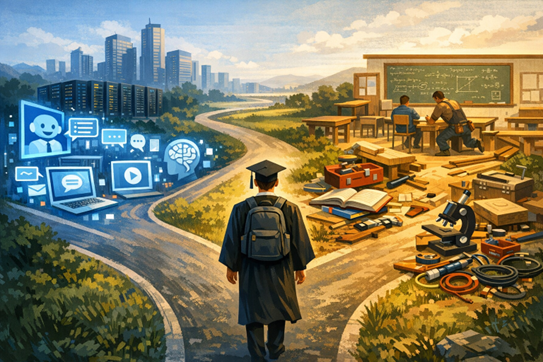
We often talk as if the future belongs only to software, data, and white-collar work. Yet the more digital life becomes, the more we rely on the physical world and the people who build, repair, and maintain it. Data centers need electricians; growing cities need carpenters, plumbers, welders, HVAC technicians, and machinists; energy transitions need grid workers and other hands-on specialists. Even the AI economy depends on concrete, steel, wiring, cooling systems, and human skill.
For decades, many societies treated trades as second-choice paths for those who did not follow prestigious academic routes. That view now looks outdated. Skilled trades are not fallback options; they often offer stability, dignity, and lasting relevance that some office jobs may not. They also show that valuable work is not defined by whether it happens behind a screen.
This is not an argument against higher education, nor a romanticization of manual labor. Universities will continue to matter. So will research, medicine, design, software, finance, and many professions that require advanced study. So if I were answering those students today, I would tell them that if the old promise was “choose the right degree and your future will follow,” the new reality is more unstable. The future of work may be uncertain, but the response need not be. Build abilities that endure: learn deeply, adapt quickly, and use AI tools without becoming dependent on them.