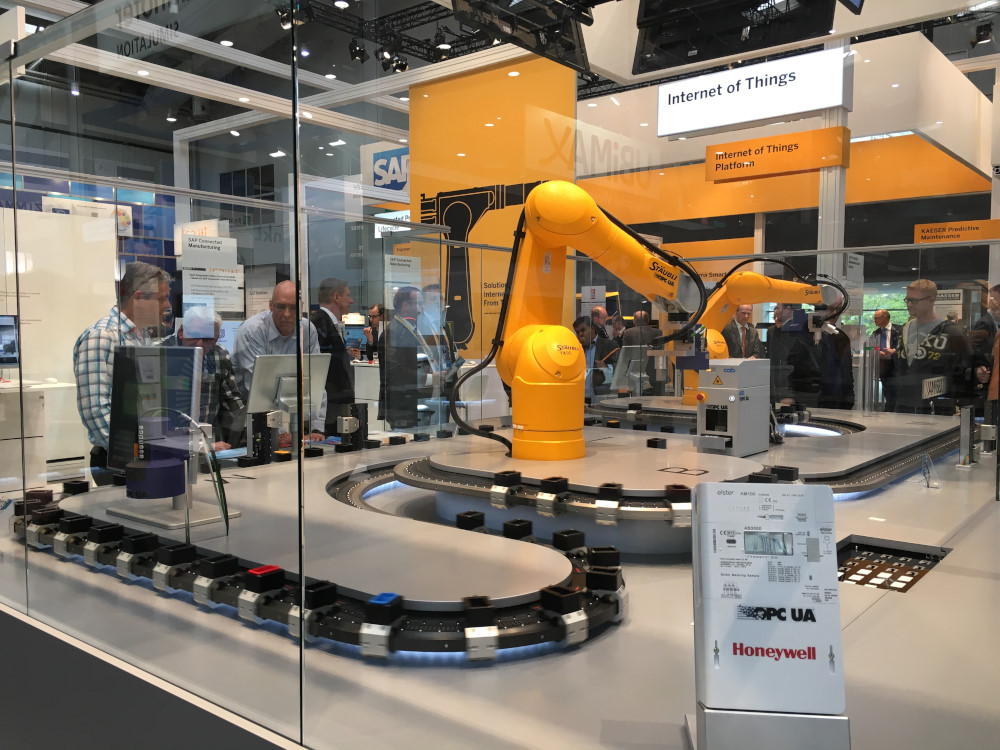
At the Hannover fair 2016, SAP and partners present an object-oriented connected manufacturing demonstrator.
SAP ME, the Manufacturing Operations Management solution by SAP is used to define a product with an individual client. Subsequently it creates an order and orchestrates manufacturing execution. OPC UA enables communication between entities taking part in the production, whether a software application or a physical object. The network-independent, service-oriented technology enables secure communication. Entities expose services (often information) via an OPC UA server. A transportation system (eXtended Transport System) conveys carriers for parts and final products. The carriers mover over an endless belt, controlled by a PC-based controller, configured using the engineering tool TwinCAT3, all provided by Beckhoff Automation. Stäubli robots pick the raw materials and assemble them according to the individualized production order. Cab Produktechnik laser marks the product with an individualized text. ASCENTICS machine vision optically monitors the production and assembly steps, reading parameters such as position, dimensional accuracy, shape, color, surface etc. If a product is off-spec, it is conveyed for rework to a manual workbench, where an operator, guided by and SAP ME application configured by Trebing+Himstedt and assisted by a ‘hands free’ bar scanning glove by ProGlove, making identification of parts and products effortless. A Honeywell smart meter monitors energy consumption, fed back to the MOM application.
The demonstrator shows that a service-oriented smart manufacturing environment can be configured based on components available today. The demonstrator is operated and located in a single location, but remote operation via Internet is thinkable.
The IIoT community is working on Industrial IoT reference architectures that will materialize in standards. I believe it is important to apply to these standards to describe objects (entities), their services or functions and the semantics to operate them. Only then will it it require little effort to set up or change IIoT production lines and guarantee applications will be extendable, maintainable, adaptable and interoperable.




















