Representative End User Clients







Representative Automation Clients







Representative Software Clients








Universal Robots (UR), a Teradyne Robotics company, has introduced Gen 7, its seventh-generation collaborative robot platform, at IMTS 2026 in Chicago. The platform includes new robot arms, controller, teach pendant, tool-flange interface, and the PolyScope X operating system, with a focus on connectivity, edge AI, and physical AI applications.
Gen 7 has been redesigned across the robot platform, from the controller to the tool flange. Universal Robots says the architecture is intended to support more advanced sensing, machine vision, external AI processing, and industrial networking while reducing integration complexity.
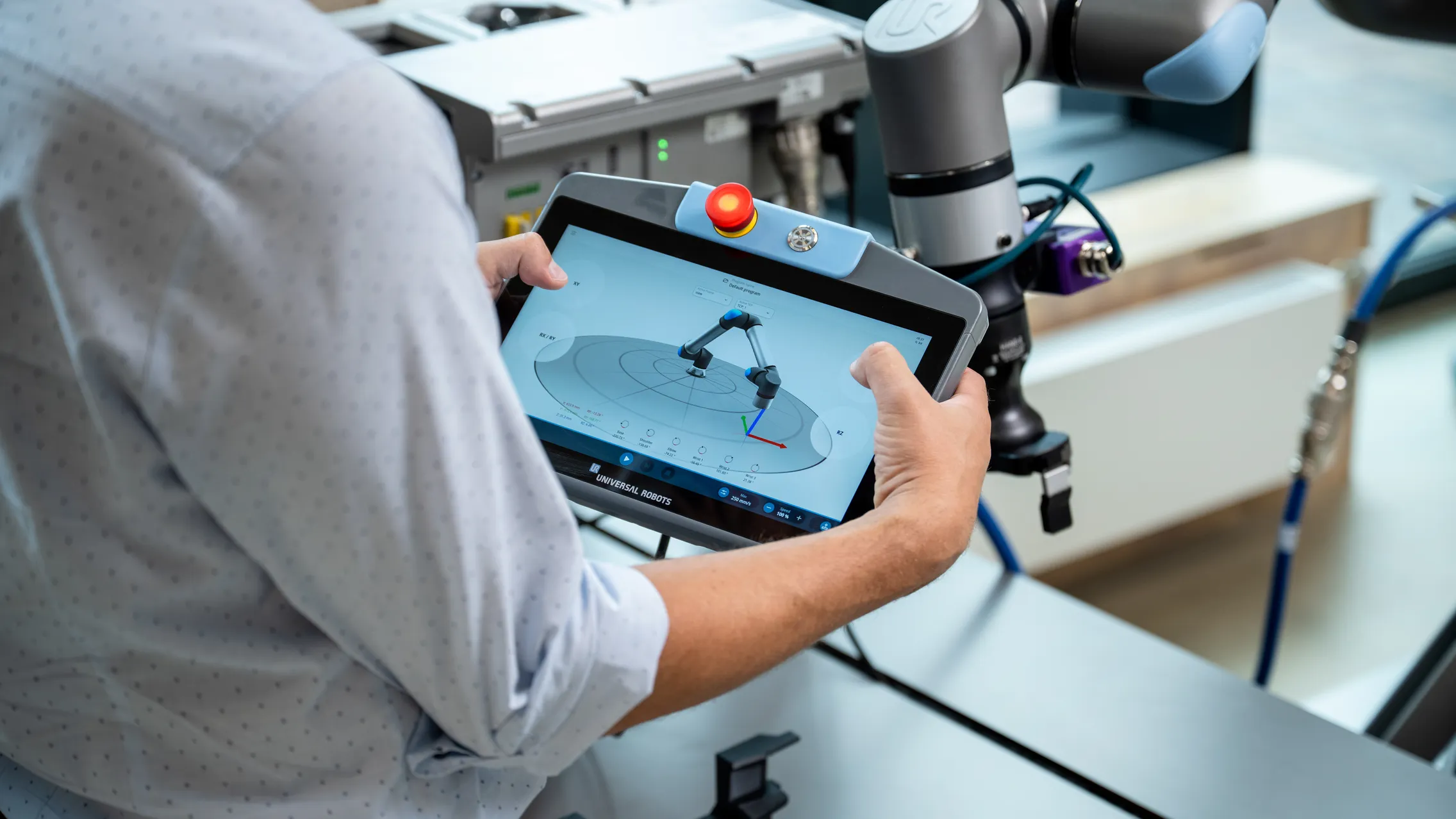
Gen 7 introduces several new hardware and software elements:
g-Series robot arms: The new lineup includes the UR10g-1750, UR17g-1300, and UR18g-950, named according to payload and reach. The tool flange provides integrated power, data, safety, and connectivity for cameras, sensors, and other end-of-arm tooling.
CB7 Core controller: The controller provides additional computing capacity and multi-network connectivity for integration with PLCs, HMIs, MES platforms, IPCs, and vision systems.
PolyScope X: Universal Robots’ operating system supports open APIs, ROS 2 communication, edge-AI applications, and integration with external AI processing systems.
TP7 Core teach pendant: The redesigned pendant is lighter than previous versions and adds configurable controls, a full-HD display, and a virtual joystick.
SP7 Smart Panel: The tool-flange interface enables operators to teach and program tasks closer to the point of operation, including applications requiring touch-to-teach functionality.
One of the more significant changes in the Gen 7 architecture is the redesigned g-Series tool flange. It brings data, power, safety connectivity, and support for higher-bandwidth sensors directly to the robot arm, reducing the need for external cabling and additional integration hardware.
The robots also incorporate force-torque sensing, impedance control, and Real-Time Data Exchange (RTDE), supporting applications that depend on more responsive interaction with the physical environment, including force-sensitive assembly and manipulation tasks.
These capabilities are relevant to the broader development of physical AI, where perception, sensing, edge computing, and robot control increasingly need to work together in real time.
PolyScope X provides the software foundation for the Gen 7 platform. Its open APIs and ROS 2 support allow developers and integrators to connect external processing systems and develop edge-AI applications.
Additional software capabilities support technologies such as ProfiSafe and OPC UA, while third-party applications can be deployed through the Universal Robots ecosystem.
The combination of local computing, open software interfaces, and expanded connectivity reflects a broader shift toward more software-defined robotic systems in which intelligence is increasingly distributed across the robot, controller, sensors, and external computing platforms.
Gen 7 also incorporates updated functional safety and cybersecurity capabilities. Universal Robots states that the g-Series uses a PLd, Category 3 architecture under ISO 13849-1 and that the robots are certified to ISO 10218-1 and UL 1740.
Teradyne Robotics also states that its development processes are certified to IEC 62443-4-1 maturity level 3 for cybersecurity.
These capabilities become increasingly important as robots are connected to broader industrial networks and incorporate more external software, sensors, vision systems, and AI processing.
Universal Robots demonstrated Gen 7 at IMTS with more than 20 ecosystem partners, including Cognex, Schunk, Magswitch, Smooth Robotics, Psyonic, Robotiq, and Inbolt.
The demonstrations highlight the platform’s open architecture and its ability to combine third-party machine vision, gripping, sensing, and physical AI technologies with Universal Robots hardware and software.
Gen 7 also remains connected to the company’s UR+ ecosystem, which provides validated hardware and software products developed by Universal Robots partners.
Gen 7 marks a broader platform shift for Universal Robots, with hardware, software, connectivity, safety, and third-party ecosystem support being developed as a more integrated system rather than as separate layers. That matters as robotic applications become more dependent on real-time sensing, edge processing, vision, and external AI tools.
For manufacturers, the significance of Gen 7 is less about adding AI as a standalone feature and more about creating a robotics platform designed to support increasingly complex automation architectures. The open interfaces, expanded connectivity, and ecosystem integration give developers and integrators more flexibility to build advanced applications while keeping the robot platform itself at the center of deployment.
ARC has also examined how AI, edge computing, and new software architectures are reshaping industrial robotics and automation.
Forging a New Language—ARC's Unified Taxonomy for the AI Robotics Era
Grounding Intelligence—Why the Robotic Edge Is the Physical Foundation
Standard Bots: How AI-Native Robotics is Redefining Industrial Automation
These ARC Insights help place Gen 7 within the broader move toward more connected, software-defined, and AI-enabled robotic systems.