Representative End User Clients







Representative Automation Clients







Representative Software Clients








Artificial intelligence is no longer a futuristic concept sitting on the edge of possibility. It now shapes hiring decisions, powers medical diagnostics, recommends what we watch, flags suspicious financial activity, and even assists with writing and research. As AI becomes more deeply embedded in everyday life, one question rises above all others: can we trust it? The answer depends not only on what AI can do, but on how responsibly it is designed, governed, and used. In that sense, ethics is no longer an optional layer added after innovation. It is becoming the foundation that determines whether AI serves society well or deepens existing harms.
The rapid adoption of AI across industries has made ethical design a practical necessity. Governments, companies, and global institutions increasingly agree that trustworthy AI should be built around a few core principles: fairness, transparency, accountability, privacy, and human oversight. Frameworks from the OECD and UNESCO, as well as risk-based regulatory models such as the EU AI Act, all point in the same direction: AI must not simply be powerful; it must also be understandable, safe, and aligned with human rights and democratic values.
Fairness remains one of the biggest concerns. AI systems learn from data, and when that data reflects historical inequalities, the result can be biased outcomes at scale. A flawed system in hiring, lending, healthcare, or policing can reinforce discrimination while appearing neutral. That is why future-focused AI governance increasingly emphasizes bias audits, diverse training data, and impact assessments before deployment. Responsible AI is not just about avoiding bad publicity; it is about preventing automated injustice.
Transparency is equally important. People increasingly want to know when AI is influencing a decision, what data it relied on, and whether a human can challenge the result. This demand is pushing the growth of explainable AI, stronger documentation practices, and clearer disclosure standards. In simple terms, if an AI system affects someone’s rights, opportunities, or safety, that person should not be left guessing how the system reached its conclusion.
Beyond fairness and transparency, AI raises deeper integrity questions about misuse, control, and social impact. One of the most visible risks is the rise of AI-generated misinformation. Deepfakes, synthetic voices, and automated content generation can blur the line between authentic and fabricated material at enormous scale. That has serious consequences for journalism, public trust, elections, and social cohesion. Policymakers and industry groups are responding with ideas such as provenance tools, watermarking, and disclosure requirements, but the race between misuse and safeguards is far from over.
Another challenge is deciding how much autonomy AI should have. In low-risk contexts, automation can save time and improve efficiency. But in high-stakes areas such as healthcare, critical infrastructure, border control, or employment, meaningful human oversight is essential. The emerging consensus is not that humans should block AI progress, but that they should remain responsible for reviewing, intervening in, and ultimately owning important decisions. This principle is becoming central to modern AI governance.
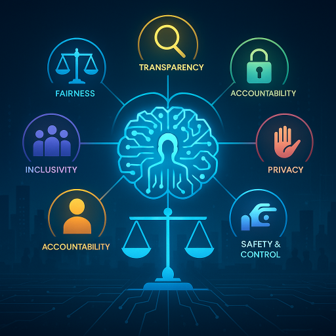
What makes the future of AI ethics especially important is that it is no longer being shaped by theory alone. Regulation is catching up. The EU AI Act is one of the clearest examples of a risk-based approach, where the strictest obligations apply to systems that could affect health, safety, or fundamental rights. At the same time, organizations such as the OECD and UNESCO continue to influence global norms by framing AI around human dignity, democratic values, privacy, and accountability. Together, these efforts suggest that the future of AI governance will be layered: international principles, national regulations, and corporate responsibility working together rather than separately.
Companies, too, are under pressure to move from slogans to systems. “Ethics by design” is becoming a serious expectation, which means building safeguards into development from the beginning instead of trying to fix problems after launch. That includes documentation, audit trails, testing for bias, incident reporting, and clear internal accountability. In other words, responsible AI will increasingly be measured not by promises, but by processes that can be reviewed and trusted.
The hardest issue, however, may not be technical at all. It is moral and cultural: whose values should AI reflect? Different societies draw the line differently on privacy, security, free expression, and collective welfare. If AI systems are built mainly by a narrow group of institutions or cultures, they risk exporting one worldview as if it were universal. That is why future AI integrity also depends on representation, pluralism, and public participation in how systems are designed and governed. Ethical AI must be globally informed, locally sensitive, and open to challenge.
A positive future is still possible. If ethics and integrity are handled well, AI could expand access to healthcare, improve education, strengthen public services, and make decision making more consistent and transparent. If handled poorly, it could normalize surveillance, accelerate inequality, and erode trust in institutions. The outcome is not predetermined. It will depend on the rules we adopt, the systems we build, and the values we choose to protect.
That is the central truth about AI ethics: it is not a brake on innovation. It is what makes innovation worth trusting. As artificial intelligence becomes more powerful, the future will belong not to the fastest systems alone, but to the most responsible ones.