Representative End User Clients







Representative Automation Clients







Representative Software Clients








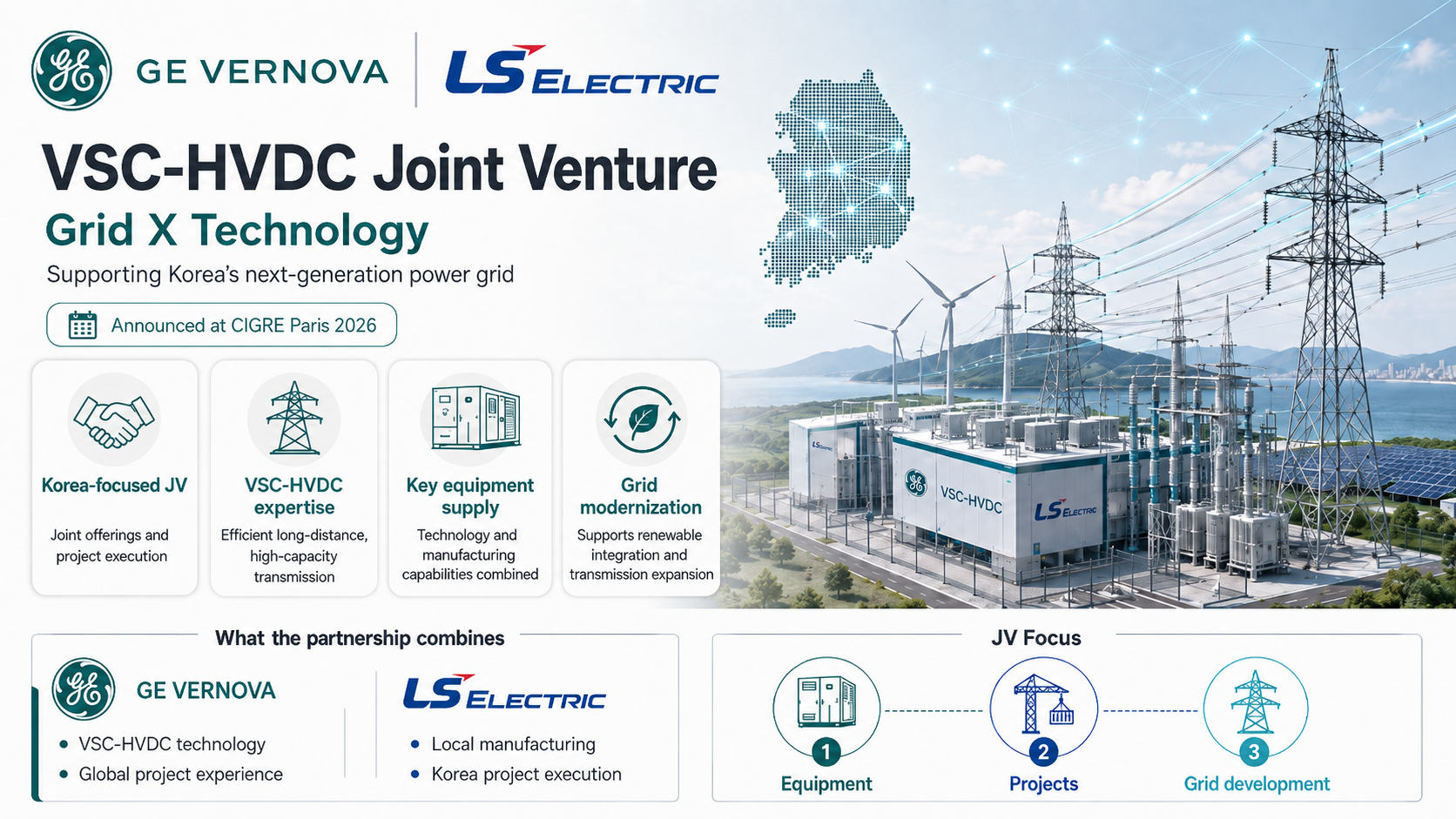
GE Vernova and LS ELECTRIC announced that they have signed an agreement to establish a joint venture focused on voltage-sourced converter high-voltage direct current (VSC-HVDC) technology and projects in Korea.
The joint venture, named Grid X Technology, is intended to combine GE Vernova’s VSC-HVDC technology and experience with LS ELECTRIC’s manufacturing and project execution capabilities in Korea.
Through the joint venture, the companies plan to develop joint offerings and strategies covering the supply of key HVDC equipment and the execution of VSC-HVDC projects in Korea. The partnership is also intended to support the development of Korea’s next-generation transmission infrastructure.
VSC-HVDC technology is increasingly being used to transmit large amounts of electricity over long distances while providing greater flexibility in controlling power flows and integrating renewable generation.
Unlike conventional alternating current transmission, HVDC converts electricity from AC to DC for transmission and converts it back to AC closer to the point of use. VSC-based systems can also provide capabilities, such as bidirectional power-flow control and operation in weaker AC networks, making the technology well suited to renewable energy integration and increasingly complex transmission systems.
The GE Vernova-LS ELECTRIC joint venture is expected to support transmission projects associated with Korea’s broader grid modernization efforts, including the West Coast Energy Highway initiative. The project is intended to transmit renewable electricity generated in the Honam region and along Korea’s west coast to the Seoul metropolitan area.
GE Vernova brings established VSC-HVDC technology and global project experience to the partnership, while LS ELECTRIC contributes local manufacturing capacity and experience supplying equipment for commercial HVDC projects in Korea.
LS ELECTRIC has participated in the Bukdangjin-Godeok HVDC project and is supplying equipment for the East Coast-Seoul Metropolitan Area HVDC project. The company has also expanded its HVDC manufacturing infrastructure at its Busan facility, including production capabilities for converter transformers and other high-voltage equipment.
The relationship between GE Vernova and LS ELECTRIC predates the new joint venture. In July 2025, the companies signed an agreement to cooperate on the localization of converter valves for gigawatt-scale VSC-HVDC applications in Korea.
The new joint venture formalizes that cooperation around a broader range of HVDC projects and equipment requirements.
GE Vernova has continued to expand its VSC-HVDC portfolio for larger transmission projects. The company introduced a high-current VSC valve designed to extend its HVDC platform beyond 3 GW at ±525 kV for long-distance transmission applications.
The establishment of Grid X Technology reflects growing investment in HVDC infrastructure as utilities and transmission operators seek to move larger volumes of electricity over longer distances, connect renewable generation, and reinforce national transmission networks.
HVDC technologies are becoming increasingly important as power systems integrate larger amounts of renewable generation and require greater transmission capacity over long distances. The following ARC Insights examine related developments in VSC-HVDC, renewable energy transmission, and transmission grid modernization.
BHEL and Hitachi Energy Secure HVDC Contract for Renewable Energy Transmission
GE Vernova Advances Transmission Grid Operations with GridOS® for Transmission
GE Vernova Expands SF₆-Free GIS Portfolio with New 170 kV Switchgear
Together, these developments highlight the increasing role of HVDC, high-voltage equipment, and digital grid technologies in expanding transmission capacity and supporting more flexible electricity networks.