Representative End User Clients







Representative Automation Clients







Representative Software Clients








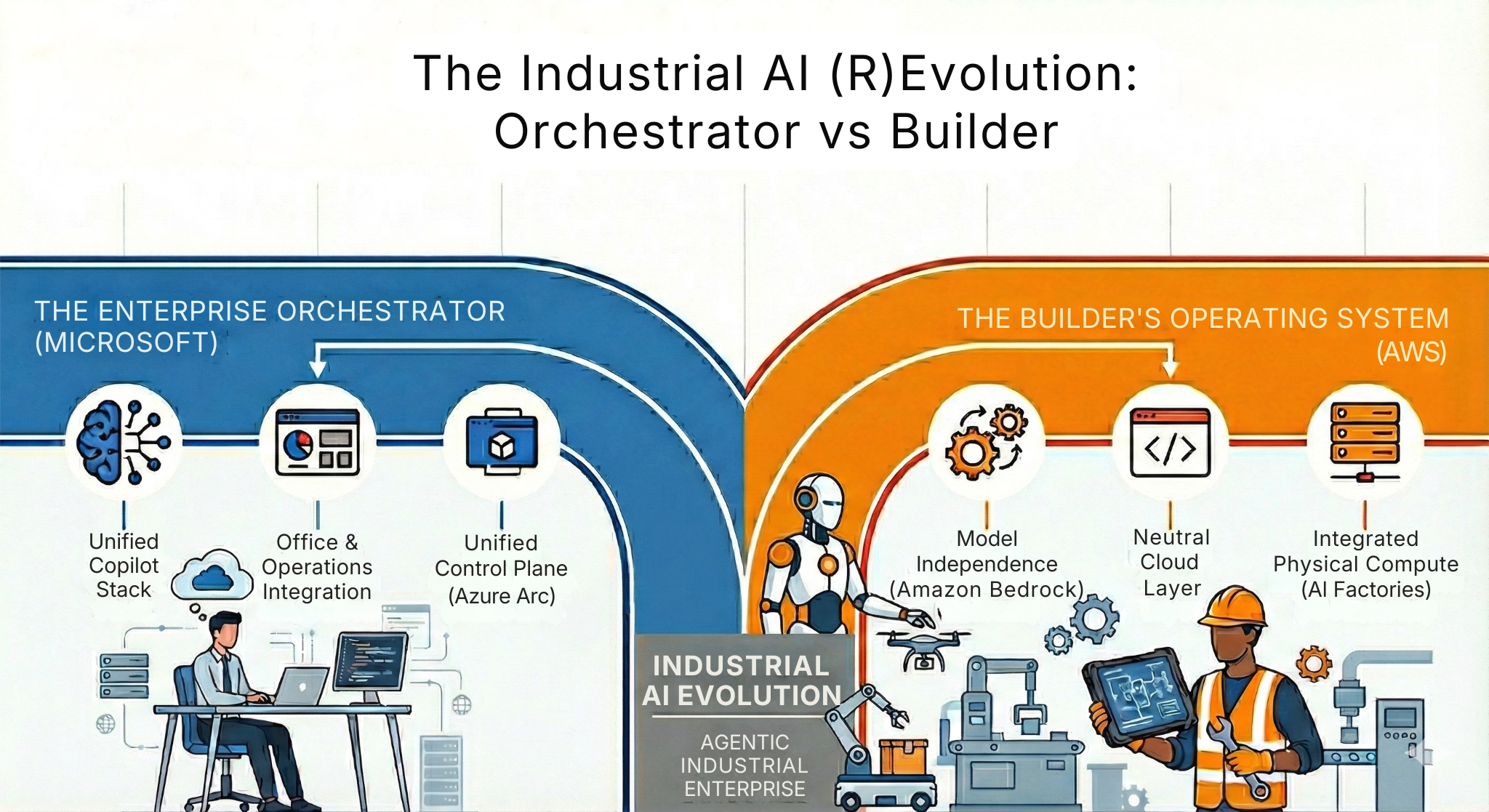
In my recent coverage, including From Co-Pilots to Humanoids and my initial analysis of AWS re:Invent 2025, I emphasized that the industrial landscape is evolving across multiple, concurrent fronts. However, closer analysis of the flurry of announcements from both Microsoft Ignite 2025 and AWS re:Invent 2025 reveals a strategic divergence between these two hyperscalers—one with significant ramifications for Industrial AI.
While both giants are arguably racing toward the same destination—the Agentic Industrial Enterprise—they appear to be taking fundamentally different paths.
We are witnessing a bifurcation of the Industrial Cloud. This raises a fundamental question for industrial CIOs and CDOs: Is your strategy better served by the established Enterprise Orchestrator (Microsoft) or the modern Builder’s Operating System (AWS)?
Here is how the landscape is evolving across four critical fronts.
The first strategic divergence lies in how organizations access intelligence.
Microsoft’s Azure AI Foundry offers access to a wide range of models, including Llama and Mistral. However, the strategic gravity of Redmond is undeniable: the “Golden Path” for Microsoft customers is often Azure OpenAI. Copilots are optimized for GPT-4, and incentives increasingly drive users toward that ecosystem.
AWS, conversely, has embraced a deliberately agnostic approach. With Amazon Bedrock, it offers a broad portfolio of models—Claude, Llama, Mistral, and its own Nova family—without strong pressure to adopt a single provider.
The question for data science leaders is whether they prioritize the ease of a unified, pre-integrated Copilot stack or whether their competitive advantage depends on model independence. As reflected in the AI Pacesetters survey, many successful industrial companies are hesitant to lock into a single “brain.” Instead, they want the right model for the right task—perhaps a cost-effective Nova Lite model for high-volume workloads in the cloud region and a large Claude model for complex reasoning.
Microsoft dominates office productivity and has a massive footprint in enterprise operations. Teams and Outlook function as the operating system of the white-collar world, while Dynamics 365 is a major ERP and CRM platform. This dominance creates a complex dynamic. For industrial software providers such as Salesforce, Workday, and SAP, Microsoft is both a cloud partner and a direct boardroom competitor.
AWS plays a different role. It has no aspirations to sell ERP applications, positioning itself as the “Switzerland” of the industrial cloud. That neutrality does not imply passivity. While AWS does not sell the software, it aims to provide the modern infrastructure required to run ERP systems and the services needed to operate them effectively.
The question for IT leaders is whether a neutral cloud layer—particularly as vendors such as Salesforce (Agentforce) and Workday deepen ties with AWS—offers better long-term flexibility for their application stacks.
Perhaps the most consequential move in the sovereign cloud discussion was the introduction of AWS AI Factories.
While Microsoft champions Azure Local as a software-defined infrastructure managed through Azure Arc, AWS is taking a more physical approach by shipping racks of Trainium UltraServers directly into customer data centers.
This reflects a practical reality for high-stakes manufacturing and defense environments. Hybrid infrastructure is not only about a software control plane; in many cases, it requires purpose-built compute that is tightly integrated into on-premise environments, ensuring data resides exactly where it must.
A significant inflection point occurred with the transition of AWS RoboMaker, effective September 2025. Rather than signaling an exit, this move highlights a stark contrast in how the two hyperscalers approach the industrial edge.
Microsoft is the historical incumbent on the factory floor. Through the long lineage of Windows Embedded and the cloud-enabled Windows IoT, it maintains a vast footprint of legacy devices. Increasingly, however, this ubiquity is viewed as a maintenance burden rather than an innovation driver.
AWS, unencumbered by this legacy operating system heritage, has made meaningful inroads in defining the modern industrial edge. By focusing on raw, scalable infrastructure such as AWS Batch and industrial data connectivity through AWS IoT SiteWise and AWS IoT RoboRunner, it is effectively bypassing operating system debates. The emphasis is on ingesting industrial data and enabling autonomous fleets, while legacy estate management largely remains with Microsoft.
The choice for 2026 is no longer simply about “AWS versus Azure,” but about architectural philosophy.
Consider Microsoft if orchestration is the priority: empowering the workforce through Copilots and governing a fleet of partner-built agents through a unified interface that spans the office and the factory floor.
Consider AWS if differentiation is the priority: building custom Industrial Foundation Models such as Nova Forge, deploying sovereign AI factories on-premise, and engineering agentic workflows that require deep control over the underlying infrastructure of operations.
For ARC Advisory Group recommendations for Navigating the AI Wars—including the Industrial Robot Wars—Closing the Digital Divide by Embracing Industrial AI, assembling your Industrial-Grade Data Fabric, and governing and guiding major decisions about enterprise, cloud, industrial edge, and AI software, please contact Colin Masson at [email protected].
Or set up a meeting with my fellow Analysts and I, at ARC Advisory Group to find out more about our Executive Insights Service for Industrial organizations, and Industrial AI Insights Service for Vendors.