Representative End User Clients







Representative Automation Clients







Representative Software Clients








In Blog 1: The "AI Native" Mirage, we pulled back the marketing curtain to show why wrapping proven procedural solvers into deterministic "Skills" is far smarter than risky greenfield rewrites. In Blog 2: Deconstructing the Stack, we established engineering definitions for Cloud Native vs. AI Native, deconstructed the four-tier hybrid enterprise topology, and examined why external software scaffolding dominates foundation model weights.
Now, as enterprise buyers step back to evaluate candidate platforms across their operations, they quickly discover an inescapable reality: the storyline changes dramatically depending on where you sit in the industrial software stack.
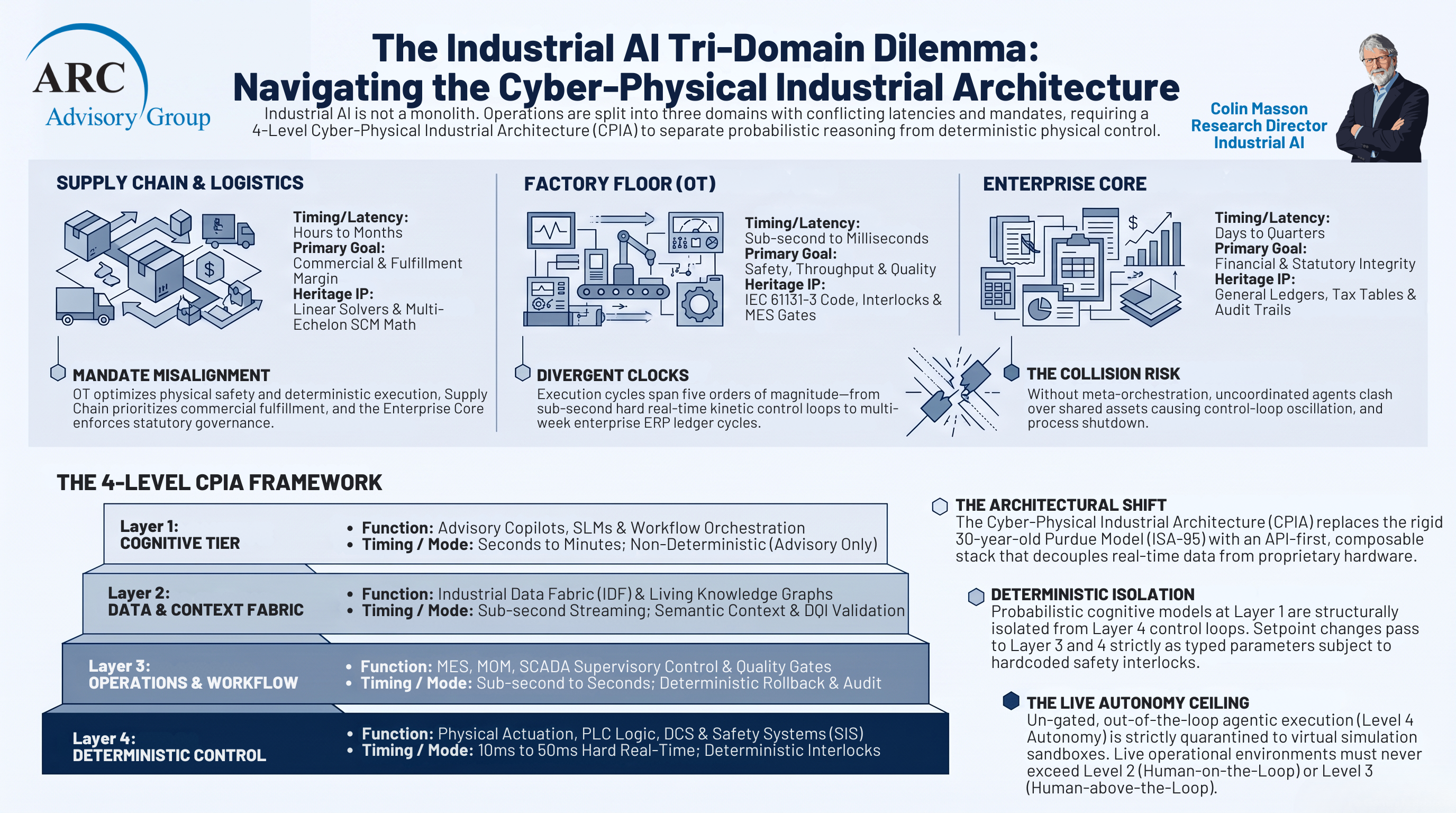
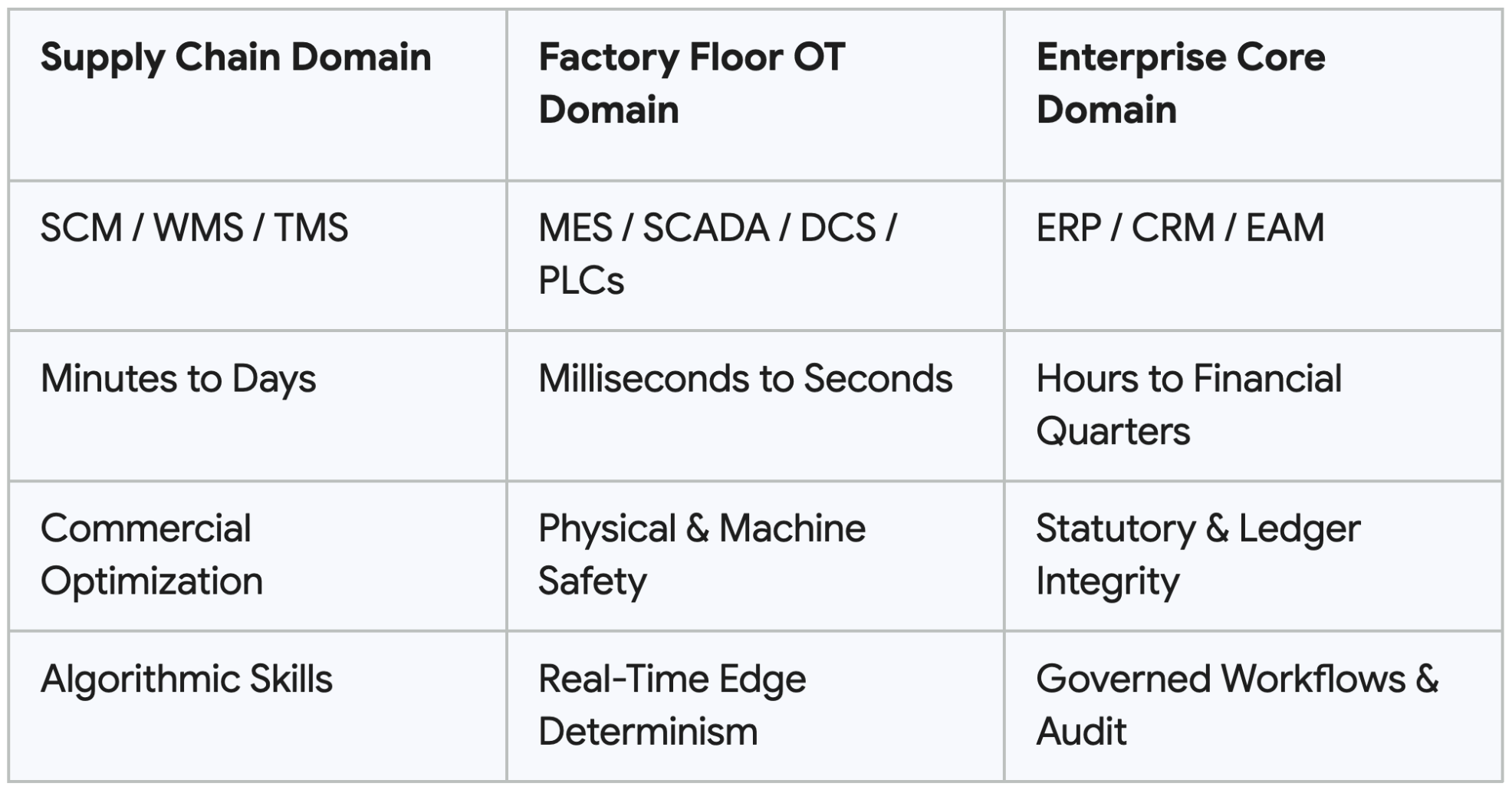
Industrial software is not a monolith. It spans three distinct operational domains, each governed by fundamentally different physics, timing constraints, failure liabilities, and commercial economics:
Before diving into these domains, let’s establish the empirical baseline. ARC Advisory Group research across Industrial Data Fabrics (IDFs), HMI/SCADA modernization, MES/MOM, and Industrial AI points to a consistent conclusion:
Value creation in industrial environments depends far less on foundation model novelty alone, and almost entirely on trusted data quality, contextualized semantics, deterministic execution boundaries, and resilient hybrid edge-cloud architectures.
When enterprise buyers evaluate platforms through this lens, they avoid chasing superficial conversational chat widgets and focus on architectural durability.
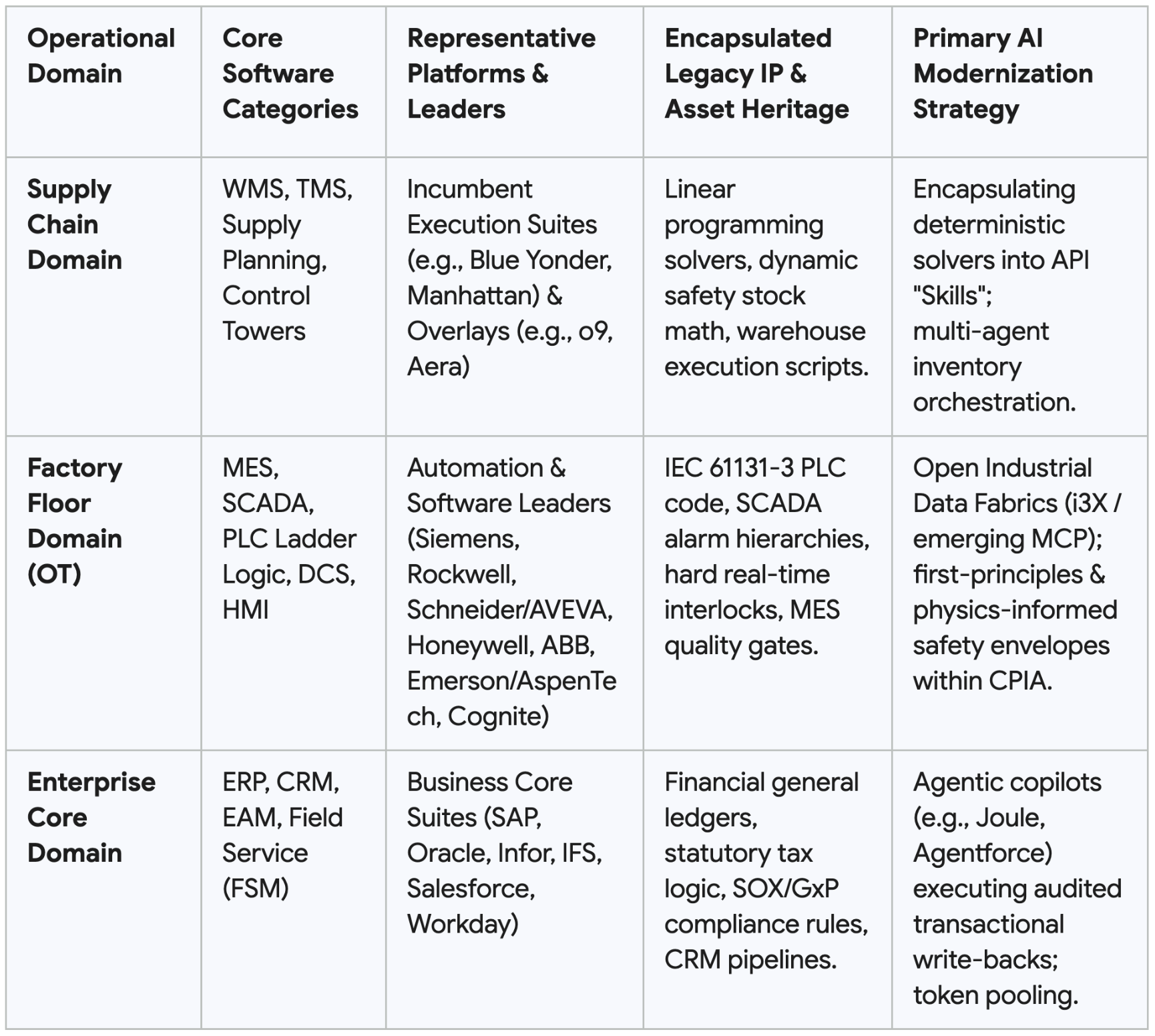
Let's drill deep into how the "AI Native vs. Wrapped Domain IP" debate plays out across each of these three distinct theaters.
In supply chain execution and planning, the core legacy IP consists of thirty years of dynamic safety stock formulas, multi-echelon inventory constraint math, C++ linear programming engines, and high-frequency warehouse execution scripts.
When enterprise buyers look to modernize, they generally navigate a choice between two dominant architectural archetypes: pure-play decision overlays and incumbent execution suites.
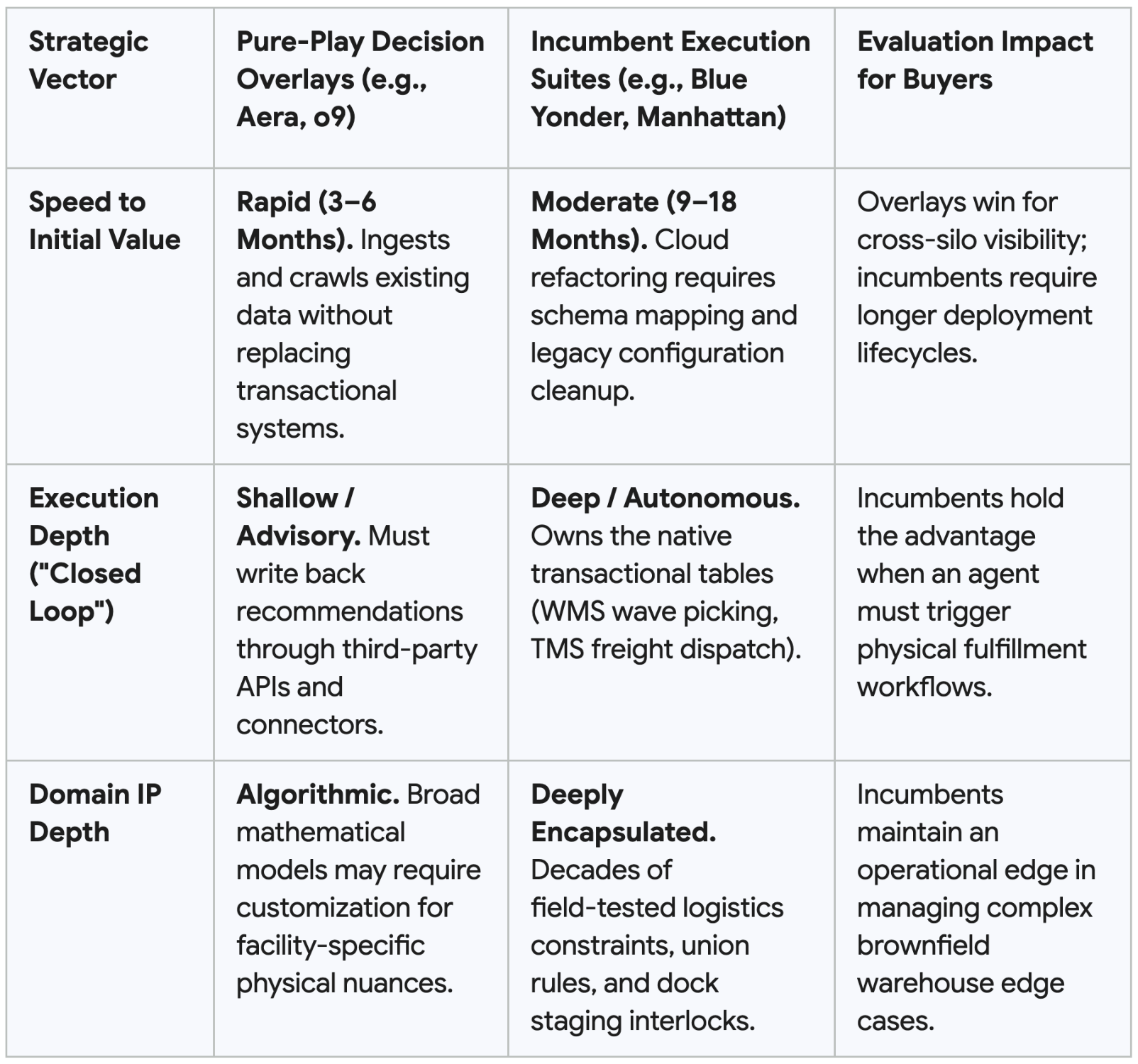
The Supply Chain Trade-off: Pure-play overlays deliver agile, cross-silo decision intelligence without touching underlying transaction code. However, if your operational goal is closed-loop execution—where an AI agent doesn't just suggest reallocating inventory, but directly re-waves a warehouse floor or dispatches a freight carrier at machine speed—incumbent suites that own the underlying execution tables maintain a structural operational advantage.
To understand why the debate between cloud overlays and on-premises execution platforms has become so urgent, buyers must look candidly at balance sheets and network physics.
While frontier labs demonstrate autonomous agents capable of navigating software interfaces, the commercial and physical realities of continuous, cloud-tethered reasoning present severe challenges for manufacturing operations:
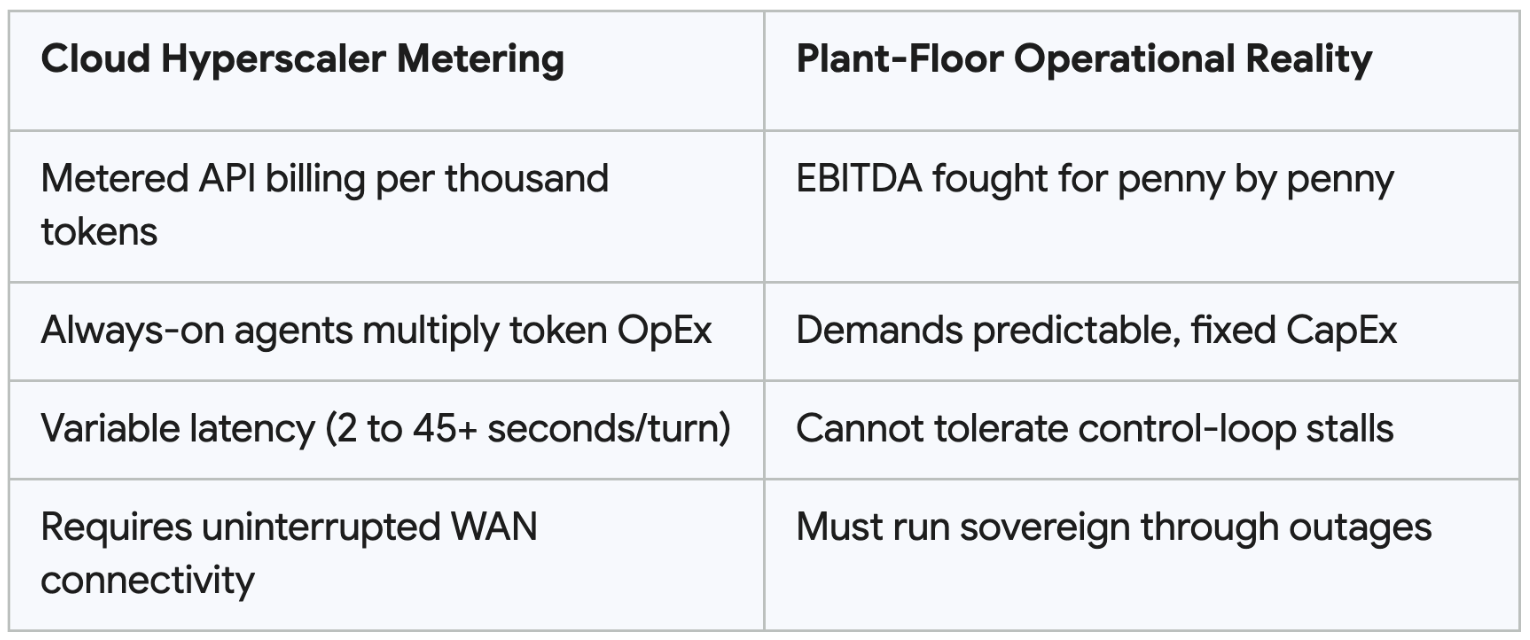
An autonomous agent running extended perception-reasoning loops across complex enterprise software consumes orders of magnitude more tokens than a standard single-turn text prompt. If an industrial enterprise tethers dozens of always-on software agents to cloud-metered endpoints to monitor operational lines, software expense transitions from a predictable software license into a volatile utility bill that scales unpredictably with plant activity.
Even if an enterprise had an unlimited budget to feed the cloud token meter, there is an immutable physical barrier: network latency.
A cloud-hosted reasoning agent communicating across wide-area networks experiences variable round-trip times ranging from several seconds to several minutes per multi-step workflow. While a multi-minute delay may be acceptable for generating a quarterly demand forecast, it is entirely unacceptable for supervising an active manufacturing process.
In manufacturing operations, response profiles must match operational realities:
Control Layer (DCS/PLC/Drives): Hard deterministic execution (typically 10 to 50 milliseconds) where safety-critical logic must remain local and hardwired.
Supervisory & Operations Layer (SCADA/HMI/MES): Near real-time response (sub-second to several seconds) requiring bounded, predictable local processing.
Enterprise Planning Layer (ERP/Supply Chain): Transactional workflows (minutes to hours) where cloud-metered reasoning is commercially viable.
Some platform advocates argue that commercial liability and market discipline are sufficient to enforce AI safety. In consumer digital software or transactional SaaS, a software glitch results in a customer apology, a legal settlement, and an overnight patch.
On the factory floor, a post hoc legal settlement is completely useless.
A legal settlement does not rebuild a compromised chemical distillation column, reverse an environmental discharge, or restore power to an interrupted grid. For physical operations, safety cannot rely on software goodwill or retroactive legal remedies; it demands deterministic execution boundaries and hardwired interlocks.
Before we step onto the factory floor, enterprise architects must confront a terminology trap that periodically resurfaces across industry discussions: the attempt to revive the legacy concept of an all-in-one "industrial data platform."
Twenty years ago, calling a process data historian or an on-premises MES database an "industrial data platform" made operational sense. It was a self-contained software silo that gathered time-series sensor tags from PLCs, compressed them into proprietary flat files, and served them to supervisory engineering consoles.
In 2026, closed monolithic architectures are becoming increasingly difficult to justify.
Why? Because enterprise IT, OT, and ET leaders recognize that no single monolithic software package can simultaneously serve as an edge connectivity broker, a hyperscale analytical repository, an enterprise-wide contextual knowledge graph, and a deterministic real-time execution core.
As ARC has detailed across our research on Assembling Industrial-Grade Data Fabrics, the industry has fundamentally moved from closed monolithic platforms to open, decoupled fabrics:
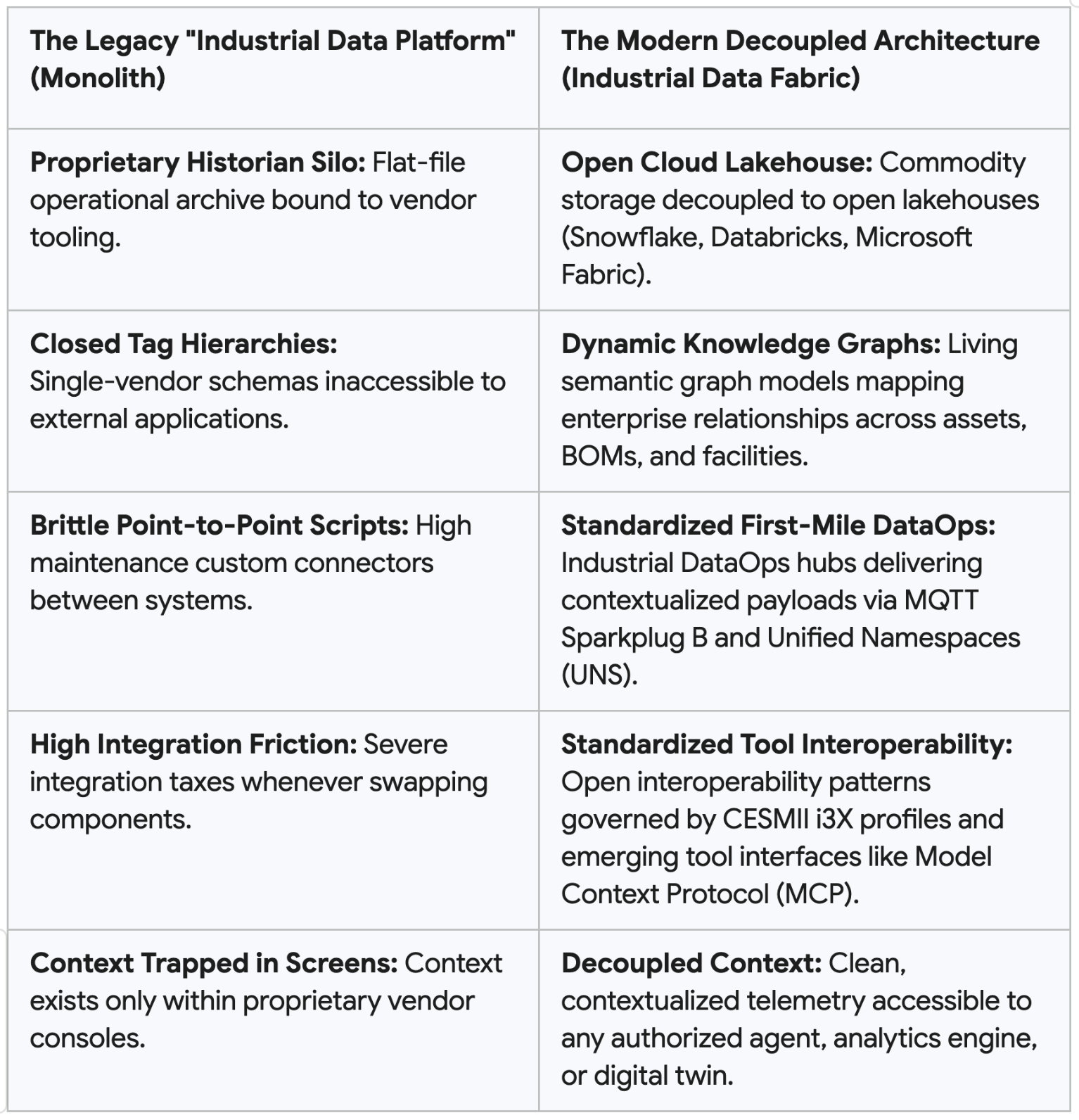
The strongest market evidence that the era of closed platforms has been superseded lies in where the world's leading industrial software innovators are investing capital. Industry pacesetters—including Emerson/AspenTech, AVEVA, Schneider Electric, and Cognite—are actively driving this architectural modernization. Rather than defending legacy, all-in-one platform silos, they have spent years executing aggressive roadmaps that directly validate the necessity of an open, decoupled Industrial Data Fabric:
Emerson and AspenTech: Have strategically decoupled their industrial software portfolios, embedding open interoperability and industrial DataOps into the AspenTech Inmation OT Data Fabric. By integrating first-principles thermodynamic and process modeling through the AspenTech AVA AI industrial platform, Emerson ensures that deep chemical and physical engineering IP is exposed to cloud ecosystems without trapping customers in proprietary storage lock-in.
AVEVA (CONNECT Platform): Rather than attempting a high-risk, ground-up rewrite of proven operational backbones like the PI System and System Platform, AVEVA built CONNECT as an open, cloud-first industrial intelligence platform. CONNECT acts as an abstraction and federation fabric, bringing together time-series telemetry, 1D/2D/3D engineering models, and real-time operations into shared cloud services. Crucially, AVEVA has forged deep strategic alliances with hyperscale data leaders like Microsoft Fabric and Databricks, enabling industrial enterprises to query operational data in place while preserving granular security and context.
Schneider Electric: Has championed open, interoperable automation through initiatives like UniversalAutomation.org (IEC 61499) and the EcoStruxure Automation Expert software architecture. Schneider Electric's software strategy centers on breaking proprietary hardware-software lock-in, enabling plug-and-produce automation where decoupled data flows freely from intelligent motor drives and switchgear to enterprise energy and carbon management systems.
Cognite (Cognite Data Fusion, Atlas AI, & Cognite Flows): Engineered from day one around the thesis that industrial data must be freed from application silos, Cognite established a benchmark for Industrial DataOps. Through its Industrial Knowledge Graph (IKG), Cognite continuously contextualizes messy, high-velocity OT telemetry, P&IDs, 3D CAD meshes, and ERP work orders into a living semantic representation of the physical enterprise. Recognizing that the future belongs to open ecosystems, Cognite has established native alliances with data lakehouse leaders (Microsoft Fabric, Snowflake) while introducing Cognite Flows—an industrial workflow canvas enabling developers to build governed agentic workflows on top of an open data foundation. Furthermore, Schneider Electric's planned acquisition of Cognite reflects the industry's strategic recognition that contextualized data fabrics are central to next-generation industrial software.
When you look across the roadmaps of Emerson/AspenTech, AVEVA, Schneider Electric, and Cognite, the architectural pattern is consistent: they are not selling closed data platforms; they are engineering the open, contextualized connective tissue of the Industrial Data Fabric.
When we move from supply chain planning down to the shop floor, the "AI Native" narrative encounters the harsh, deterministic reality of operational technology (OT). Here, an enormous volume of mission-critical IP is trapped in IEC 61131-3 PLC ladder logic, DCS routines, SCADA alarm hierarchies, HMI screen layouts, and Manufacturing Execution Systems (MES).
For twenty years, IT executives have predicted the demise of MES, calling for it to be replaced by cloud analytics or enterprise ERP. Yet MES has proven to be the ultimate cat with nine lives.
Why? Because manufacturing operations cannot tolerate probabilistic decision latency or network outages in execution-critical paths. If a cloud AI model encounters network jitter during a high-speed assembly, stamping, or batching process, physical machinery breaks, batch runs are ruined, and worker safety may be compromised.
To safely deploy agentic intelligence without breaking shop-floor determinism, ARC Advisory Group articulates this operational reality through the Cyber-Physical Industrial Architecture (CPIA).
The CPIA represents an API-first, composable architectural standard designed specifically to replace the rigid, 30-year-old hierarchy of the Purdue Model (ISA-95). Rather than forcing all plant-floor interactions through sequential, tightly coupled hardware layers, CPIA establishes clean structural boundaries across four operational tiers:
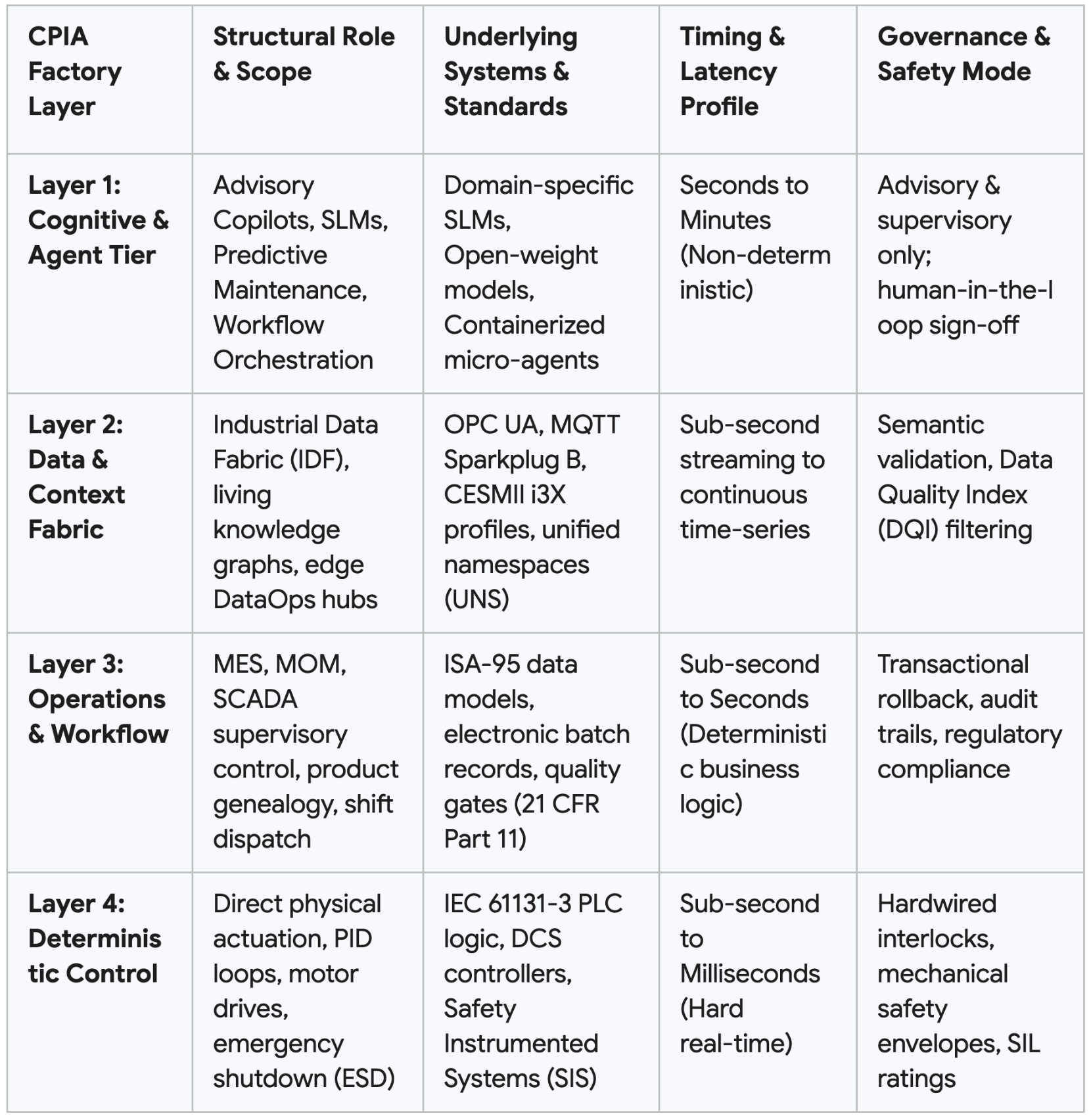
Under the Cyber-Physical Industrial Architecture (CPIA), the relationship between probabilistic AI and physical execution is strictly codified:
Standardized Abstraction at Layer 2: The Industrial Data Fabric provides bottom-up agility. Initiatives like CESMII's i3X and modern edge DataOps platforms wrap raw PLC tags and SCADA registers into standardized, type-safe semantic objects. Higher-level software and AI agents interact with the digital representation of the machine rather than injecting ad hoc code into the PLC.
Context Engineering at Layers 2 & 3: Top-down ontologies and dynamic knowledge graphs contextualize operational events, ensuring that an AI agent querying machine state understands asset relationships, active recipes, and maintenance histories.
Behavioral Corridors at Layers 3 & 4: Cognitive agents operating at Layer 1 are structurally prevented from issuing direct, raw setpoint commands to physical machinery. Instead, agent recommendations are passed to Layer 3 (MES/SCADA) and Layer 4 (PLC/SIS) as typed parameters that must validate against deterministic rules, physical interlocks, and hardcoded safety bounds before actuation occurs.
In the factory domain, the operational landscape is heavily shaped by Industrial Automation titans—such as Siemens, Rockwell Automation, Schneider Electric/AVEVA, Honeywell, ABB, and Emerson. These incumbents hold an extraordinary concentration of physical domain expertise. They understand the nonlinear physics of continuous chemical reactors, the kinematics of multi-axis robots, and the precise timing of high-speed packaging lines.
Crucially, these automation leaders are not sitting idle. They have built sophisticated software, data science, and AI divisions. Rather than attempting the impossible task of replacing battle-tested MES and PLC control loops with probabilistic LLMs, they are executing a disciplined skill-wrapping and data fabric strategy aligned with CPIA:
Standardizing Asset Semantics: Deploying open standards like CESMII's Industrial Information Interoperability Exchange (i3X), OPC UA, and MQTT Sparkplug B to structure legacy PLC and SCADA signals into standardized, contextualized payloads.
Productizing MES Logic as Reusable Skills: Exposing core MES functions—such as "Check material genealogy," "Verify operator certification," "Validate quality gate," or "Trigger maintenance hold"—as deterministic, type-safe tools that higher-level agents can query.
Grounding AI in Physics and Engineering Rules: Fusing machine learning with first-principles models, engineering constraints, physics-informed neural networks (PINNs), and rule-based safety envelopes so that generative assistants cannot suggest setpoints that violate mechanical or thermodynamic safety bounds.
Emerging Interoperability Patterns: Treating specifications like Anthropic's Model Context Protocol (MCP) as an emerging agent-to-tool orchestration pattern—valuable for structuring how cognitive agents invoke software tools, while leaving hard real-time execution to proven industrial protocols.
If a vendor claims to offer a pure "AI Native MES" that completely bypasses local control logic and SCADA networks, treat the claim with healthy skepticism. In physical manufacturing, encapsulated shop-floor physics wrapped as governed Skills beats pure-play cloud AI in most safety- or execution-critical use cases.
When we transition to the Enterprise Core—systems governed by major business application leaders like SAP (Joule), Oracle, Infor, IFS, Salesforce (Agentforce), and Workday—the storyline shifts once again.
In the Enterprise Core, legacy IP is not defined by physical thermodynamics or warehouse wave scripts. It is defined by financial ledgers, statutory compliance rules, tax codes, SOX/GxP audit trails, and complex customer workflow rules.
Enterprise Core Division of Responsibilities
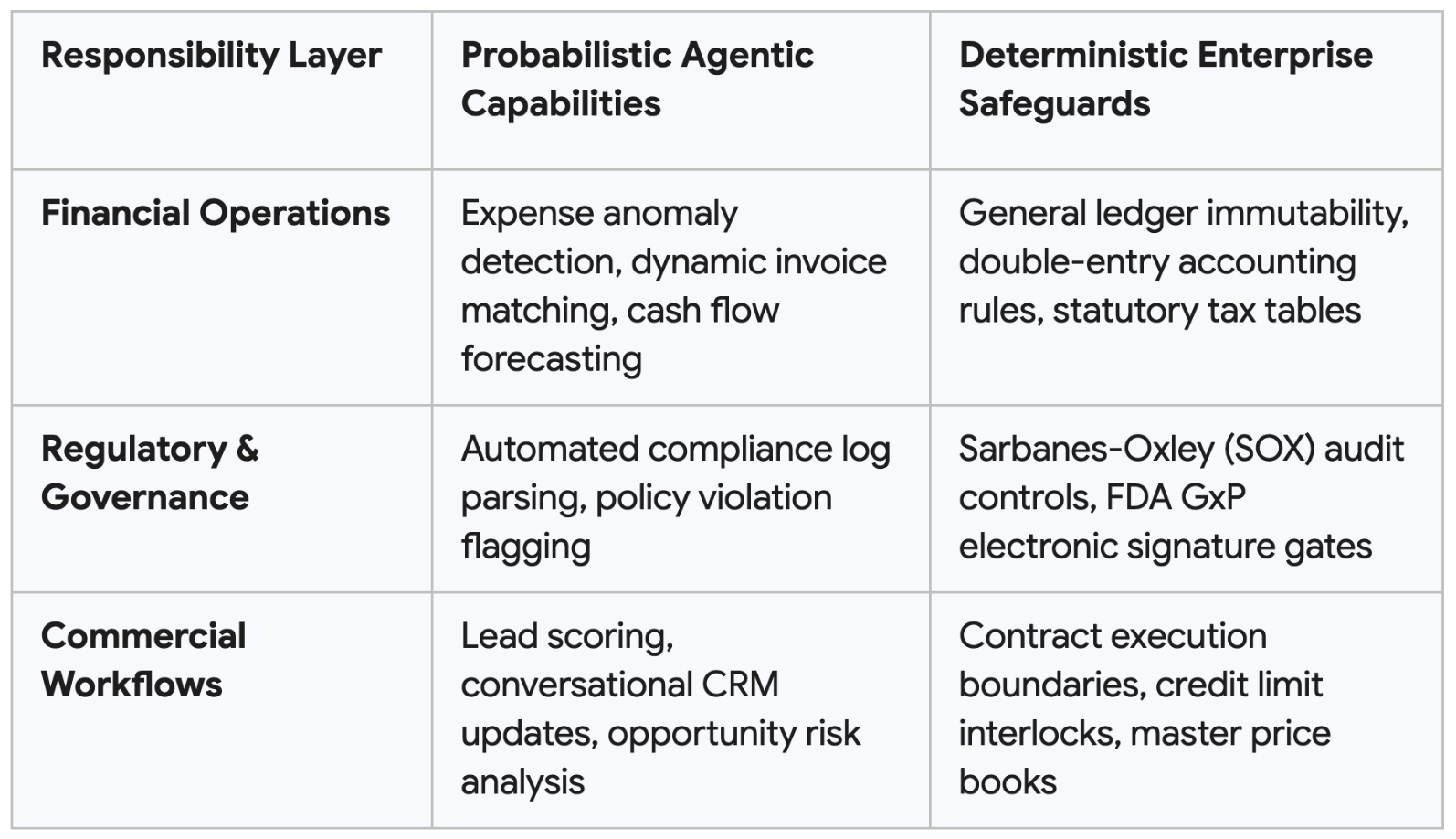
Financial & Regulatory Risk vs. Physical Risk: In factory OT, an ungrounded AI decision causes physical asset damage or safety hazards. In ERP/CRM, an ungrounded AI decision causes financial misstatements, regulatory non-compliance, or corrupted customer master data. Thus, "Skill wrapping" in ERP focuses on enforcing rigid financial control gates and compliance rules before write-backs occur.
The "Agentic Arbitrage" Threat to Seat Licensing: ERP and CRM vendors historically built their business models on per-seat user licensing. The rise of autonomous agents (such as Salesforce Agentforce or SAP Joule) that execute tasks programmatically across backend APIs challenges the traditional seat model. This is driving the market shift toward Autonomous Work Tokens or outcome-based pricing.
Data Uniformity: Unlike the factory floor, where esoteric PLC protocols create significant semantic friction, enterprise ERP/CRM data is highly structured in relational tables. This makes it far easier for cloud-native overlays to ingest ERP data into centralized lakehouses (Microsoft Fabric, Databricks, Snowflake).
The most urgent architectural danger in multi-agent deployment occurs when uncoordinated agents from separate domains clash over the same physical machinery or business workflow:
The OT Reliability Mandate: An asset performance management (APM) agent reads vibration telemetry on a boiler feed pump, detects early bearing wear, and autonomously initiates a script to derate the motor by 30 percent to extend life until the weekend shift.
The Commercial Fulfillment Mandate: Simultaneously, an ERP Supply Chain Fulfillment agent detects a high-penalty customer delivery deadline, optimizes schedule throughput, and commands the line to overdrive that exact pump to 105 percent capacity!
Without deterministic meta-orchestration, the two agents wage an invisible, high-speed war across supervisory control layers, driving control-loop oscillation, valve fighting, cavitation, and severe equipment damage or unstable operating conditions. This illustrates why cross-domain arbitration must be governed by deterministic protocols rather than unconstrained agency.
When evaluating vendor pitches and cross-domain AI platforms, use this diagnostic checklist to ensure your architectural foundation is solid:
Autonomy Scope & Operational Level: Is the proposed AI use case advisory (Level 1), supervisory (Level 2), or closed-loop (Level 3)? Does the vendor clearly respect that Level 4 autonomy belongs strictly in virtual digital twin sandboxes?
System of Record & Write-Back Ownership: Which system owns the transactional write-back? Does the AI agent call a deterministic, type-safe "Skill" bounded by hardcoded business rules, or is it executing probabilistic code on the fly?
Latency & Deterministic Timing: What are the timing requirements of the target workflow? Does the architecture isolate real-time kinetic control loops (sub-second to millisecond local execution) from cloud-tethered reasoning hops?
Contextualization & Data Decoupling: Does the platform require copying all operational data into a proprietary cloud store, or does it natively query an open Industrial Data Fabric (IDF) with living semantic knowledge graphs?
CPIA Alignment & Cross-Domain Arbitration: How does the solution partition probabilistic reasoning from deterministic control loops across the CPIA layers? When an APM agent and an ERP fulfillment agent generate conflicting setpoints for the same physical asset, what deterministic meta-orchestration engine arbitrates the dispute?
Cost Governance & Inference Economics: How are runtime costs managed as agentic task loops scale? Are continuous, high-frequency execution loops running on unmetered edge iron, or are you exposed to unpredictable cloud API token billing?
Now that we have navigated the technical trade-offs across Supply Chain, Factory Operations, and Enterprise Ledgers—and established the necessity of open Industrial Data Fabrics and CPIA alignment—we must confront the ultimate variable in the industrial autonomy equation: human capital.
Up Next in Blog 4: "AI Skills vs. Human Skills—Navigating the Demographic Cliff, Headless Firms, and Synapse Workers." We will step into the boardroom to address labor substitution and the demographic cliff. We will analyze the "junior hollowing" crisis that threatens the engineering talent pipeline, map Henry Mintzberg’s bureaucracy breakdown into Phanish Puranam’s "Headless Enterprise," examine the historical parallel between 1990s Object Brokers and modern Agentic Orchestrators, and show how capturing tribal IP into reusable software Skills elevates frontline personnel into strategic Synapse Workers.
The Industrial AI (R)Evolution is moving faster than ever. To dive deeper into the frameworks and data shaping the future of the industrial sector, explore my latest research:
Navigating the AI Wars and the escalating Industrial Robot Wars
Closing the Digital Divide by Embracing Industrial AI
Assembling your Industrial-Grade Data Fabric
Charting the new frontier of Physical Intelligence and transitioning to a Cyber-Physical Industrial Architecture (CPIA)
Mapping your maturity and strategy with ARC's 3-Axis Industrial AI Models Taxonomy
Surviving the SaaSpocalypse and Taming the Tokenpocalypse by Mastering Multi-Agent Industrial Governance
Organizational Design and the Future of Industrial Work in the era of Agentic AI
Take our Industrial AI Assessment to benchmark your organization's maturity, identify critical gaps in your IT/OT/ET convergence, and get actionable recommendations to accelerate your path to becoming an Industrial AI Pacesetter (and download the 2026 Report). If you think you’re already a Pacesetter, nominate your team for the ARC Industrial Pacesetters Awards!
Don't guess what your global operations or prospective customers need. Use empirical data to align your stakeholders and de-hype the market with ARC Advisory Group's Voice of Market Service.
For tailored recommendations on governing and guiding major people, process, and technology decisions across the enterprise, cloud, industrial edge, and AI, please contact Colin Masson at [email protected].
Or, set up a meeting with my fellow Analysts and I at ARC Advisory Group to find out more about our Executive Insights Service for Industrial organizations and our Industrial AI Insights Service for Vendors.