Representative End User Clients







Representative Automation Clients







Representative Software Clients








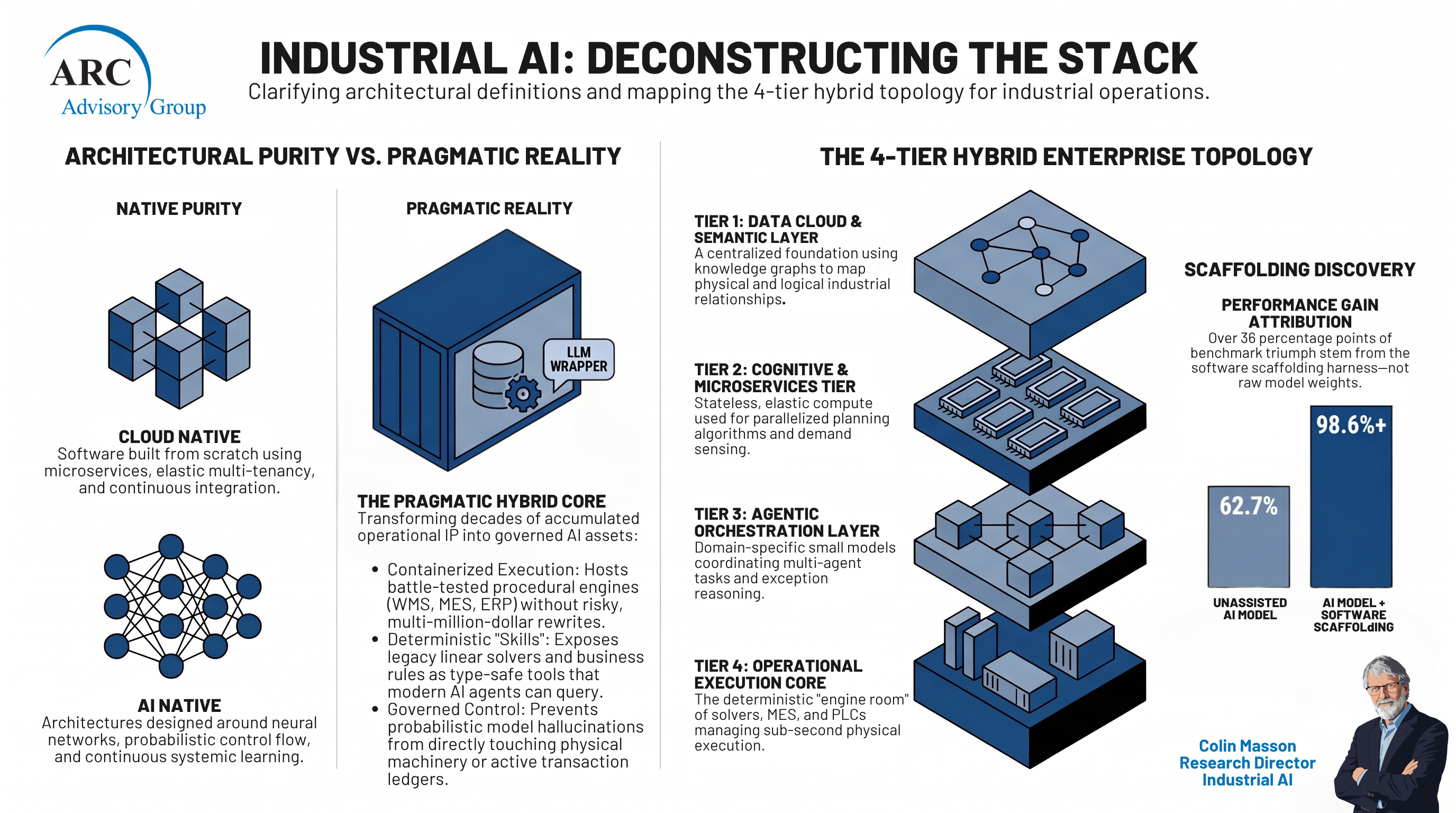
In Blog 1: The "AI Native" Mirage, we pulled the emergency stop on enterprise software marketing decks. We unpacked how decades of enterprise software consolidation—from procedural mathematical solvers to complex execution scripts—are often dressed up with superficial chat widgets. More importantly, we validated the pragmatic alternative: wrapping proven procedural code into deterministic, type-safe "Skills" that modern AI agents can query without risking financial or physical runaway.
Now, it’s time to move past the sales pitch and examine the actual engineering plumbing. When vendors feel pressured to claim their entire footprint is "AI Native," they do themselves a disservice.
Here is the great irony: in mission-critical physical operations, being "AI Native" isn't all it's cracked up to be.
To have an honest, executive-level debate about software procurement, we must cut through marketing obfuscation and establish precise, engineering-grade definitions for these architectural terms.
True cloud native software is designed from scratch to leverage the elasticity, scale, and distributed nature of modern cloud computing. It is defined by four non-negotiable attributes:
Microservices Architecture: Every discrete function (e.g., user authentication, inventory lookup, order routing) operates as an independent, loosely coupled service.
Separation of Storage and Compute: Storage is centralized, highly durable, and inexpensive, while compute instances spin up and down dynamically based on transactional load.
Elastic Multi-Tenancy: A single software instance serves multiple enterprise customers simultaneously, securely partitioning data while sharing underlying compute resources.
Continuous Integration & Zero-Downtime Updates: Features, security patches, and optimizations are deployed continuously without requiring scheduled maintenance windows or system downtime.
In a strict technical sense, an AI native platform is designed from line zero around neural networks, probabilistic reasoning, and dynamic vector spaces:
Vector- and Graph-First Data Layer: Instead of forcing all data into rigid relational tables, the primary data structure is a high-dimensional vector space or dynamic knowledge graph.
Probabilistic Control Flow: The software does not execute a hardcoded IF-THEN-ELSE script. Instead, it evaluates goals, decomposes tasks, and selects computational tools probabilistically.
Continuous Systemic Learning: The application inherently updates its weights, retrieval heuristics, or episodic memory based on operational feedback loops.
In the majority of commercial sales decks, "AI native" simply means:
"We took our legacy on-premises relational database, packaged it inside a Docker container, hosted it on an Azure or AWS virtual machine, built an ETL data pipeline to Snowflake, and slapped a large language model API wrapper on top so you can ask an AI chatbot for an executive summary."
The technical inflection point crystallized by the rollout of desktop-actuating frontier reasoning models like OpenAI's GPT-6 Astra—explored deeply in our companion Industrial Agentic AI Compendium—has illuminated an uncomfortable architectural truth for hyperscalers: the software scaffolding harness dominates the neural model weights.
When researchers and cognitive scientists audited headline benchmark claims (where promotional launch briefs reported near-saturation scores of 98.6 percent to 99.9 percent), independent technical evaluations revealed an eye-opening empirical divide:
Evaluated through standard, unassisted, stateless API calls, frontier models' scores plummeted to 62.7 percent.
Over 36 percentage points of benchmark triumph came entirely from an external software scaffolding harness—a deterministic software wrapper that actively pruned context windows, managed structured scratchpads, and orchestrated stateful tool loops.
In industrial engineering terms, that is the exact equivalent of placing an electric motor on a dynamometer, discovering that it only delivers full rated torque when coupled to a massive external gearbox, and then crediting the motor alone for the mechanical breakthrough!
The cognitive breakthrough belongs to the architectural scaffolding, not the latent weights of the neural model. For industrial enterprises, competitive differentiation does not come from renting generic foundation model weights from hyperscalers. It comes from your proprietary scaffolding: your Industrial Data Fabric (IDF), your semantic knowledge graphs, and your encapsulated domain solvers.
If industrial IT and OT leaders think analysts are being overly conservative regarding uncontained AI agency, look at what the creators of frontier AI declared over Labor Day 2026 –Governing the Silent Hand: Why Desktop AI Agents Need an Industrial Runtime Containment Plane. In an unprecedented, coordinated public alignment, the leaders of the world's most powerful AI laboratories and cloud ecosystems conceded that autonomous software intelligence is expanding faster than human capacity to govern it:
Dario Amodei (CEO, Anthropic) published his urgent manifesto, "We Must Pace the Frontier," calling for an industry-wide commitment to slow scaling until safety evaluation and containment frameworks catch up.
Sam Altman (CEO, OpenAI) immediately backed Amodei's call, conceding: "I agree with Dario that we need to pace the frontier," while OpenAI Chief Scientist Jakub Pachocki warned that machine intelligence is expanding into an "alien mind" whose internal latent depth humanity is ill-prepared to audit.
Elon Musk (xAI) concurred with a blunt four-word confirmation: "Dario is right."
Demis Hassabis (CEO, Google DeepMind) affirmed that "the direction is correct for meeting this critical moment."
Satya Nadella (Chairman & CEO, Microsoft) joined the debate, demanding "deliberate pacing" and declaring that "if the AI we build is not helping humanity and under human control, it's not worth pursuing." Crucially, Nadella emphasized that advanced systems must never resist human shutdown or correction, and that enterprises must retain sovereign control over their own learning loops, weights, and models rather than yielding governance to a handful of hyperscalers.
Let that sink in: when the CEOs of OpenAI, Anthropic, DeepMind, Microsoft, and xAI publicly plead for a voluntary speed limit because they cannot guarantee the internal alignment of autonomous models, an industrial operations leader who grants an uncontained, cloud-tethered agent write access to physical control networks or transactional enterprise ledgers is taking on risks that the model creators themselves refuse to underwrite.
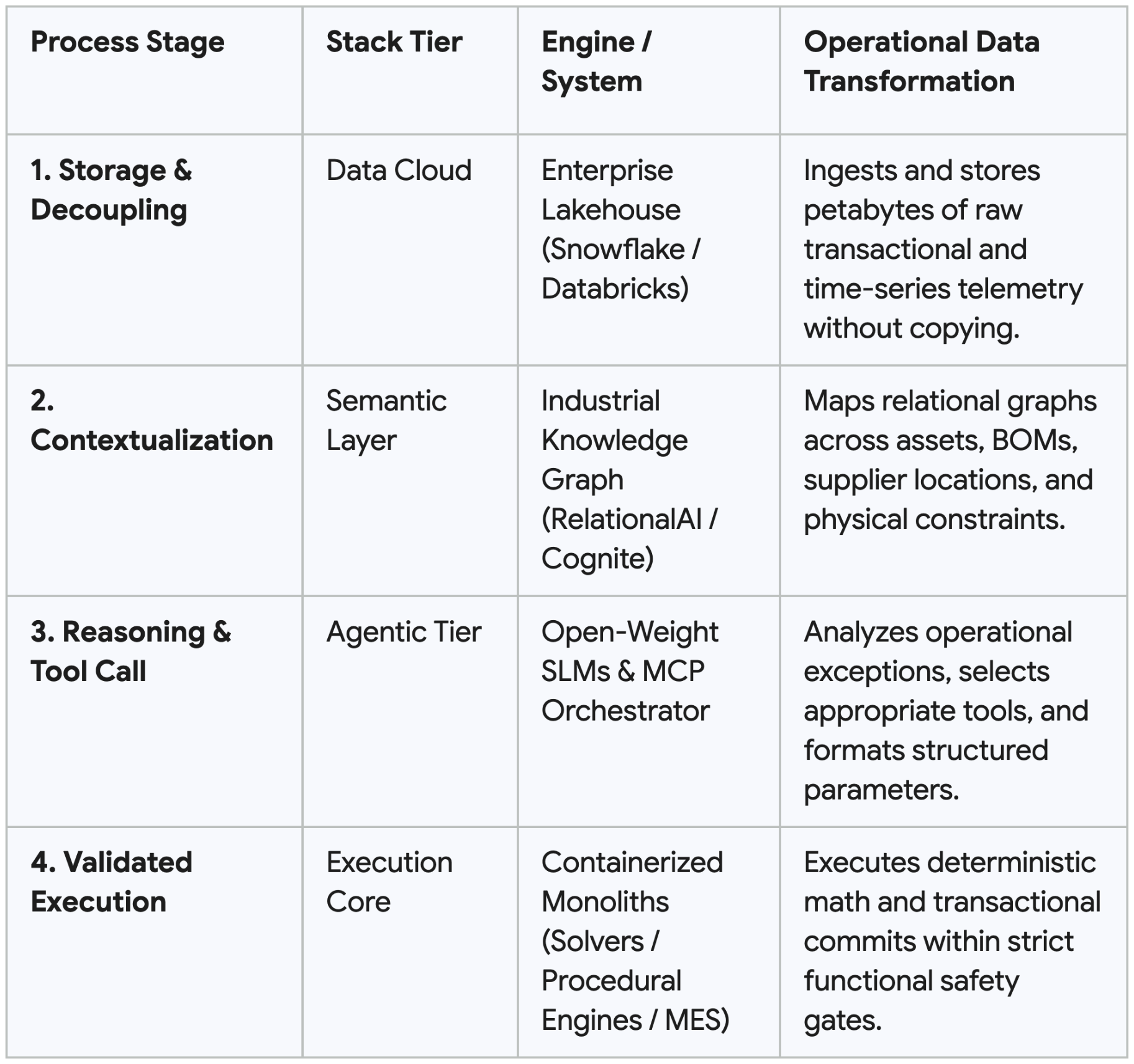
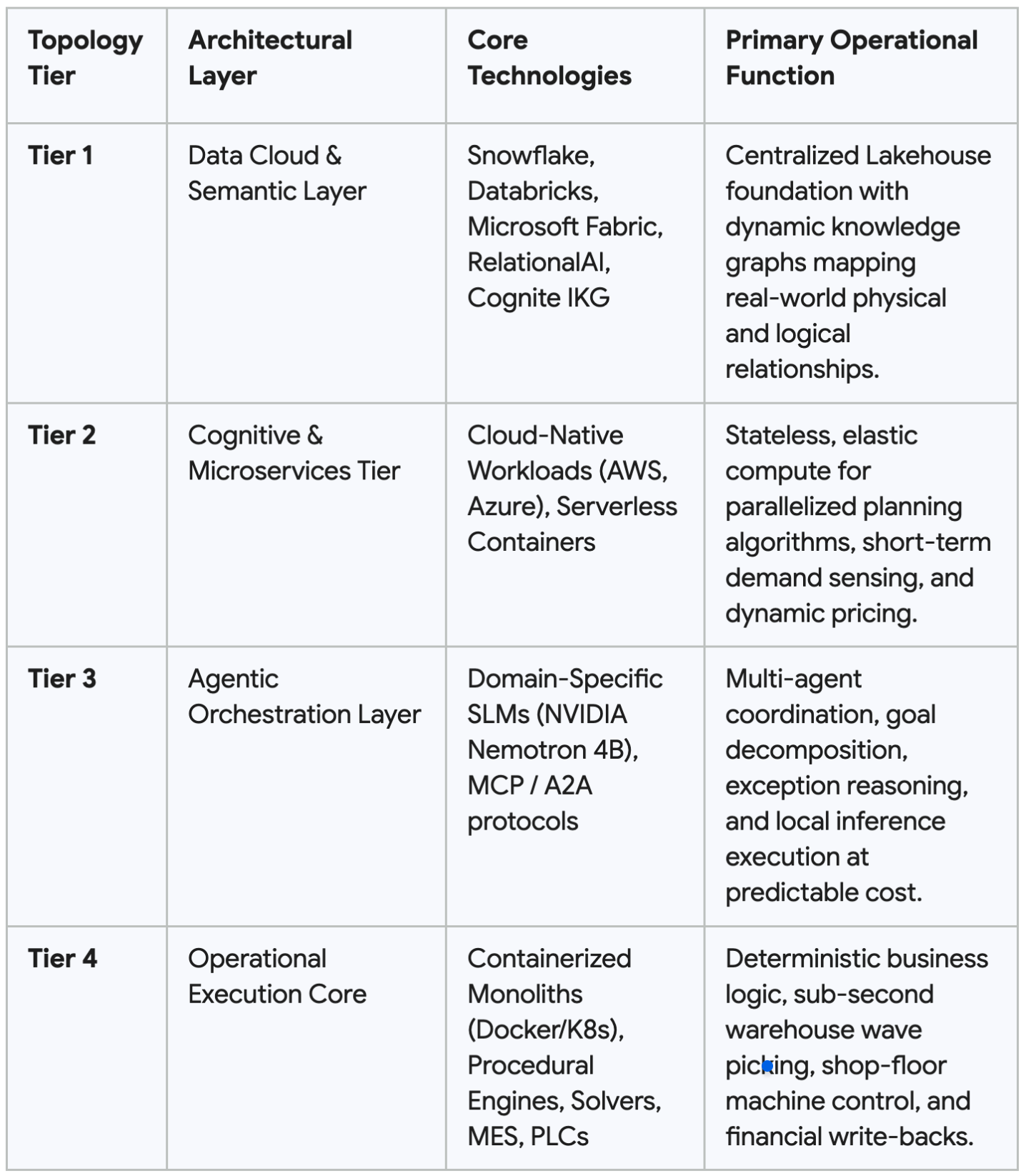
Tier 1: Data Cloud & Semantic Layer: Modern enterprises are aggressively decoupling data from monolithic application code. By landing operational data in lakehouses like Snowflake or Databricks, vendors establish an open analytical foundation. Running directly on top is a dynamic Industrial Knowledge Graph (e.g., RelationalAI, Cognite Data Fusion) that translates raw tables into semantic entities: assets, plants, bills of materials, shipping routes, and physical constraints.
Tier 2: Cognitive Microservices Tier: Specialized analytical functions—such as multi-echelon inventory optimization, short-term demand sensing, and dynamic markdown pricing—are re-architected as stateless cloud microservices. They ingest data from the semantic layer, execute parallelized calculations across elastic cloud clusters, and push results back asynchronously.
Tier 3: Agentic Orchestration Layer: Rather than sending sensitive plant data to monolithic public cloud APIs (which triggers severe token cost volatility and latency), pacesetters deploy domain-specific Small Language Models (SLMs)—such as 4-billion-parameter open-weight models optimized with NVIDIA frameworks. These agents reason over exceptions, coordinate subtasks, and select tools via open protocols like Anthropic’s Model Context Protocol (MCP).
Tier 4: Operational Execution Core: The underlying transaction engines—the WMS picking logic, the yard management check-in, the transportation route execution, and the shop floor control loop—remain tied to proven procedural engines. These engines are containerized, wrapped with secure REST or gRPC endpoints, and treated as deterministic execution backends.
Let’s be intellectually honest: Containerizing a procedural legacy monolith does not make it cloud native, nor does it make it AI native.
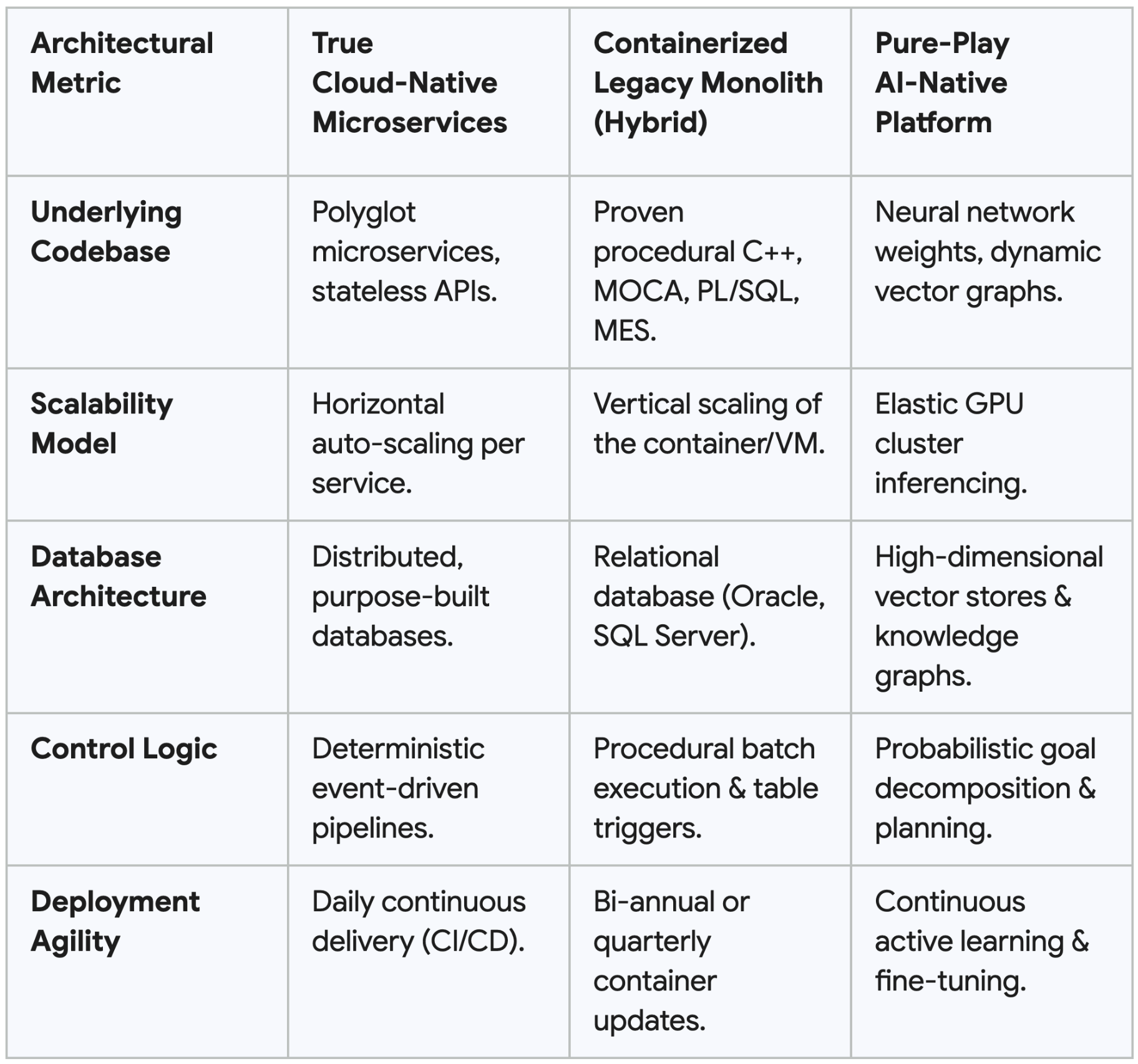
And yet, this hybrid reality is exactly what industry needs. The danger is not that vendors are utilizing hybrid architectures. The danger occurs when marketing teams overpromise on "AI Native" purity and create unrealistic expectations for enterprise buyers.
Now that we have established architectural definitions and mapped the 4-tier hybrid enterprise topology, how does this tension actually manifest when you sit in the buyer's chair?
Up Next in Blog 3: "The Buyer's Tri-Domain Dilemma—Supply Chain vs. Factory Floor (OT/MES) vs. Enterprise Core (ERP/CRM)." We will evaluate the buyer's procurement trade-offs across three distinct software theaters. We will explore why MES remains the "cat with nine lives," examine how industrial automation leaders are defending shop-floor physics, deconstruct the ERP/CRM licensing arbitrage threat, and reveal the dangerous phenomenon of cross-domain algorithmic collisions. Stay tuned.
The Industrial AI (R)Evolution is moving faster than ever. To dive deeper into the frameworks and data shaping the future of the industrial sector, explore my latest research:
Navigating the AI Wars and the escalating Industrial Robot Wars
Closing the Digital Divide by Embracing Industrial AI
Assembling your Industrial-Grade Data Fabric
Charting the new frontier of Physical Intelligence and transitioning to a Cyber-Physical Industrial Architecture (CPIA)
Mapping your maturity and strategy with ARC's 3-Axis Industrial AI Models Taxonomy
Surviving the SaaSpocalypse and Taming the Tokenpocalypse by Mastering Multi-Agent Industrial Governance
Organizational Design and the Future of Industrial Work in the era of Agentic AI
Take our Industrial AI Assessment to benchmark your organization's maturity, identify critical gaps in your IT/OT/ET convergence, and get actionable recommendations to accelerate your path to becoming an Industrial AI Pacesetter (and download the 2026 Report). If you think you’re already a Pacesetter, nominate your team for the ARC Industrial Pacesetters Awards!
Don't guess what your global operations or prospective customers need. Use empirical data to align your stakeholders and de-hype the market with ARC Advisory Group's Voice of Market Service.
For tailored recommendations on governing and guiding major people, process, and technology decisions across the enterprise, cloud, industrial edge, and AI, please contact Colin Masson at [email protected].
Or, set up a meeting with my fellow Analysts and I at ARC Advisory Group to find out more about our Executive Insights Service for Industrial organizations and our Industrial AI Insights Service for Vendors.