Representative End User Clients







Representative Automation Clients







Representative Software Clients








Pharmaceutical manufacturing is under growing pressure to improve efficiency, quality, and resilience while operating within some of the most stringent regulatory frameworks of any industrial sector. As digitalization efforts mature, manufacturers are increasingly evaluating where Industrial AI can deliver tangible value across production, quality, and asset management—without compromising compliance. As Industrial AI adoption accelerates, it is also increasingly important to stop “AI washing.” Grouping a GxP-compliant pharmaceutical agent and a consumer chatbot under the same label is not just inaccurate—it is one of the primary reasons organizations remain trapped in pilot purgatory.
Unlike AI adoption in less regulated industries, pharmaceutical manufacturers are approaching these technologies with caution. GxP requirements, validation and qualification cycles, and strict data integrity expectations mean that explainability and auditability are non-negotiable. As Colin Masson recently outlined in ARC’s discussion of a developing three-axis taxonomy of Industrial AI in From Co-Pilots to Humanoids: Mapping the Entire Industrial AI Battlefield, regulated industries such as pharmaceuticals represent a proving ground for higher levels of intelligence maturity. For pharmaceutical manufacturing, the distinction is binary: an L2 “industry-aware” model may retrieve a procedure or flag an anomaly, but only an L4 “regulated” agent can participate in signing off a batch record. In this environment, the AI model itself is merely an ingredient; the true product is the governance platform and the immutable audit trail that enables validated, GxP-compliant decisions.
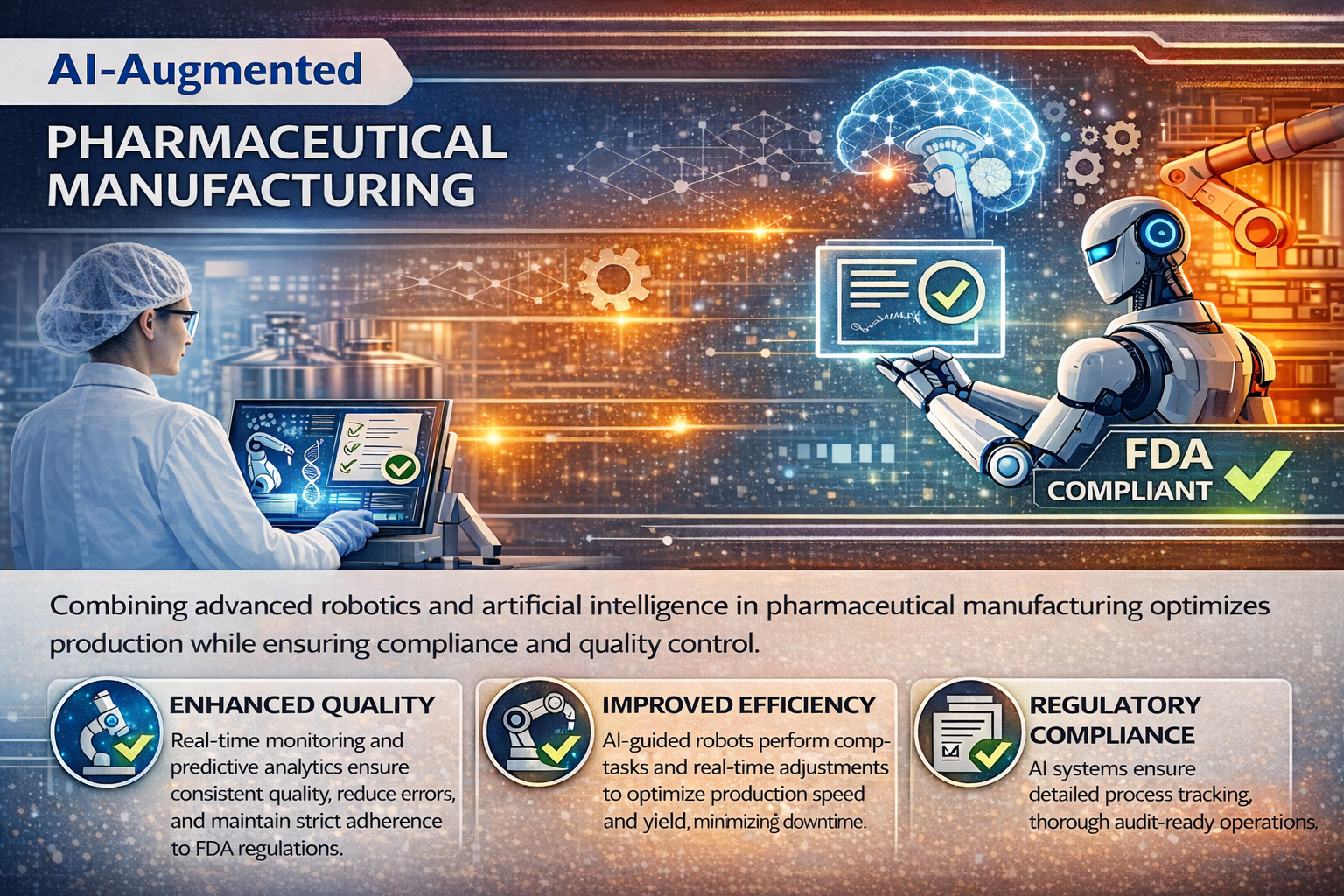
As a result, early Industrial AI deployments in pharmaceutical manufacturing remain focused on tightly bounded use cases. Common applications include anomaly detection in critical process parameters, predictive maintenance for high-value assets, yield and throughput analysis in batch operations, quality trend monitoring, and optimization of utilities and energy usage. These deployments support the Augmented Engineer model, where AI assists qualified personnel rather than replacing them, ensuring accountability remains clearly defined in regulated operations.
ARC’s research on manufacturing systems in regulated industries points to similar operational constraints. Studies covering pharmaceutical manufacturing execution systems (MES-P) highlight the added complexity associated with batch management, electronic batch records, and validation requirements. Related research on quality management systems (QMS) underscores the importance of structured deviation handling, traceability, and data integrity. In contrast, medical device manufacturers typically align more closely with discrete manufacturing models, often reflected in different MES requirements. Across life sciences manufacturing, however, the need for tightly integrated production and quality systems remains a consistent theme.
Existing automation and MES infrastructure continues to play a central role in enabling Industrial AI at scale. Reliable instrumentation, control systems, historians, and contextualized production data are foundational requirements. Escaping pilot purgatory requires more than isolated analytics projects; it depends on assembling an industrial-grade data fabric that provides a single version of the truth across IT, OT, and engineering technologies. ARC’s 2025 Industrial AI Pacesetter Survey, discussed in From Insight to Action: Where Do You Stand in the Industrial AI Race?, highlights that organizations able to scale AI treat this data foundation as a long-lived operational asset rather than a temporary integration layer. By assembling an industrial-grade data fabric, pharmaceutical manufacturers are not simply cleaning data; they are building a proprietary data moat. Their validated P&IDs, SOPs, and historical batch records become context fuel that general-purpose AI cannot replicate, creating a durable advantage in manufacturing excellence.
This difference in approach is also reflected in how organizations view the role of AI in the workforce. ARC’s 2025 Industrial AI Pacesetter Survey highlights a widening divide between Leaders and Laggards. While Laggards continue to apply AI primarily for cost reduction, Leaders prioritize workforce augmentation to address growing skills gaps. Successful pilots are therefore shifting from “Digital Workers” who use AI tools to ARC Synapse Workers™—an emerging class of professionals who collaborate with digital teammates. In pharmaceutical manufacturing, this most often manifests as the Augmented Engineer, where AI absorbs the massive cognitive burden of batch data reconciliation and documentation, allowing human experts to focus on high-risk deviations, judgment, and accountability.
As these capabilities mature, manufacturers are also recognizing that scaling Industrial AI in regulated environments requires a shift in discipline. The challenge is no longer improving prompt engineering, but mastering context engineering. Recent ARC analysis, outlined in Industrial AI Needs Context Engineers, Not Prompt Engineers, emphasizes the importance of grounding AI agents in the validated state of the factory, including SOPs, P&IDs, batch records, and real-time operational context. In pharmaceutical manufacturing, this discipline is essential to eliminating hallucinations and enabling AI systems to function as validated teammates rather than probabilistic tools.
Governance and lifecycle management remain central throughout this journey. AI models deployed in regulated manufacturing environments must be validated, version-controlled, and managed as long-lived assets. Changes to models, training data, or operational scope can trigger revalidation requirements, adding complexity compared with traditional analytics. These realities continue to shape deliberate, risk-aware adoption strategies across the sector.
From ARC’s perspective, Industrial AI adoption in pharmaceutical manufacturing will continue to progress incrementally. The sector’s regulatory rigor makes it a definitive testing ground for regulated, certified intelligence. Success will depend less on algorithmic novelty and more on disciplined integration across automation systems, data architecture, workforce models, and quality governance. Manufacturers that align AI initiatives with these foundations will be best positioned to move beyond pilots and achieve sustained operational value.