Representative End User Clients







Representative Automation Clients







Representative Software Clients








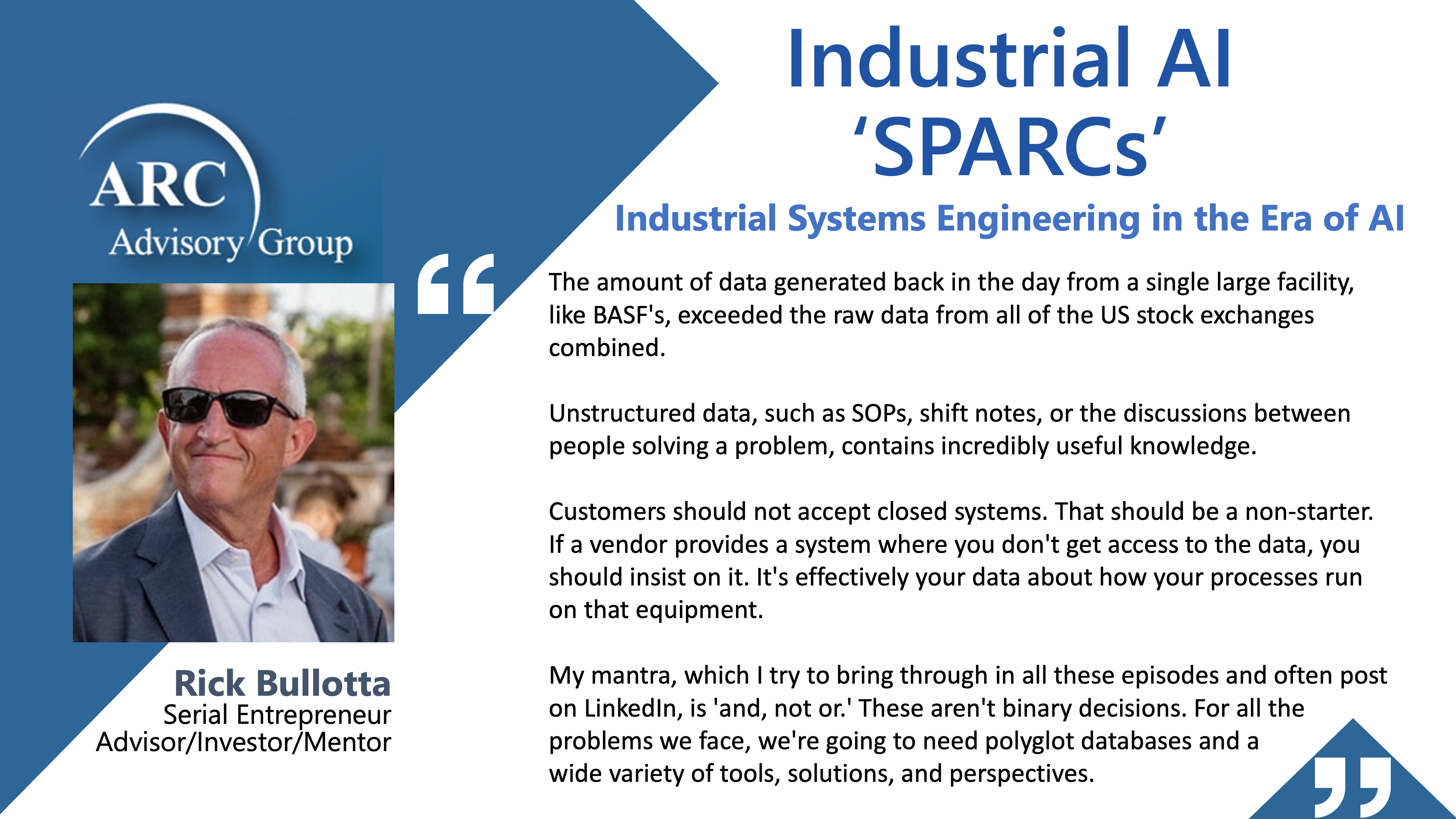
Welcome to the first post in a new blog series where I, Colin Masson, Director of Research for Industrial AI at ARC Advisory Group, share insights from my ongoing conversations with industry veteran Rick Bullotta.
Our theme? Unpacking the challenges and opportunities of Industrial Systems Engineering in the Era of AI.
For those unfamiliar with Rick, he's a heavyweight in the industrial tech world. As co-founder of Lighthammer (which became SAP MII) and ThingWorx (acquired by PTC), Rick has been a driving force in connected systems, digital transformation, and intelligent automation.
I’ve long considered him a serial entrepreneur, trusted advisor, and one of the sharpest minds in industrial AI—especially where data and operations converge in advanced manufacturing.
In our first conversation (which this blog draws from), we explored the core data challenges Rick has tackled over the decades—from connecting early factory systems to navigating the rise of Industrial IoT and the evolving role of industrial data.
You don't just have to read about our conversations; you can also listen in! Our discussions will be available on:
We kicked things off by revisiting the early Lighthammer days and the core challenge of unifying diverse plant systems. Rick noted that even before Lighthammer, companies like Wonderware were working on bridging the “last foot of connectivity” across devices with differing protocols.
Rick Bullotta: “The initial epiphany was recognizing the opportunity to connect disparate systems. That was the natural starting point.”
This laid the foundation for Enterprise Manufacturing Intelligence—a way to gain visibility across hundreds of factories through a “single pane of glass.” The goal: streamline data access for functions like quality control.
One major roadblock back then (and often still today) was closed systems. Many lacked APIs, forcing teams to reverse-engineer access from raw data stores.
Rick Bullotta: “The most obvious obstacle we and our customers encountered was fundamentally closed systems.”
Another early learning: don’t duplicate data. With storage costly and latency a concern, the strategy was to keep data in the source system and layer on correlation, contextualization, and aggregation to support near real-time decision-making.
As we moved into the ThingWorx era and the rise of Industrial IoT, new data dimensions emerged. Now, data followed the product beyond the factory, opening the door to continuous feedback loops for design and operations.
Rick Bullotta: “A big change was that we started leaving the plant… the product lifecycle continues long after it leaves the factory.”
One breakthrough during this time was realizing the value of unstructured data—SOPs, shift notes, and human conversations captured during problem-solving.
Rick Bullotta: “Unstructured data… contains incredibly useful knowledge.”
Persistent challenges remain—like inconsistent asset IDs across systems and metadata normalization.
Rick Bullotta: “In a perfect world, you shouldn’t need to know what a system contains… the tooling can learn that and help you build applications.”
And then there’s sheer scale. Rick recalled a moment from his BASF experience:
Rick Bullotta: “The amount of data generated from a single large facility… exceeded the raw data from all U.S. stock exchanges combined.”
Looking ahead to the AI era, Rick pointed to the growing importance of unstructured and semi-structured data—including image and video—as well as a firm stance on data ownership:
Rick Bullotta: “Customers should not accept closed systems… it’s your data about how your processes run.”
Rick closed with a recurring philosophy:
Rick Bullotta: “‘And,’ not ‘or.’ These aren’t binary decisions. We’ll need polyglot databases and a wide range of tools, solutions, and perspectives.”
As we venture further into topics like building robust data infrastructures and modernizing architectures to effectively infuse AI, I highly recommend readers explore some of my existing research:
My blog series on "Assembling Industrial-grade Data Fabrics."
My series on "The Rise of A2A: Completing the Industrial AI Protocol Stack with OPC UA and MCP."
The article, "Core Capabilities of the Industrial-grade Data Fabric: Powering AI Infusion and Modernization", which is the sixth post in the Data Fabric series and delves into the essential solution services these fabrics enable.
These pieces offer a solid foundation for the themes Rick and I will continue unpacking in this series.
In our next episode, we’ll dive into what it takes to ready your data for the AI era—touching on data governance, security, industrial data ops, and how to serve both enterprise and data science teams.
We’re just getting started, and we’re glad to have you along for the ride.
Engage with ARC Advisory Group
For ARC Advisory Group recommendations for Navigating the AI Wars, Closing the Digital Divide by Embracing Industrial AI, assembling your Industrial-Grade Data Fabric, and governing and guiding major decisions about enterprise, cloud, industrial edge, and AI software, please contact Colin Masson at [email protected] or set up a meeting with me, or my fellow Analysts at ARC Advisory Group.