Representative End User Clients







Representative Automation Clients







Representative Software Clients









A recent briefing with Lytica highlights a shift in procurement from opaque negotiation toward statistically grounded pricing intelligence.
Procurement has long operated with an imbalance of information.
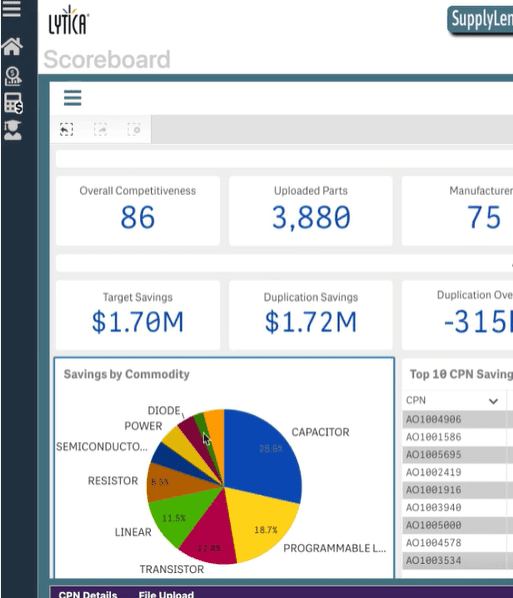
Suppliers understand pricing across customers, volumes, and market conditions. Buyers rely on internal history, limited benchmarks, and negotiation experience to determine whether a price is competitive. In categories such as electronic components, this gap is amplified by volatility and limited transparency.
The result is consistent. Different companies, and often different divisions within the same company, pay materially different prices for the same component.
Lytica is attempting to address that condition.
Lytica’s platform is built on anonymized buyer transaction data aggregated across a network of companies. This creates a continuously updated view of pricing across suppliers, regions, and time.
This is not modeled data or survey input. It reflects observed market behavior.
That distinction allows procurement teams to assess pricing against a broader market reference:
Where are we overpaying?
How do suppliers price across customers?
What does competitive pricing look like?
This represents a move from internal spend analysis to external market intelligence.
The more important development is how this data is modeled.
Lytica treats pricing as a measure of competitiveness rather than a fixed value. Prices exist within a distribution shaped by real transactions. Each company occupies a position within that distribution.
This enables a more structured evaluation of procurement performance:
Prices can be ranked relative to the market.
Outliers can be identified and examined.
Expected price ranges can be estimated using observed data.
The question shifts from “Is this price good” to “How competitive is this price relative to the market?”
This introduces a more disciplined approach to procurement performance.
Once pricing is modeled this way, negotiation becomes more structured.
Procurement teams can enter discussions with:
Target pricing ranges based on transaction data.
Evidence of variance across comparable buyers.
Supplier-specific pricing patterns over time.
This replaces qualitative positioning with data-backed arguments.
The result is more consistent outcomes and shorter negotiation cycles.
The next step is applying this dataset in operational workflows.
As outlined in modern supply chain architectures, AI systems become more useful when grounded in domain-specific data and applied with context.
In this case, systems can:
Identify deviations from competitive pricing levels.
Estimate expected pricing ranges based on observed transactions.
Generate supplier-specific negotiation guidance.
Monitor pricing performance over time.
These outputs are typically delivered as structured guidance for sourcing teams.
The effectiveness of this approach depends on how data is accessed and retained.
Retrieval-based architectures allow systems to reference current transaction data when generating recommendations. Context-aware systems retain supplier history, pricing behavior, and prior outcomes across decision cycles.
This supports continuity in decision-making rather than isolated analysis.
Lytica does not replace ERP or sourcing platforms. It operates as an intelligence layer above them.
This reflects a broader shift:
Systems of record manage transactions.
Systems of execution manage workflows.
Systems of intelligence guide decisions.
Over time, as confidence in recommendations increases, this layer is likely to become more integrated into execution.
Lytica reflects a shift in procurement.
Pricing is moving from opaque negotiation toward structured, data-based market positioning.
This changes how procurement operates:
From internal benchmarks to external reference points.
From periodic sourcing to continuous evaluation.
From intuition to structured decision support.
In more volatile supply environments, this type of capability becomes increasingly relevant.
Organizations that adopt it early will have a clearer understanding of their market position and a more consistent approach to improving it.
AI Is Reshaping Supply Chain Execution. Here’s What Comes Next.
A practical framework for A2A coordination, MCP, and graph-enhanced reasoning in modern supply chain systems.
AI is moving beyond isolated copilots and into coordinated, operational decision systems. This ARC Advisory Group white paper explains how A2A, MCP, retrieval architectures, and graph-enhanced reasoning are beginning to reshape supply chain execution, visibility, and resilience.
Independent ARC research for supply chain leaders and technology decision-makers.