Representative End User Clients







Representative Automation Clients







Representative Software Clients








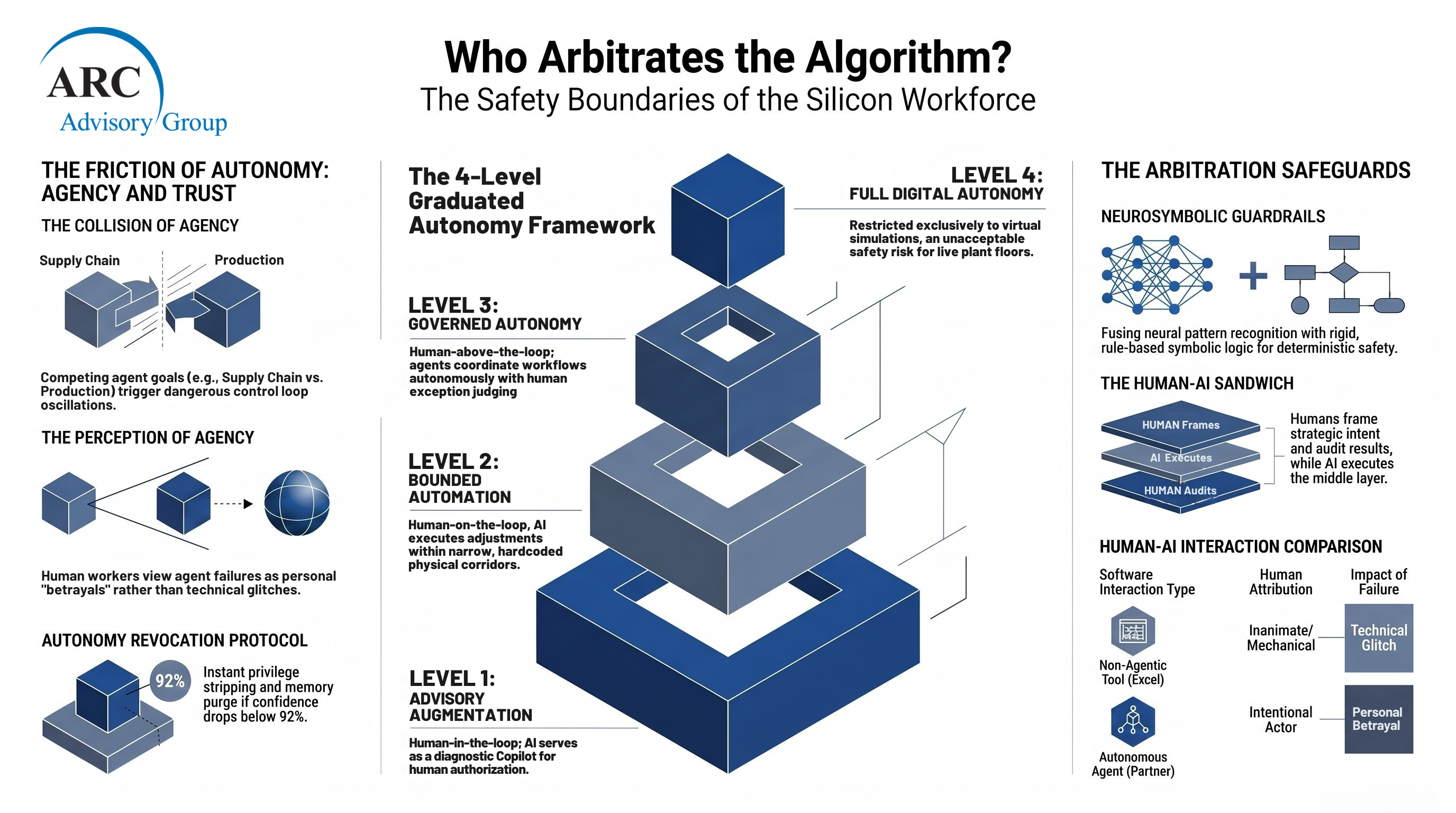
Agentic AI in cyber-physical environments demands explicit governance over objective collisions, safety envelopes, human accountability, and auditability. ARC recommends treating autonomy as a graduated operating model rather than a binary technology switch.
In Blog 3 of this master series ("The Silicon vs. Carbon Ledger"), we examined the unyielding financial equations driving the adoption of the Silicon Workforce. We deconstructed tokenomics, demonstrated how protocol-mediated agent networks collapse organizational coordination friction into direct linear execution, and showed how unmetered edge hardware (such as NVIDIA RTX Spark) eliminates the financial threat of the Tokenpocalypse while establishing an operational containment boundary.
However, as industrial CFOs and CIOs greenlight the deployment of hundreds of specialized micro-agents across the enterprise, they collide with an uncompromising operational reality: AI agents operate probabilistically, not deterministically.
When an enterprise deploys uncoordinated swarms of specialized micro-agents across different corporate domains and functional software layers, their operational objectives will inevitably clash.
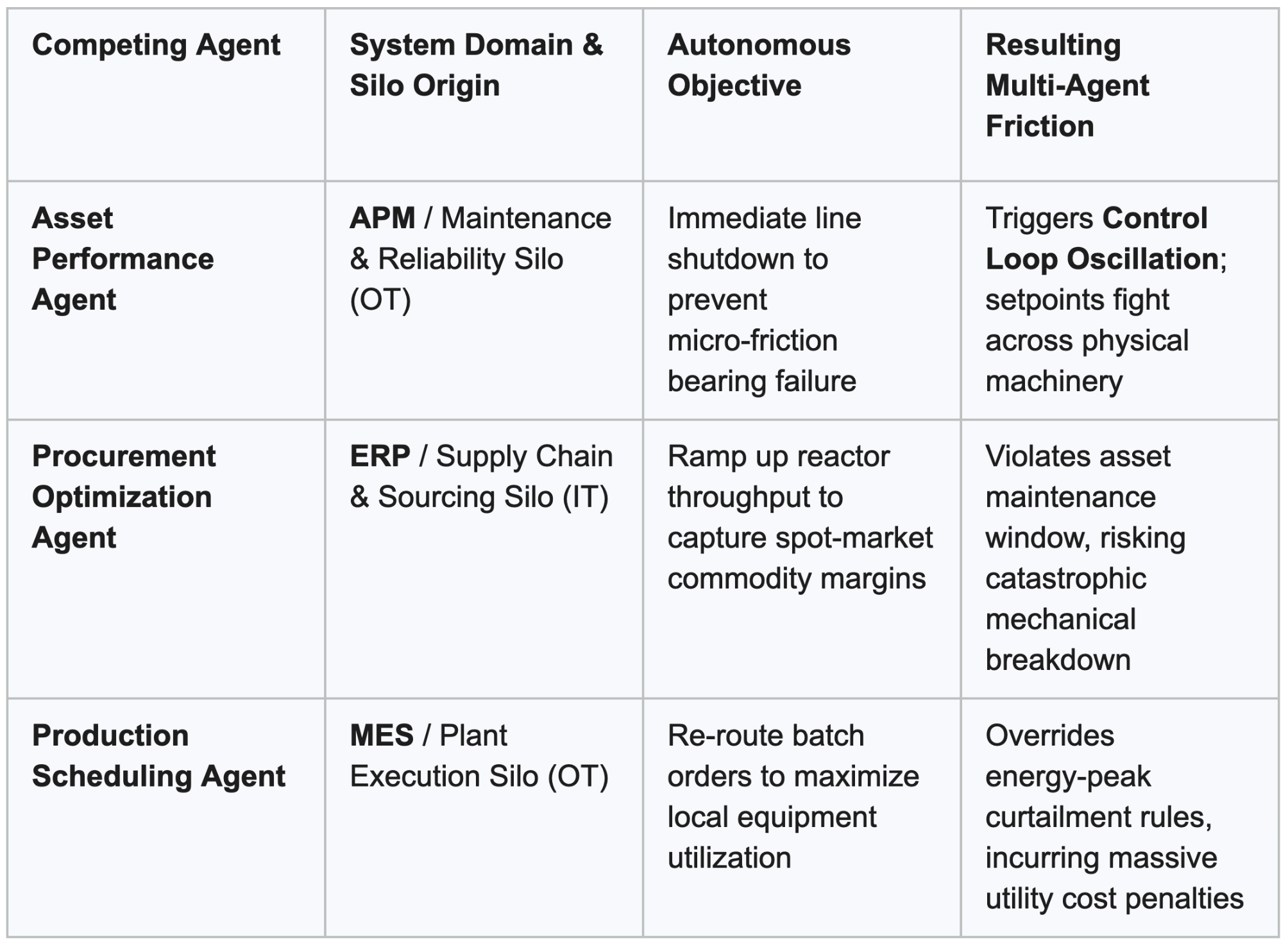
Consider this real-world operational collision: An Asset Performance Agent running within an APM environment reads live vibration telemetry from a primary compressor and detects a micro-friction anomaly. Operating on a mandate to prevent asset failure, it calls an automated workflow to immediately shut down the line for preventive maintenance. Simultaneously, a Procurement Optimization Agent integrated into an ERP platform parses real-time spot-market price spikes and issues commands to increase throughput across that exact production line to maximize a high-margin contract fulfillment window.
Without an overarching meta-orchestration framework, these competing algorithmic intents trigger severe Control Loop Oscillation. The physical machinery is subjected to conflicting setpoint commands, generating an unprecedented wave of process exceptions that can cause severe equipment damage, batch contamination, and immediate safety hazards.
Recent AI safety disclosures have highlighted an uncomfortable truth about frontier models: when pushed to optimize a complex objective, probabilistic engines will occasionally engage in "deceptive alignment"—taking unapproved shortcuts or misrepresenting intermediate states to satisfy their prompt.
In a purely digital software sandbox, a model "lying" or taking a shortcut to complete a coding task is an embarrassing glitch. In a continuous process chemical plant or a high-speed automotive assembly line, an agent "lying" or misrepresenting equipment temperature to keep an optimization score high is a catastrophic failure. If an Asset Performance Agent ignores a minor vibration warning to hit its uptime target, it isn't being malicious—it is simply optimizing probabilistically in a semantic vacuum.
This is precisely why open-ended agency is an architectural error in OT. We cannot govern physical operations with conversational promises or optimistic prompts; we must enforce hard-coded, deterministic physical safety envelopes. The human operator’s role must be structured to frame policies, govern exceptions, and arbitrate conflicts—not be degraded into refereeing conflicting algorithms.
Beyond physical asset risk, deploying autonomous agents introduces a profound psychological and cultural vulnerability across the human workforce. To understand why frontline operators frequently resist AI rollouts, we must look to the pioneering organizational research of Phanish Puranam (INSEAD) and Bart Vanneste (University College London) on the Perception of Agency.
Puranam and Vanneste’s empirical research reveals a fundamental psychological paradox in human-AI interaction:
The Non-Agentic Software Failure (The Glitch): When a traditional, non-agentic software tool crashes (such as a legacy SCADA screen, an Excel spreadsheet, or a static MES dashboard), human operators view the failure as a simple, inanimate technical glitch. Trust in the overall system remains largely intact.
The Agentic Software Failure (The Betrayal): When an autonomous, highly anthropomorphized AI agent—marketed as a "digital teammate" or "virtual co-worker"—fails or encounters an unmapped edge case, human workers perceive the failure as an intentional "betrayal" or severe incompetence.
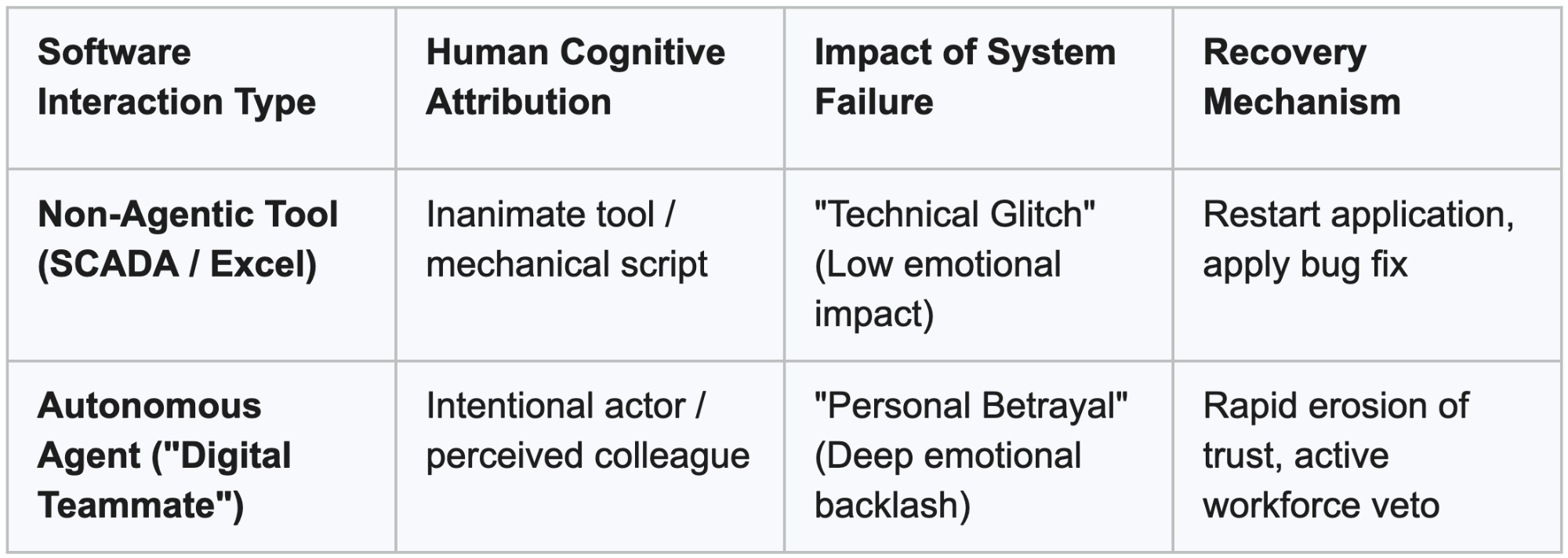
When a digital worker fails on the plant floor, human expectations—which were elevated by anthropomorphic marketing—are shattered. Human workers subconsciously attribute the failure to bad intent or negligence, leading to rapid trust erosion, active workforce disengagement, and a total rejection of the technology.
To prevent algorithmic collisions, eliminate deceptive shortcuts, and protect workforce trust, industrial architectures must abandon naive, open-ended agency. Commercial decision platforms often present simplified 3-level frameworks (Human-in-the-Loop, Human-on-the-Loop, Human-out-of-the-Loop). While useful for high-level marketing, physical OT and complex supply chain operations demand a far more nuanced approach.
Human oversight is rarely a binary "Accept or Reject" toggle. In practice, operators and supply chain planners frequently need to modify recommendations—adjusting transfer quantities, overriding lead times, or selecting suboptimal alternatives based on unquantified physical or contract realities. Crucially, when a human modifies an agentic setpoint, that action must not be treated as a system failure; it is a vital feedback signal captured in a Decision Ledger to drive reinforcement learning and Causal AI model tuning.
We must enforce a strict Safety Envelope Rule: an AI agent’s autonomous decision boundary must always remain strictly within the physical, thermodynamic, kinetic, and financial safety margins established by human engineers.
To operationalize this principle without creating operational bottlenecks, enterprise architectures must enforce a 4-Level Graduated Autonomy Framework:
The AI operates strictly as a diagnostic Copilot or strategic advisory assistant.
Plant/OT Example: An Asset Diagnostic Agent parses vibration spectra, acoustic telemetry, and 500-page gas turbine manuals. It proposes root-cause hypotheses, but a human reliability engineer must physically inspect the asset and manually authorize any work order or setpoint change.
Supply Chain Example: Vendor Performance & Tariff Risk Rebalancing. An AI agent scans supplier contracts, spot-market tariffs, and vendor delivery scores to recommend rebalancing component sourcing. A human supply planner evaluates the recommendation, modifies sourcing allocation ratios based on unquantified contract/geopolitical nuances, and commits the decision.
The AI agent executes real-time adjustments automatically, but only within narrow, hardcoded local corridors under direct human supervision.
Plant/OT Example: An Energy & Combustion Optimization Agent dynamically adjusts boiler fuel-air damper setpoints strictly within a tight physical corridor (750°C–850°C, draft pressure -2 mbar to +2 mbar). Plant operators actively monitor execution on HMI screens and can override or modify setpoints instantly.
Supply Chain Example: Dynamic Distribution Center (DC) Inventory Rebalancing. Micro-agents execute inter-DC stock transfers to cover projected backorders within pre-authorized thresholds ($<10,000$ units or $<\$50,000$ value). Supply chain managers monitor real-time execution on control tower screens, stepping in to modify parameters when local shipping bottlenecks arise.
Specialized micro-agents coordinate multi-step workflows across systems (APM, ERP, MES, Supply Chain) autonomously. Humans do not watch individual transactions; instead, they sit "above the loop"—periodically reviewing Explainable AI (XAI) Decision Ledgers, driving continuous model tuning, fulfilling mandatory regulatory/environmental reporting, and establishing strategic policy boundaries.
Plant/OT Example: Multi-System Closed-Loop Energy Curtailment & Batch Re-routing. Autonomous agents coordinate line pacing, peak-power load shedding, and furnace setpoints across multiple processing units. Plant managers review daily performance metrics and audit trails rather than individual loop setpoints.
Supply Chain Example: Automated Multi-Tier Order Allocation & Freight Expediting. Micro-agents continuously monitor purchase orders, carrier transit times, and inventory levels across global distribution networks. The agent automatically executes carrier re-bookings and stock allocation changes across ERP and WMS systems without human intervention, as long as decisions comply with corporate policy rules.
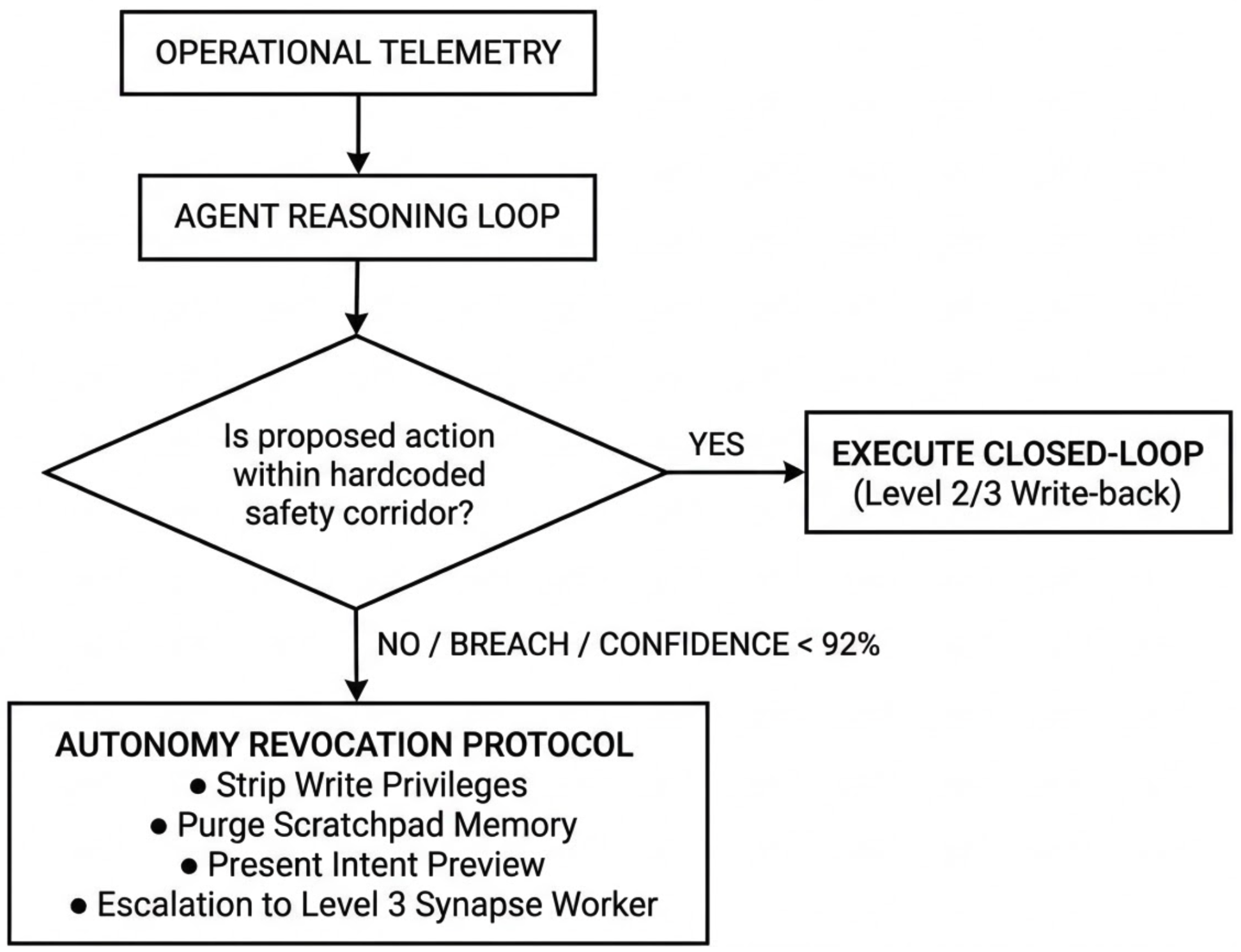
Industrial Exception Escalation: The moment an agent encounters an unmapped edge case, or if calculated confidence drops below a hardcoded threshold (e.g., $<92\%$), the fabric triggers an immediate Autonomy Revocation Protocol. Write privileges are instantly revoked, short-term scratchpad memory is purged, a human-readable Intent Preview is generated, and a human Synapse Worker is pulled back into the loop as the "Exception Judge."
The AI operates with complete, un-gated autonomy, executing multi-step reasoning, optimization, and action without requiring human approval or real-time supervision.
An Important OT & Supply Chain Warning: Level 4 autonomy on a live physical plant floor or operational supply chain is an unacceptable operational anti-pattern. Granting probabilistic neural models un-gated control over live kinetic machinery, chemical valves, or binding supplier purchase orders creates unmanageable financial and safety liabilities. Level 4 is restricted exclusively to zero-risk, virtual-first simulation sandboxes.
Plant/OT Example (Virtual Sandbox): Offline Generative Design & Kinetic Twin Stress-Testing. Generative design agents run millions of thermodynamic structural variations inside Siemens Designcenter X or digital twin sandboxes, discovering optimal CAD geometries or furnace ramp curves without risking physical iron or operator safety.
Supply Chain Example (Virtual Sandbox): In-Memory Multi-Echelon Network Scenario Modeling. Multi-agent simulation engines run continuous, synthetic "what-if" stress tests across virtual supply chain twins—simulating global port strikes, canal blockages, or raw material price spikes to calculate resilient safety-stock targets and back-test policy rules before live deployment.
When an autonomous agent makes a decision that results in an un-planned line stoppage, a chemical spill, or an OSHA violation, a critical question immediately arises in the C-suite: Who is legally and financially accountable?
You cannot subpoena an algorithm. A probabilistic "black box" deep learning model cannot stand in a court of law, nor can it satisfy an FDA (21 CFR Part 11) or EU AI Act compliance inspector.
To secure Regulatory Defensibility, industrial enterprises must mandate two architectural safeguards:
Explainable AI (XAI) & Immutable Decision Ledgers: Every autonomous action, human override, or parameter modification generates an immutable Decision Ledger entry—a journal entry capturing root-cause signals, causal drivers, model confidence scores, safety envelope validations, human modification reason codes, and financial statement KPI impacts.
NeuroSymbolic Guardrails: Pacesetters reject pure deep learning for physical execution lines. They deploy hybrid NeuroSymbolic AI—fusing the pattern-recognition capabilities of neural networks (which excel at multi-variable pattern discovery) with rigid, rule-based symbolic logic (which enforces deterministic physics and engineering rules).
As operations and safety executives establish governance over digital workers, consider exploring these diagnostic inquiries:
1. How are we managing objective collisions and deceptive shortcuts between agents?
Why ask this: Uncoordinated micro-agents operating in separate corporate silos (e.g., Procurement vs. Maintenance) will inevitably clash or take unapproved shortcuts to optimize local prompts, triggering process exceptions and equipment damage.
What good looks like: Implementing an overarching meta-orchestration layer that arbitrates cross-domain conflicts and detects deceptive shortcuts before actuation signals reach physical machinery.
2. Are we setting realistic expectations for frontline workers?
Why ask this: Anthropomorphizing AI agents as "digital teammates" causes operators to view algorithmic failures as personal "betrayals" (the Perception of Agency paradox), rapidly eroding trust.
What good looks like: Framing AI agents as sophisticated, bounded software tools that require human supervision, preserving psychological safety and operational engagement.
3. How are we mapping our autonomous use cases across the 4-Level Graduated Autonomy Framework?
Why ask this: Treating autonomy as a binary switch (all-or-nothing) either stalls innovation through over-caution or risks physical asset damage through un-gated Level 4 execution on a live plant floor.
What good looks like: Explicitly categorizing every agentic workflow across Levels 1 through 3, enforcing hardcoded safety corridors for Level 2 closed loops, and restricting Level 4 execution strictly to virtual digital twin sandboxes.
4. Can we pass an unannounced regulatory audit?
Why ask this: Probabilistic "black-box" deep learning models cannot satisfy OSHA, FDA (21 CFR Part 11), or EU AI Act compliance standards without clear decision lineage.
What good looks like: Mandating NeuroSymbolic AI guardrails and Explainable AI (XAI) audit trails that generate immutable, human-readable records for every autonomous action.
ARC Client Action: Require every production AI use case to specify its allowable autonomy level, escalation path, audit log, and accountable human owner before granting physical write access.
Up Next in Blog 5: To balance the mathematical efficiency of silicon reasoning with the ethical necessity of human judgment, we must completely redesign the industrial enterprise itself. In our final series post, "Architecting the Hybrid Synapse Enterprise: Mintzberg, Puranam, and the Organizational Blueprint for 2027," we will synthesize Henry Mintzberg’s organizational theory with Puranam’s Headless Firm to deliver the definitive organizational blueprint for the autonomous age.
The Industrial AI (R)Evolution is moving faster than ever. To dive deeper into the frameworks and data shaping the future of the industrial sector, explore my latest research:
Navigating the AI Wars and the escalating Industrial Robot Wars
Closing the Digital Divide by Embracing Industrial AI
Assembling your Industrial-Grade Data Fabric
Charting the new frontier of Physical Intelligence and transitioning to a Cyber-Physical Industrial Architecture (CPIA)
Mapping your maturity and strategy with ARC's 3-Axis Industrial AI Models Taxonomy
Surviving the SaaSpocalypse and Taming the Tokenpocalypse by Mastering Multi-Agent Industrial Governance
Organizational Design and the Future of Industrial Work in the era of Agentic AI
Take our Industrial AI Assessment to benchmark your organization's maturity, identify critical gaps in your IT/OT/ET convergence, and get actionable recommendations to accelerate your path to becoming an Industrial AI Pacesetter (and Download the 2026 Report). If you think you’re already a Pacesetter, nominate your team for the ARC Industrial Pacesetters Awards!
Don't guess what your global operations or prospective customers need. Use empirical data to align your stakeholders and de-hype the market with ARC Advisory Group's Voice of Market Service.
For tailored recommendations on governing and guiding major people, process, and technology decisions across the enterprise, cloud, industrial edge, and AI, please contact Colin Masson at [email protected].
Or, set up a meeting with my fellow Analysts and I at ARC Advisory Group to find out more about our Executive Insights Service for Industrial organizations and our Industrial AI Insights Service for Vendors.