Representative End User Clients







Representative Automation Clients







Representative Software Clients








The future of industrial automation in robotics is accelerating, driven by the convergence of Artificial Intelligence and advanced robotics. NVIDIA has opened pre-orders for its Jetson AGX Thor developer kit, with production modules coming soon, marking a significant leap in empowering robots with real-time, intelligent reasoning at the edge. This launch represents more than just increased robot performance; it’s a key enabler of the "physical how" of Software-Defined Manufacturing (SDM) and the realization of Agentic AI—concepts ARC has been closely analyzing.

In our recent ARC SPARC podcast series, we've explored the conceptual groundwork—the what and the why of this industrial shift—with industry leaders like Steve Blackwell of AWS. SDM is a holistic, software-first philosophy, and we see Agentic AI as the "great orchestrator," evolving from passive analytics to actively executing complex, multi-step digital workflows.
This announcement from NVIDIA, focused on the Jetson Thor, directly addresses the "how"—the embodiment phase of SDM. Here, abstract software-defined concepts and Agentic AI-driven decisions are translated into action on the factory floor. The Jetson Thor acts as the core "brain" for these robotic systems, converting digital intent into physical execution.
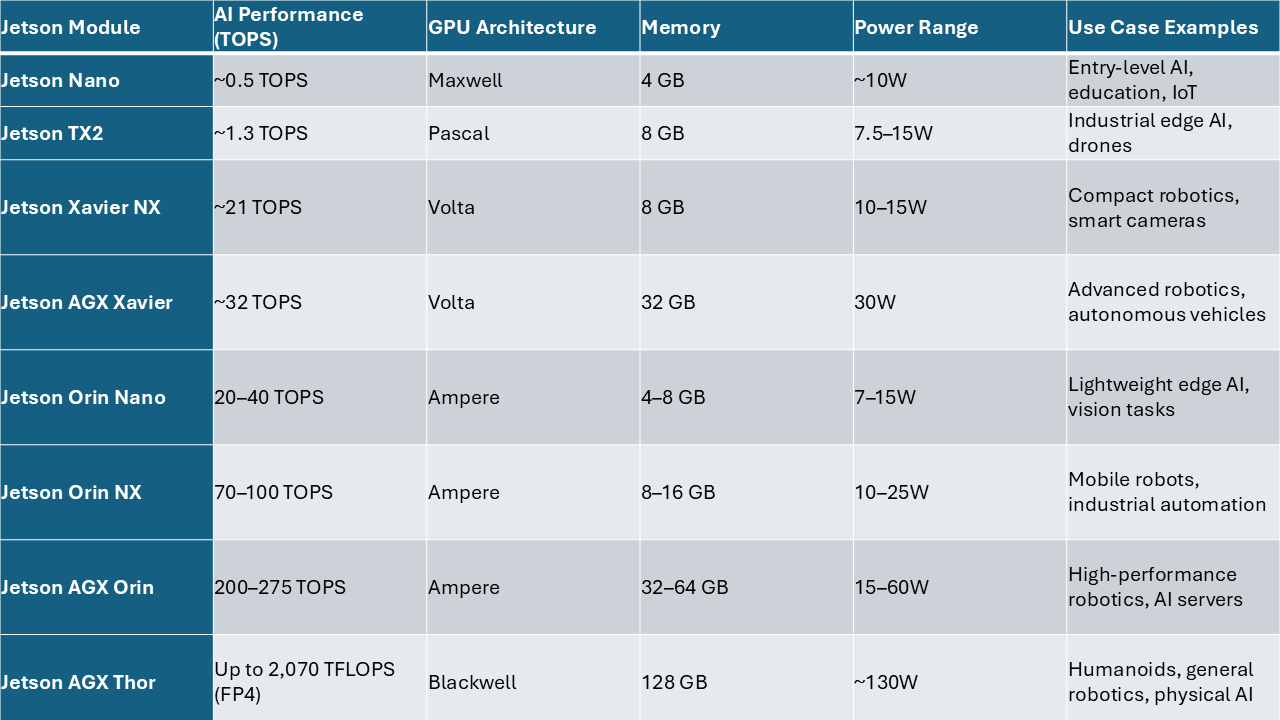
NVIDIA describes Jetson Thor as an "AI edge supercomputer" designed for general robotics and physical AI. It delivers up to 2,070 FP4 teraflops of AI compute and 128 GB of high-speed memory—a major upgrade from Jetson Orin. This enhanced capability enables processing of high-speed sensor data and complex visual reasoning directly at the edge.
Built to run generative reasoning models—including large transformer models and vision-language-action models (VLAMs)—in real-time, Jetson Thor leverages the Blackwell GPU's transformer engine to power multi-modal foundation models that allow AI agents to perceive, reason, and act on intricate instructions in real-world environments.
NVIDIA’s Jetson platform offers a range of edge AI modules tailored for robotics, autonomous machines, and embedded systems. Each Jetson variant balances performance, power efficiency, and form factor to suit different use cases—from tiny drones to humanoid robots. Here's a breakdown of the major Jetson platforms and how they differ:
Orchestrating Physical Actions with Enhanced Autonomy: Agentic AI with Jetson Thor moves robots beyond rigid, pre-programmed tasks to learning, adapting, and making real-time decisions. Low-latency processing supports complex, multi-AI workflows for intelligent interaction with humans and dynamic environments.
Democratizing Robot Programming via Natural Language: Generative AI is transforming human-robot interaction. Operators can use natural language prompts to guide robots—examples include KUKA's iiQWorks.Copilot and ABB’s LLM integrations. While current solutions often rely on cloud AI, Jetson Thor delivers the edge compute to run these models onboard, enabling untethered, real-time autonomy.
Autonomous Task Planning and Adaptation: Generative AI gives robots the ability to break down high-level goals into executable steps and adapt to unforeseen "open-world" challenges.
Accelerated Perception and Edge Decision-Making: Jetson Thor enhances computer vision, object recognition, and autonomous navigation. NVIDIA’s Isaac Perceptor for AMRs and Isaac Manipulator for robotic arms are designed to fully leverage this platform.
Simulation-First Development and Digital Twins: Simulation is central to robotics innovation. NVIDIA’s Isaac Sim, built on Omniverse, enables training AI models in virtual environments, while Jetson Thor brings these models to life on the factory floor. Amazon Devices’ "zero-touch manufacturing" is a prime example—training robots in a digital twin before deployment.
Industry leaders like Agility Robotics, Boston Dynamics, Figure AI, and Amazon Robotics are adopting Jetson Thor for humanoid, surgical, and logistics robotics. NVIDIA’s approach—integrating DGX for training, Omniverse for simulation, and Jetson for deployment—forms a comprehensive platform for over 2 million developers and thousands of companies driving the physical AI revolution.
Jetson Thor is more than hardware; it’s the catalyst for embedding Agentic AI into robotics, transforming Software-Defined Manufacturing from abstract code to operational reality.
Next Step: Our companion piece, "The 'Brain' for the Autonomous Factory," will explore ecosystem strategies, partnerships, and recommendations for industrial leaders.
For ARC Advisory Group recommendations for Navigating the AI Wars, Closing the Digital Divide by Embracing Industrial AI, assembling your Industrial-Grade Data Fabric, and governing and guiding major decisions about enterprise, cloud, industrial edge, and AI software, please contact Colin Masson at [email protected] or set up a meeting with me, or my fellow Analysts at ARC Advisory Group to find out more about our Executive Insights Service for Industrial organizations, and Industrial AI Insights Service for Vendors.