Representative End User Clients







Representative Automation Clients







Representative Software Clients








Industrial organizations are rapidly transitioning from isolated digital initiatives to enterprise-scale Industrial AI programs. However, success remains constrained by fragmented, inconsistent, and inaccessible data. Open Industrial Data Fabrics (OIDF) provide the means to overcome these challenges and enable scalable, sustainable AI-driven operations.
An Industrial Data Fabric (IDF) provides a unified, logical connectivity layer that integrates and contextualizes data across Operational Technology (OT), Information Technology (IT), and Engineering Technology (ET) domains. The use of open concepts extends the value of industrial data fabrics by enabling interoperability, consistent data context, and governance across industrial ecosystems.
Industrial AI initiatives are increasingly data-constrained rather than technology-constrained. Recognizing this, leading industrial companies ensure that they have appropriate data foundations in place before launching major investments in AI applications. Leaders also recognize the value of data fabrics in place of isolated data warehousing approaches.
Traditional architectures, like data lakes, historians, and application silos:
Are plagued by inconsistent, untrustworthy information across domains.
Deliver real-time data, but lack the context to support innovative AI applications.
Lack support for the full spectrum of edge-to-cloud environments.
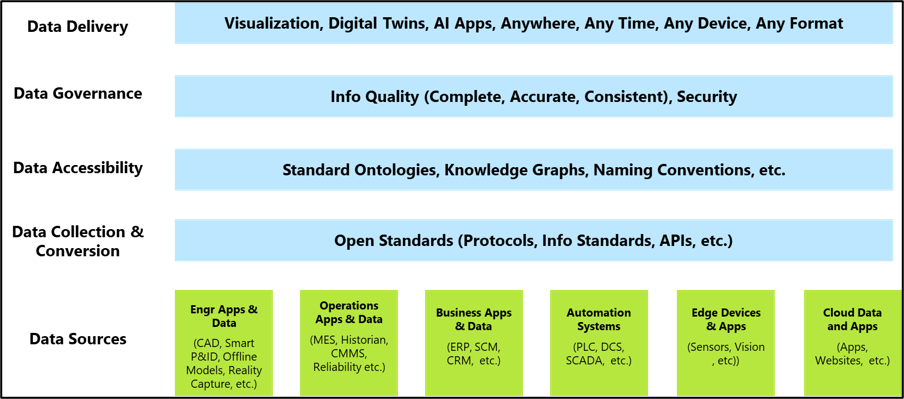
IDFs address these limitations by creating a unified connectivity layer that integrates diverse data sources, including:
Plant systems, such as PLC, DCS, SCADA, historians, etc.
Engineering systems, such as CAD and digital models.
Enterprise systems, such as ERP and EAM.
Edge devices and sensors.
Cloud platforms.
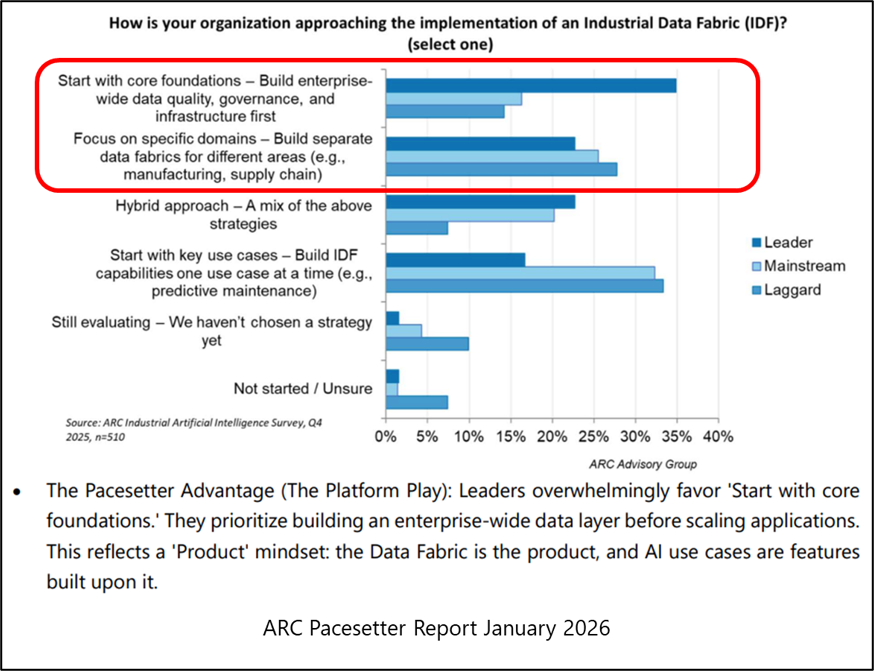
An Industrial Data Fabric (IDF) is a federated information architecture that automates the integration, management, and sharing of data across industrial environments, including edge, cloud, and hybrid infrastructures. Unlike a monolithic data lake, an IDF does not necessarily require moving all data to a single location. Instead, it creates a unified, logical connectivity layer that weaves together data from disparate sources, like automation systems, IT systems, ET systems, edge devices, and cloud platforms, making all information discoverable, governed, and AI-ready for any authorized consumer, whether a human or machine agent.
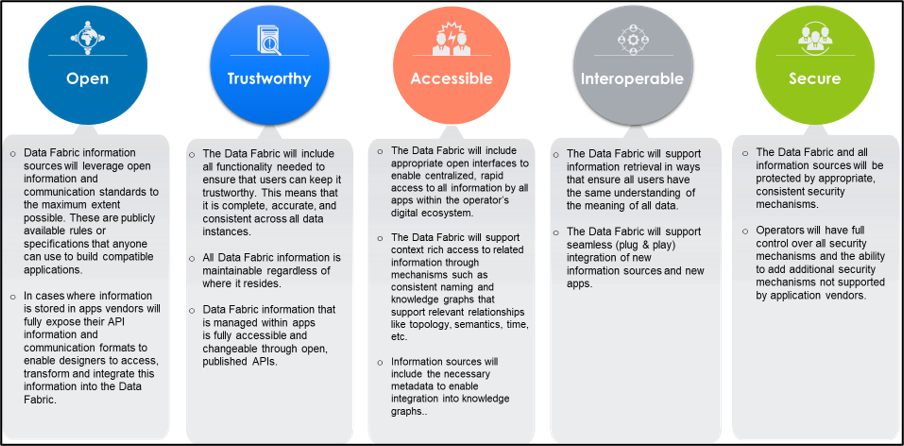
An Open Industrial Data Fabric (OIDF) extends Industrial Data Fabric value through:
The use of open standards and open APIs that enable interoperability across a company’s digital ecosystem and facilitate rapid adoption of innovative business strategies and new technology solutions.
The use of open, industry-recognized ontologies and knowledge graphs that ensure consistent context and meaning across all uses of data by apps in the company’s digital ecosystem.
The use of open change management capabilities that span all information sources across the full asset lifecycle, including design, build, operate, and maintain, and facilitate consistent governance and maintenance of data quality.
The OIDF approach transforms disparate, siloed data into AI-ready, context-rich information access that provides trustworthy information to users, whether human or machine agents.
ARC research indicates that organizations should “assemble, not buy” their data fabric infrastructure so they can leverage openness and best-of-breed components rather than rely on a single vendor’s proprietary platform.
The implication is clear: openness is no longer optional. It is a prerequisite for innovation and ecosystem collaboration.
Based on the OIDF framework and ARC research, industrial organizations should build data fabrics based on certain guiding principles:
Position the Industrial Data Fabric, not applications or AI models, as the core architectural layer for digital transformation and AI initiatives.
Select solutions that support open standards and APIs.
Avoid architectures that create data silos or continue vendor lock-in.
Ensure data can flow freely across lifecycle stages and systems.
Invest in:
Data governance frameworks.
Industry-recognized ontologies and knowledge graph capabilities.
Standardized naming and metadata models.
These are critical enablers of AI value.
Ensure the architecture supports:
Real-time edge data processing.
Scalable cloud analytics.
Hybrid deployment models.
Recognize that no single vendor can deliver a complete solution.
Adopt an “assemble, don’t buy” approach to create a flexible, best-of-breed data ecosystem.