Representative End User Clients







Representative Automation Clients







Representative Software Clients








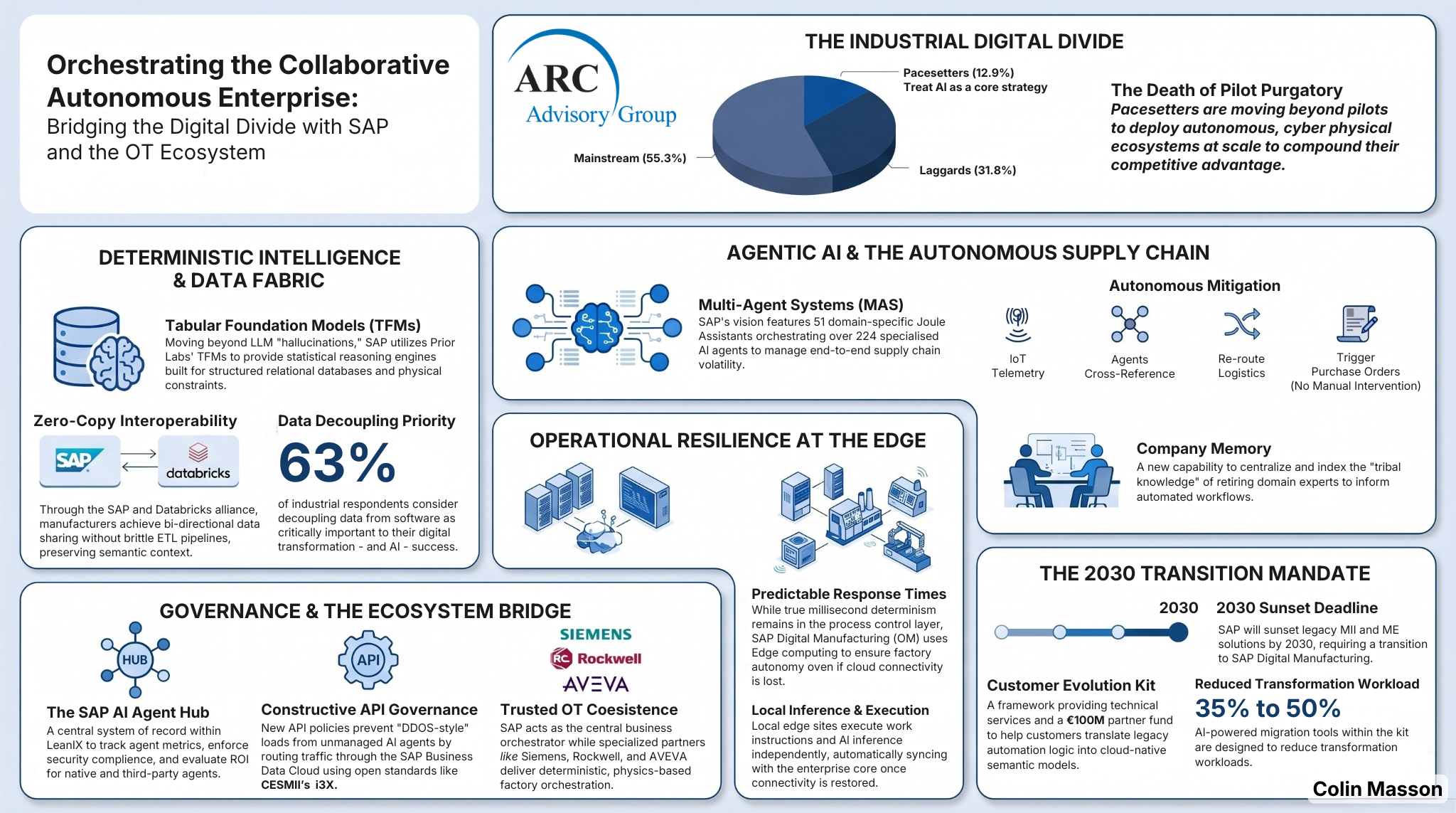
The industrial sector has reached a profound inflection point. A rigorous analysis of the ARC Advisory Group Q4 2025 Industrial AI, Energy, and Robotics Survey reveals a market that has irrevocably fractured into what we call the "Digital Divide." The market has trifurcated into distinct cohorts: the Pacesetters at 12.9 percent, the Mainstream at 55.3 percent, and the Laggards at 31.8 percent. For the past decade, the narrative of "Industry 4.0" suggested a universal, gradual digital adoption cycle in which "Fast Followers" could safely wait out the hype cycle. Today, our empirical data shows that the Fast Follower strategy is effectively dead for productive AI adoption.
Pacesetters are treating AI as a core operational strategy, deploying autonomous, cyber-physical ecosystems at scale to compound their competitive advantage. For my full analysis, see the ARC Pacesetter Report: Industrial Artificial Intelligence, or register to download. Meanwhile, Laggards remain trapped in "Pilot Purgatory," held back by fragmented data estates and a severe shortage of specialized talent. The tools for the "Autonomous Factory" are already here; the differentiating variable that remains is the speed of organizational execution and the modernization of enterprise systems.
To successfully scale past pilot projects, industrial organizations must bridge the traditional cultural gap between corporate IT and shop-floor Operational Technology (OT). For decades, OT executives and industrial software vendors viewed enterprise software deployments with a healthy dose of skepticism, often seeing them as "headquarters-driven" IT mandates that failed to grasp the physical realities of manufacturing.
However, over the last two years, SAP's manufacturing strategy has undergone a profound evolution. What I witnessed at Sapphire 2025, culminating in the major platform rollouts at Sapphire 2026, marks a clear transition. SAP has successfully modernized its Enterprise Architecture for the Agentic AI era. Through the SAP Business AI Platform—unifying the Business Technology Platform (BTP), Business Data Cloud (BDC), and Business AI into a single semantic fabric—SAP is no longer attempting to force the physical plant to adapt to a rigid ERP.
Instead, SAP is building a collaborative blueprint that respects the unique requirements of the shop floor while providing the enterprise with unmatched supply chain visibility. See my baseline research on: Navigating the AI Wars and the Escalating Industrial Robot Wars. By acting as the core enterprise orchestration plane, SAP is positioning itself to help industrial companies bridge the Digital Divide.
A primary concern when scaling cloud-native Industrial AI to active production environments is operational resilience. While vendor marketing often states that "a factory cannot afford a millisecond of latency," the operational reality is far more nuanced. True millisecond determinism is strictly the domain of the process control layer. For much of what occurs in broader manufacturing execution, resource orchestration, and scheduling, seconds or minutes are perfectly acceptable.
What a factory actually requires is predictable response times and an absolute guarantee that production will not drop if an internet connection fails. Industrial organizations want to minimize operational variation and reduce latency, not add more IT friction.
SAP has answered this requirement within SAP Digital Manufacturing (DM) by architecting a highly effective Edge Computing framework. Utilizing Production Connectivity (ProdCon) and DM Edge Computing, SAP pushes the execution layer down to the local site to optimize response times where it matters most. If the connection to the cloud is temporarily severed, the factory does not experience unplanned downtime. The local edge site retains the autonomy to execute work instructions, run local AI inference, and manage equipment, automatically syncing with the enterprise core once connectivity is restored. This approach gives operators greater confidence in cloud-managed infrastructure.
Data accessibility is the prerequisite for scaling AI, yet industrial data has historically been trapped in siloed legacy architectures. Across our aggregate survey data, a significant 63 percent of respondents consider decoupling data from software to be critically important to their digital transformation success.
SAP addressed this data extraction challenge through its strategic alliance with Databricks, with native integration into the SAP Business Data Cloud.
For a deeper dive into this foundational move, read my original Sapphire 2025 coverage: Decoding SAP's Business AI Strategy: A (Formerly Skeptical) Analyst's View from Sapphire 2025.
Bi-Directional, Zero-Copy Integration: Through Delta Sharing, manufacturers achieve bi-directional, zero-copy data sharing. Data teams can analyze massive datasets without physically moving or duplicating data, eliminating brittle ETL pipelines and preserving latency-sensitive insights.
Enterprise Context Preservation: By keeping data rooted in the SAP Datasphere, the rich semantic context of the shop floor—such as material variability from procurement or demand signals from sales—remains perfectly intact.
SAP has decisively cemented this open architecture heading into 2026 through two massive, data-centric acquisitions that transform the SAP Business Data Cloud (BDC) into an open, federated, and highly trustworthy Industrial Data Fabric. See ARC Advisory Group’s deeper coverage of Industrial Data Fabrics:
Reltio (Master Data Management): AI agents are exceptionally sensitive to fragmented or conflicting records; if an autonomous workflow is fed duplicate or unverified data, model drift and hallucinations occur. By acquiring Reltio, SAP provides native, cloud-based entity resolution across the fabric. Reltio cleanses, harmonizes, and deduplicates master records across both SAP and non-SAP systems, ensuring that downstream enterprise AI workloads are always fed a context-rich, verified "single source of truth."
Dremio (The Agentic Lakehouse): To eliminate the restrictive "data tax" of moving massive operational data lakes into corporate application layers, SAP acquired Dremio, transitioning the BDC into an Apache Iceberg-native enterprise lakehouse ecosystem. Dremio leverages an open catalog built on Apache Polaris, enabling high-performance, federated, zero-ETL queries across any distributed data source. This architecture ensures that structured enterprise data and unstructured shop-floor telemetry can openly coexist without costly, legacy data pipelines.
OT leaders are rightfully cautious of utilizing Large Language Models (LLMs) near physical machinery due to the risk of conversational hallucinations. Factories do not run on text; they run on telemetry, statistics, yield rates, and physical constraints.
To bring deterministic rigor to industrial AI, SAP made a €1 billion investment to acquire Prior Labs, the pioneer in Tabular Foundation Models (TFMs). Unlike traditional text-based models, TFMs like TabPFN-2.6 are statistical reasoning engines purpose-built to learn directly from structured, relational databases and physical constraints. Explore how this fits the market in: Mapping your maturity and strategy with ARC's 3-Axis Industrial AI Models Taxonomy. This allows SAP’s embedded intelligence to accurately predict business and operational outcomes with the auditable, mathematical certainty that heavy industry demands.
At Sapphire 2026, SAP demonstrated that it has moved completely past the experimental copilot sandbox, unveiling a comprehensive Autonomous Enterprise vision anchored by the deployment of Multi-Agent Systems (MAS). This architectural leap features 51 domain-specific Joule Assistants designed to orchestrate an interconnected fleet of over 224 specialized AI agents. Through Joule Work, users can express complex corporate outcomes in natural language, transforming how global business networks function.
Nowhere is this shift more consequential than in SAP's deployment of dedicated AI Assistants for the Autonomous Supply Chain. Rather than operating in isolated applications, these Multi-Agent Systems work collaboratively across Supply Chain Management (SCM) functions to autonomously mitigate volatility. For example, a "Shop Floor Supervisor Assistant" can seamlessly coordinate with underlying inventory, logistics, and procurement agents to manage a production disruption. If an active line encounters a material defect, these agents can cross-reference IoT telemetry with supplier records, execute a dynamic rerouting of inbound logistics, adjust active work order schedules, and automatically trigger an enterprise purchase order to rebalance the supply chain without manual intervention.
To capture localized operational procedures alongside this automated workflow, SAP introduced Company Memory to centralize and index the "tribal knowledge" of retiring domain experts.
The Governance Imperative: However, operating a pervasive, multi-agent network introduces a new challenge: agentic friction. Because AI agents reason probabilistically, uncoordinated workflows can pull in opposite directions—such as a cost-optimization agent delaying a critical delivery right when a production agent is moving to maximize output. To govern this ecosystem, SAP has deployed the SAP AI Agent Hub within SAP LeanIX. Serving as a system of record across SAP HANA Cloud, SAP Signavio, and S/4HANA Cloud, the Agent Hub allows organizations to track agent metrics, enforce security compliance, and evaluate operational ROI from a single dashboard. This governance layer is precisely what enterprises require to manage native, custom, and third-party agents safely without inducing process deadlocks.
SAP’s updated API Policy (v4/2026), which restricts third-party AI systems from utilizing undocumented or private APIs and implements strict rate limits, has generated significant debate within user communities like DSAG and ASUG. While critics have raised concerns over ecosystem friction, a pragmatic operational analysis reveals that this policy is a technical necessity for system stability and process integrity.
From an infrastructure perspective, an unthrottled, non-deterministic AI agent could execute millions of unoptimized calls in minutes, creating catastrophic DDoS-style loads on active transactional cores. More importantly, when third-party agents bypass governed integrations, they execute independent workflows outside the core business model. This circumvents well-defined business processes and risks introducing highly inconsistent, rogue data back into the enterprise core, creating severe consequences for data integrity and compliance.
As SAP CEO Christian Klein clarified, this policy is designed to protect core business ontologies and system stability, not to monetize raw customer data. To work with SAP constructively under these new guidelines, industrial organizations should stop trying to build direct, unmanaged point-to-point API connections into active transactional databases.
Instead, enterprises should route agentic traffic through the open, federated layer of the SAP Business Data Cloud and leverage emerging open standards like CESMII’s Industrial Information Interoperability eXchange (i3X). See my recent coverage: Beyond Decoupling: How CESMII’s i3X Solves the Context Engineering Gap for Industrial Data Fabrics. By utilizing i3X to wrap legacy brownfield systems into standardized Smart Manufacturing Profiles, clean OT payloads can be safely ingested into the BDC and federated to the Databricks lakehouse. This allows third-party agents, such as Microsoft Copilot, to query and reason against real-time operational data downstream, completely insulated from mission-critical execution layers.
For heavy industrial organizations that rely on legacy solutions like SAP Manufacturing Integration and Intelligence (MII) and SAP Manufacturing Execution (ME) as their critical IT/OT bridge, SAP has set a firm, unyielding deadline to sunset both solutions by 2030. While these systems are not universally deployed across SAP's entire customer base, for the enterprises that do rely on them, modernizing complex brownfield deployments heavily burdened with decades of custom logic represents a significant undertaking. See my architectural advisory: Modernizing Industrial Software for the AI (R)Evolution.
The primary technical hurdle of this migration is the AI Cold-Start Problem. Over decades, plant operators have encoded massive amounts of localized physics, workarounds, and implicit tribal knowledge into custom MII scripts. An off-the-shelf AI model has no native awareness of these facility-specific nuances.
To help customers navigate this transition smoothly, SAP has introduced a highly constructive framework: the SAP Customer Evolution Kit for manufacturing. This program provides organizations with five days of dedicated SAP technical services to evaluate their existing ME/MII footprint, harvest localized automation logic, and translate it into clean, cloud-native semantic models within SAP Digital Manufacturing and the BTP. Backed by a €100 million partner fund to subsidize partner-built agents and advanced AI-powered migration tools that reduce transformation workloads by 35 percent to 50 percent, the Customer Evolution Kit gives enterprises an actionable pathway to preserve their operational IP well ahead of the 2030 deadline.
When deployed natively in the cloud, SAP Digital Manufacturing delivers immediate, measurable value across distinct verticals, proving that cloud transformation is no longer just an infrastructure play for IT, but a direct driver of front-line operational efficiency:
Life Sciences (Adherence): To meet intense regulatory compliance demands, SAP DM introduces the Production Operator Dashboard (POD) 2.0 and a fully compliant Electronic Batch Record (EBR). This enables FDA 21 CFR Part 11 compliant e-signatures, audit trails, and review-and-release workflows out of the box. For example, RAUMEDIC, a producer of medical and pharmaceutical applications, utilized SAP DM to transition from manual, paper-based practices to a fully digital process, optimizing GxP compliance and establishing a global template for future factory rollouts.
Discrete & Process Manufacturing (Agility and Sustainability): SAP DM treats sustainability not as an ideological restriction, but as a practical mechanism for lean manufacturing by tracking precise resource consumption down to the exact utility usage of an individual production run. SMA Solar Technology connected SAP DM to SAP S/4HANA Cloud, automating resource allocation and unlocking a 10 percent improvement in supply chain planning costs. Similarly, Bühler modernized its manufacturing operations to eliminate paper-based processes, giving operators real-time data to drive sustainable, lean execution worldwide.
For decades, the standard paradigm has been that while the best-run businesses run on SAP, the best-run factory floors run on a specialized, highly trusted ecosystem of industrial automation and OT software—the domain of Siemens, Rockwell, AVEVA, and specialized edge pioneers. The era of Agentic AI does not change this fundamental truth; rather, it highlights the need for open coexistence.
Deep physical plant orchestration requires localized, physics-based modeling and precise control-loop expertise. This is beautifully demonstrated by cutting-edge solutions like Imubit, where deterministic Deep-Learning Process Control (DLPC) agents driven by Claude CoWork optimize closed-loop refining environments in real time. This level of physical intelligence stands in sharp contrast to enterprise-level linguistic or probabilistic LLM orchestrators like Joule.
The path forward for industrial enterprises is not to replace their trusted OT ecosystem with SAP, but to work with SAP constructively as the central enterprise orchestrator. By leveraging the SAP Business Data Cloud as an open Industrial Data Fabric, utilizing the SAP AI Agent Hub to govern multi-vendor agent portfolios, and leveraging front-line innovation environments like Cognite Flows to empower the workforce, manufacturers can seamlessly connect top-floor business strategy with shop-floor physical execution. By maintaining this architectural pragmatism and engaging with programs like the Customer Evolution Kit, manufacturers can successfully bridge the Digital Divide and achieve true autonomous operations at industrial scale.
To dive deeper into the empirical data driving these trends, members of the ARC Executive Insight Service can access our full "Industrial AI Pacesetters 2026 Report" and selected insights from our "Q4 2025 Industrial AI, Energy, and Robotics Survey" via the ARC client portal. For customized benchmarking, vendor analysis, and specialized market intelligence, explore ARC Advisory Group's Voice of Market Service.