Representative End User Clients







Representative Automation Clients







Representative Software Clients








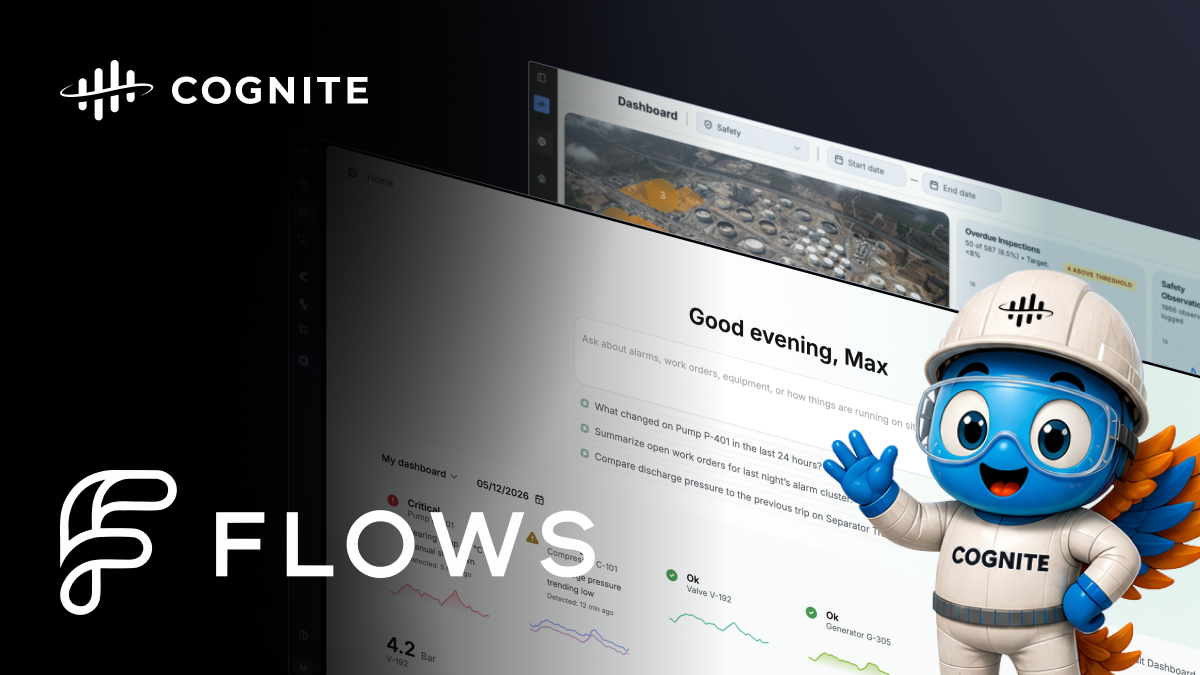
I recently received an email from Cognite teasing a "monumental day for Industry" and promising the "most consequential product launch in Cognite’s history to date." That is a bold claim from a company that has already redefined how asset-heavy industries manage their data. The teaser highlighted a glaring disparity: while tools like Cursor and Claude have revolutionized application development in the carpeted, corporate enterprise space, the "uncarpeted space"—the factory, the supply chain, and the offshore rig—remains hindered by complex data, siloed expertise, and underwhelming digital solutions.
Following a pre-briefing with Cognite’s leadership—including Chief Product Officer Chirayu Shah and Head of Cognite Flows Halvard Eggen—I can confirm that the hype is warranted. On May 12, Cognite officially announced the launch of Cognite Flows, aiming to establish what they call the "System of Action" (you can also tune in to their launch livestream event on LinkedIn).
For those of us tracking the Industrial AI (R)Evolution here at ARC Advisory Group, this announcement represents the logical, and frankly obvious, next step. Here is a breakdown of why Cognite Flows matters, and why we must fundamentally rethink the user interface for the era of Cyber-Physical Industrial AI.
Over the past year, I have fielded an increasing number of questions from industrial leaders and automation incumbents regarding the user interface (UI) of the future. As I noted during the briefing, gone are the days when a vendor could simply slap a tiny chatbot into the corner of a 20-year-old Manufacturing Execution System (MES) or Supervisory Control and Data Acquisition (SCADA) screen and call it "AI-enabled."
Operators and engineers are tired of rigid, monolithic screens. If an AI agent can dynamically pull a P&ID, cross-reference it with a live historian feed, and draft a work order, the interface needs to be equally dynamic.
Cognite addresses this directly with what they term "Adaptive Experiences"—a personalized, AI-first UI that actively changes based on the user's role, location, and the current operational context.
For those following my recent 7-part blog series on the ARC Advisory Group 3-Axis Industrial AI Models Taxonomy, this launch significantly clarifies Cognite's trajectory.
Historically, we have firmly planted Cognite as the quintessential anchor for Archetype 6: AI Platforms and Data Space Operators (The Foundation).
Through Cognite Data Fusion (CDF), they provide the indispensable Industrial Data Fabric (IDF) required to organize, clean, and feed highly contextualized data into other systems. They do the heavy lifting of untangling decades of "PLC spaghetti code" and translating cryptic OT telemetry into clean, relational, AI-ready intelligence. This solves the "Context Trap"—providing the semantic layer that keeps AI from hallucinating.
However, with Atlas AI and now the launch of Cognite Flows, they are aggressively moving up the Level of Autonomy axis. By providing a low-code workbench and pre-built agent templates, Cognite is expanding its footprint directly into Level 2: Industry-Aware models.
They are moving beyond being a passive data foundation and are now empowering what we define as the Industrial Copilot—a highly contextualized, human-in-the-loop AI interface securely tethered to proprietary engineering and operational data. Cognite Flows is the orchestration layer that allows these Level 2 and Level 3 agents to interact seamlessly with the frontline "Synapse Worker."
This expansion across our taxonomy archetypes requires a new type of tooling. During our discussion, I told the Cognite team that I struggled to categorize exactly what they were showing me, but in my mind, they have essentially built an "AI-centric IDE." It is an integrated development environment that goes all the way from the foundational data models to the objects or agents built on top, drives the workflows, and puts it all into a usable UI.
In traditional software engineering, an IDE provides the foundational tools—the code editor, compiler, debugger, and libraries—so a developer can focus on writing logic rather than wrestling with infrastructure. Cognite Flows is the AI-era equivalent of this, but critically, it is an Industrial IDE.
Calling it an Industrial IDE highlights the specific, high-stakes guardrails Cognite provides:
Embracing "Vibe Coding" with Guardrails: Instead of forcing users into a rigid, proprietary drag-and-drop UI builder, Cognite allows developers to use the best generative AI coding tools available on the market, such as Claude, Cursor, or GitHub Copilot. The barrier for pro-coding has fallen drastically; developers now just need to be able to describe the operational problem and the domain.
Native Domain Context (The Compiler and Libraries): General-purpose AI platforms require the user to build the industrial context from raw data. Cognite Flows natively plugs into the CDF Industrial Knowledge Graph, meaning it has a pre-built understanding of maintenance, production, and operations. Cognite also provides a library of specific industrial UI components, like 3D viewers and P&ID viewers, resulting in applications built with a deterministic flow that is critical for industrial users.
Certified for the Real World (The Deployment Server): In the consumer space, a hallucination is an inconvenience; on a factory floor, it is a safety hazard. Cognite is eschewing the "Wild West vibe" often associated with the citizen developer approach. When an application is hosted inside their platform, they apply testing, code signing, and certification to ensure it is secure and follows strict operational best practices before it goes live.
The most compelling evidence of this new architecture's power came from a lighthouse deployment at a Top 10 Global Pharma Company.
Prior to Cognite, the pharmaceutical giant had spent 16 months working with a Global Systems Integrator (GSI) attempting to build a custom production tracking solution, yielding no deployable results. Their existing process was archaic: they tracked massive, complex batches of materials using physical folders on a physical Kanban board on the shop floor.
Leveraging the contextualized data foundation already built in CDF, Cognite deployed a team to a major European production facility and utilized Cognite Flows. Within just one week, they translated that physical board into a live, digital Kanban application. The application provided executive overviews, asset-centric views, and bottleneck tracking, eventually expanding into three more applications over the next six weeks.
That is not just an incremental improvement; that is a 75x faster time-to-value.
Cognite’s explicitly stated "moonshot" is to generate $100 billion in customer value by 2035. You do not reach that number by merely storing data efficiently; you reach it by fundamentally altering how human workers interact with their facilities. For more on Cognite’s Moonshot, read my coverage of Cognite Impact 2025 “From Data Fabric to Digital Teammates: The Agentic AI Vision at Cognite Impact 2025”.
Cognite Flows bridges the critical gap between raw data contextualization (Archetype 6: The Foundation) and the daily, practical workflows of the frontline worker (Archetypes 1 and 2: The Workforce Enabler).
By providing an open, AI-centric orchestration layer—a true Industrial IDE—that treats agents, data, and human intent as equal citizens, Cognite is laying the definitive groundwork for the Cyber-Physical Industrial Architecture (CPIA). The battleground has officially shifted from the back-end data fabric to the frontline industrial experience.
The Industrial AI (R)Evolution is moving faster than ever. To dive deeper into the frameworks and data shaping the future of the industrial sector, explore my latest research:
Navigating the AI Wars and the escalating Industrial Robot Wars
Closing the Digital Divide by Embracing Industrial AI
Assembling your Industrial-Grade Data Fabric
Charting the new frontier of Physical Intelligence and transitioning to a Cyber-Physical Industrial Architecture (CPIA)
Mapping your maturity and strategy with ARC's 3-Axis Industrial AI Models Taxonomy
Where do you stand in the Industrial AI (R)Evolution? Take our Industrial AI Assessment to benchmark your organization's maturity, identify critical gaps in your IT/OT/ET convergence, and get actionable recommendations to accelerate your path to becoming an Industrial AI Pacesetter.
Don't guess what your global operations or prospective customers need. Use empirical data to align your stakeholders and de-hype the market with ARC Advisory Group's Voice of Market Service.
For tailored recommendations on governing and guiding major people, process, and technology decisions across the enterprise, cloud, industrial edge, and AI, please contact Colin Masson at [email protected].
Or, set up a meeting with my fellow Analysts and I at ARC Advisory Group to find out more about our Executive Insights Service for Industrial organizations and our Industrial AI Insights Service for Vendors.