Representative End User Clients







Representative Automation Clients







Representative Software Clients








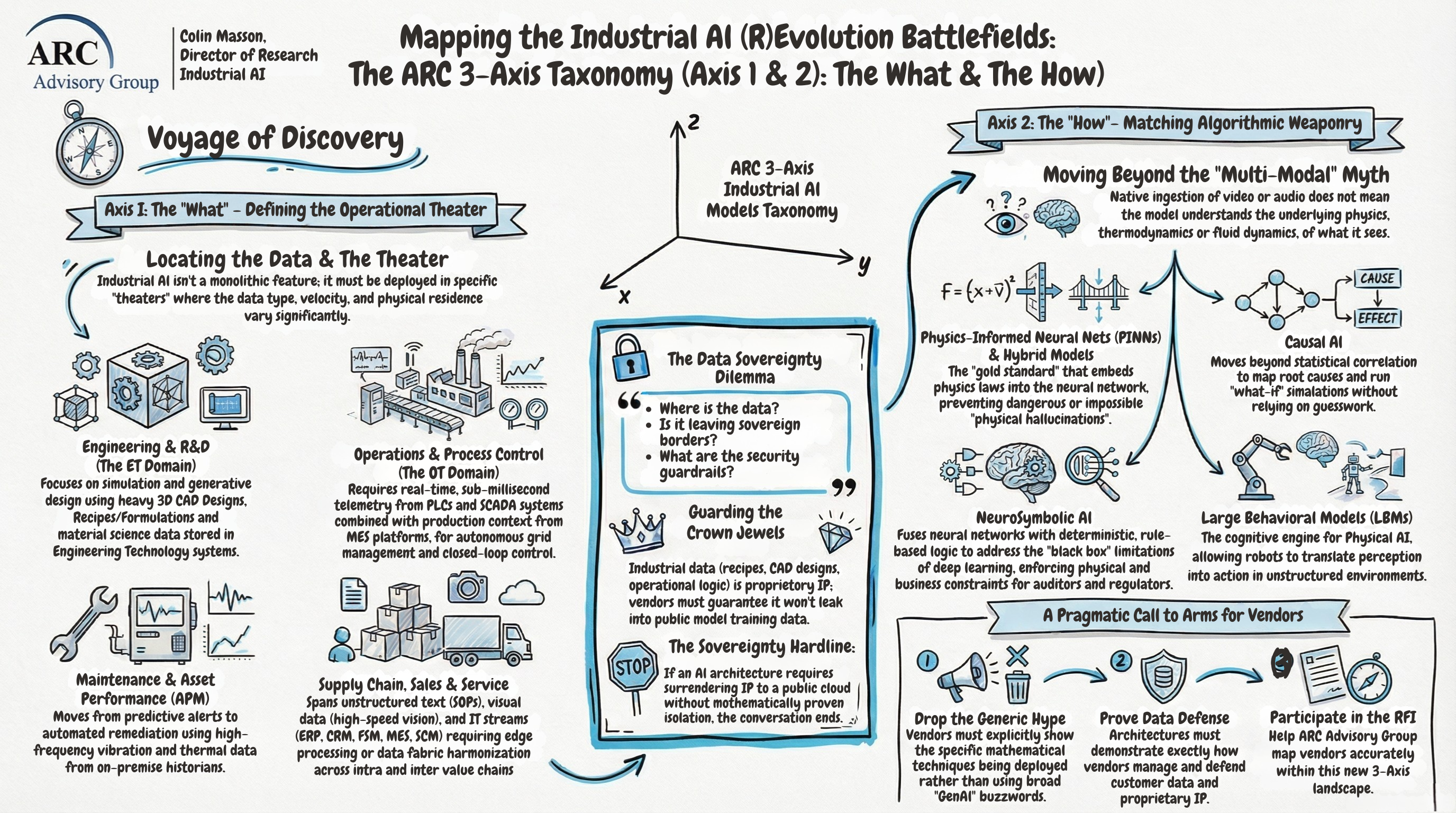
Welcome back to our series on the ARC 3-Axis Industrial AI Models Taxonomy. To successfully escape the gravity of pilot purgatory, industrial leaders must fundamentally rewire how they procure intelligence. We must stop evaluating AI as a monolithic, magical software feature and begin systematically deconstructing it based on harsh operational realities. That evaluation begins by rigorously defining the first two dimensions of our framework: the "What" and the "How."
Industrial workflows are not office applications; they are inherently specialized, unforgiving, and deeply rooted in physical reality. A generic model that excels at summarizing corporate emails will fail catastrophically if asked to optimize a continuous chemical batch process.
Axis 1 defines the specific operational theater where the AI will be deployed. More importantly, it dictates the type of data the AI will consume, its velocity, and exactly where that data physically resides today:
Engineering, R&D, and Design: The goal here is accelerating time-to-market through simulation and generative design. The data feeding this theater—heavy 3D CAD files, material science physics, and Product Lifecycle Management (PLM) data—resides deep within ET (Engineering Technology) systems. This is highly structured, massive-file data that is often heavily siloed and guarded as the company's core intellectual property.
Operations and Process Control: This theater demands closed-loop optimization and autonomous yield management. It requires real-time, sub-millisecond time-series telemetry pulled directly from Programmable Logic Controllers (PLCs), SCADA systems, and edge devices bolted to the factory floor. In this domain, latency isn't a mere inconvenience—it is a critical safety hazard.
Maintenance and Asset Performance Management (APM): Moving from predictive failure alerts to prescriptive, automated remediation. This theater relies on high-frequency vibration, thermal, and acoustic data. This information is typically housed in on-premise operational historians that are notoriously difficult and expensive to pipe to the public cloud without losing fidelity.
Quality, Safety, and Compliance: Focused on real-time defect detection and automated regulatory auditing. This theater relies heavily on massive streams of unstructured visual data from high-speed vision systems, LIDAR, and security cameras. The sheer bandwidth required means processing must often happen at the edge, directly at the point of ingestion.
Supply Chain and Logistics: Multi-tier visibility and dynamic routing. This pulls from traditional IT data streams like ERPs, Warehouse Management Systems (WMS), and highly decentralized external logistics networks, requiring advanced data fabric harmonization.
Workforce and Field Service: Augmenting human operators with contextualized, step-by-step guidance. The data feeding these copilots is often unstructured, messy text—digitized Standard Operating Procedures (SOPs), legacy maintenance manuals, shift logs, and tribal knowledge buried in SharePoint drives.
Before we can even begin to discuss how AI processes this data (Axis 2), we have to address the elephant in the room: the physical location, ownership, and vulnerability of the data itself.
Industrial data is not just administrative exhaust; it represents the absolute crown jewels of the enterprise. It is the exact molecular composition of a pharmaceutical drug. It is the proprietary tolerance levels of a next-generation aerospace turbine. It is the real-time operational status of critical national energy grids. For decades, this data has been heavily guarded—locked safely behind firewalls in on-premise servers and physically air-gapped factory networks.
Now, software vendors and hyperscalers are asking industrial organizations to stream this highly sensitive, proprietary information into the public cloud to feed their new AI models. As we highlighted in our recent research, this request is triggering massive anxiety and institutional resistance. When I speak with plant managers and CISOs, they are halting AI deployments to ask four uncompromising questions:
Where exactly is our data being managed and stored?
Is it leaving our sovereign borders?
What explicit security guardrails are in place to minimize cyber risk in our critical infrastructure?
And crucially, how are you guaranteeing that our hard-earned proprietary intellectual property (IP)—our recipes, our CAD designs, our operational logic—won't leak into the training data of your public models?
— ARC Advisory Group's Industrial Customers
If a vendor's AI architecture requires a manufacturer to blindly surrender their IP to a public hyperscaler without strict, mathematically proven data isolation and residency controls, the conversation ends there. Period.
In any overarching war, there are countless, distinct battlefields—each demanding entirely different tactics, logistics, and weapons. This brings us directly to Axis 2. Once we know the specific domain (the battlefield) and the sensitivity of the data, we must select the correct AI model class (the weaponry) to process it. You wouldn't bring a submarine to a land battle, and you absolutely shouldn't bring a probabilistic LLM to a deterministic PID control loop.
Before we dive into the specific model classes, we must address a common counter-argument from the proponents of massive frontier or foundation models. Vendors are quick to point out that their latest releases are no longer strictly Large Language Models (LLMs); they are now multi-modal, capable of natively ingesting video, audio, and images alongside text.
While this multi-modal capability is an impressive computer science milestone, let me be absolutely clear: processing an image does not mean the model suddenly understands the underlying physics of what it is seeing. Being able to ingest a live video feed of a chemical reaction or scan a complex 3D CAD rendering does not mean the foundation model has cracked the code on fluid dynamics, thermodynamics, or complex stoichiometry.
Multi-modality simply changes the input mechanism; it does not magically overcome the inherent problems of probabilistic hallucinations, predictability, or explainability—let alone provide the strict determinism required for safe, closed-loop industrial control. An AI that can accurately describe a picture of a failing turbine still cannot be trusted to autonomously adjust its high-pressure valves without physical grounding.
This is exactly why we must cut through the deafening Generative AI noise and look beyond generalized foundation models. Industrial pacesetters are actively deploying highly specialized, diverse mathematical frameworks designed to handle the exact constraints of their specific battlefield:
Analytics and ML: Traditional data-driven predictive and prescriptive models (like Random Forests or Gradient Boosting). These remain foundational for identifying historical trends and anomalies in structured time-series data. Because they are mature, they can often run efficiently at the edge without requiring massive, expensive cloud compute overhead.
Computer Vision: Vision Transformers (ViTs) and Convolutional Neural Networks (CNNs) for spatial computing. Because video and image data is incredibly heavy, uploading it to the cloud is often economically and functionally unviable. These models require robust edge-computing infrastructure to process data locally, preventing bandwidth saturation and eliminating latency.
Physics-Informed and Hybrid Models (PINNs): A transformative class that embeds first-principles physics (thermodynamics, fluid dynamics, kinetic energy) directly into the neural network's loss function. Because they learn the rules of physics natively, they require significantly less training data. Most importantly, they are mathematically prevented from "physically hallucinating" impossible or dangerous scenarios, making them the gold standard for process optimization.
Causal AI: Moving beyond traditional statistical correlation (which often flags irrelevant symptoms buried in noisy sensor data), causal AI maps generative processes using Structural Causal Models (SCMs). This allows operators to run counterfactual "what-if" simulations and pinpoint the exact root causes of machinery failure without relying on statistical guesswork.
NeuroSymbolic AI: Fuses the statistical pattern-matching power of neural networks with hard-coded, rule-based deterministic logic. This is crucial for eliminating "black box" opacity, ensuring absolute reliability, and satisfying auditors in heavily regulated environments where every decision must be explicitly traceable.
Behavioral Models (LBMs): The cognitive engine of physical intelligence. These models (including Vision-Language-Action or VLA architectures) are capable of translating environmental perception directly into fluid, physical action. By learning policies from video and teleoperation data, they empower humanoid robotics and autonomous guided vehicles to navigate dynamic, unstructured physical spaces rather than being confined to safety cages.
Let me pause here and ask a critical question: Is this list of algorithmic weaponry exhaustive? Absolutely not. The Industrial AI landscape is evolving at a breakneck speed. We are already tracking the rise of highly specialized Small Language Models (SLMs) purpose-built for low-power edge devices, federated learning techniques that train models across multiple global plants without ever moving raw data across borders, and the early, promising stages of quantum machine learning for complex chemical synthesis.
This taxonomy is a living framework, and we need your input to ensure it remains the definitive industry standard. I am putting out a call to our ARC clients, academic researchers, and technology vendors: What significant algorithmic categories are we missing on Axis 2? What emerging or proven techniques are you successfully deploying on the plant floor—or elsewhere across the industrial enterprise? We want to hear from you as we expand and refine this axis during our Voyage of Discovery.
In my next post, we will explore (arguably) the most critical differentiator in the AI Wars: Axis 3, which directly addresses the data sovereignty and governance questions raised today, defining whether your AI is protected by a shallow data wrapper or a mathematically rigorous domain foundation.
Vendors: Keep an eye out for ARC’s upcoming RFI for our Industrial AI Models MAR. Ensure your specialized architectures, data residency controls, and unique mathematical approaches are properly represented.
The Industrial AI (R)Evolution is moving faster than ever. To dive deeper into the frameworks and data shaping the future of the industrial sector, explore my latest research:
Navigating the AI Wars and the escalating Industrial Robot Wars
Closing the Digital Divide by Embracing Industrial AI
Assembling your Industrial-Grade Data Fabric
Charting the new frontier of Physical Intelligence and transitioning to a Cyber-Physical Industrial Architecture (CPIA)
Mapping your maturity and strategy with ARC's 3-Axis Industrial AI Models Taxonomy
Where do you stand in the Industrial AI (R)Evolution? Take our Industrial AI Assessment to benchmark your organization's maturity, identify critical gaps in your IT/OT/ET convergence, and get actionable recommendations to accelerate your path to becoming an Industrial AI Pacesetter.
Don't guess what your global operations or prospective customers need. Use empirical data to align your stakeholders and de-hype the market with ARC Advisory Group's Voice of Market Service.
For tailored recommendations on governing and guiding major people, process, and technology decisions across the enterprise, cloud, industrial edge, and AI, please contact Colin Masson at [email protected].
Or, set up a meeting with my fellow Analysts and I at ARC Advisory Group to find out more about our Executive Insights Service for Industrial organizations and our Industrial AI Insights Service for Vendors.
Editor's Note: As Colin Masson emphasizes throughout this series, charting the Industrial AI landscape is an active "Voyage of Discovery." Since the initial publication of these early blogs, ARC Advisory Group has rigorously tested our taxonomy with our network of industrial clients and vendors. Based on this direct market feedback, we have significantly refined Axis 1 (Application Domain) from a flat menu of categories into a strict hierarchical "Escalation Ladder of Physical Consequence" (Levels 0 through 5). The AI Archetypes explored in the subsequent posts of this series reflect this newly updated, battle-tested taxonomy.