Representative End User Clients







Representative Automation Clients







Representative Software Clients








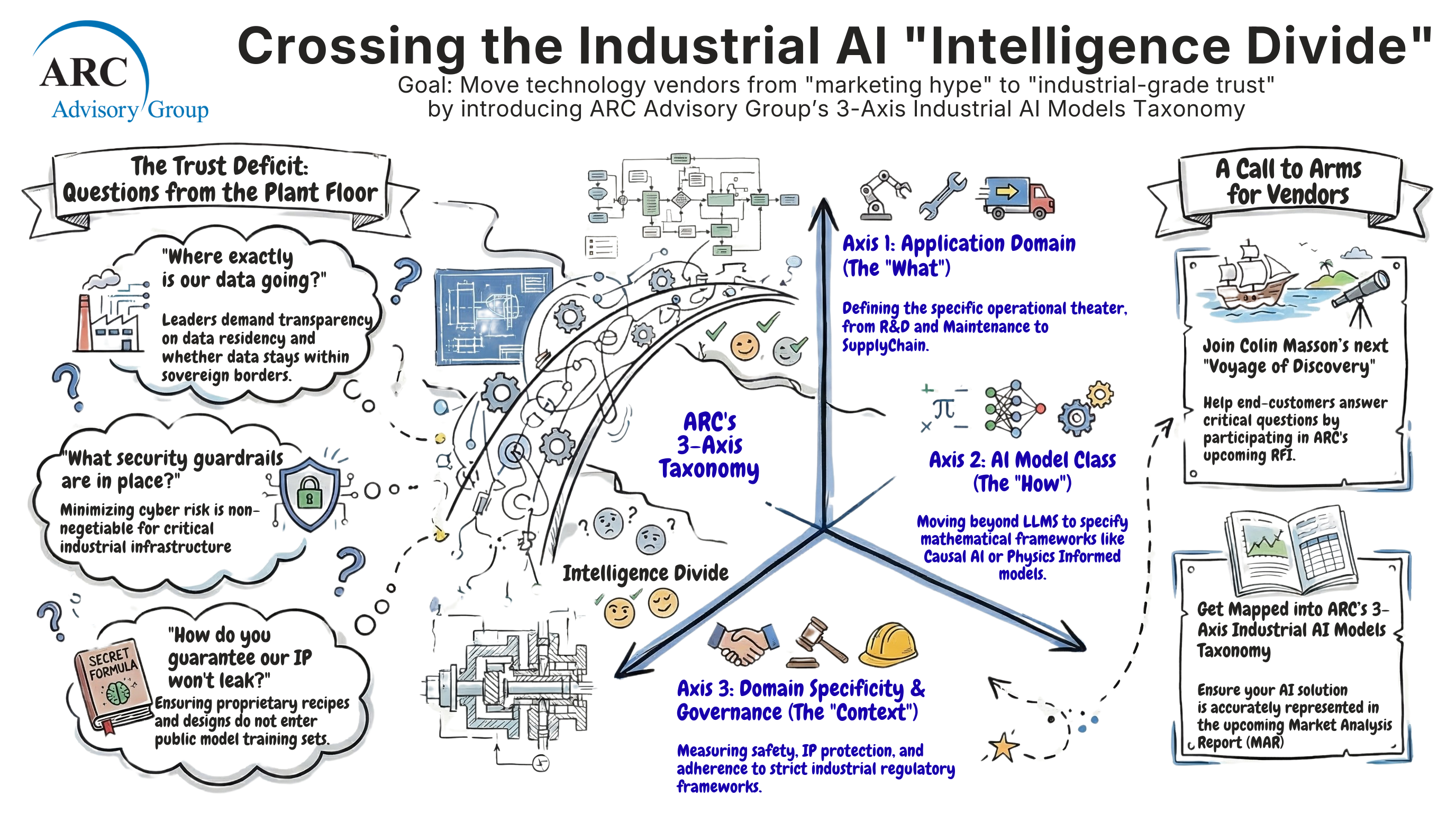
In my daily role as a pragmatic advocate for Industrial AI here at ARC Advisory Group, I spend my time talking to leaders across the entire industrial spectrum. Whether I am speaking with the elite Pacesetters who are aggressively scaling autonomy, the Mainstream majority desperately seeking solid traction, or the Laggards who are feeling completely left behind, a common, urgent frustration consistently surfaces. The industrial sector is bifurcating along a severe fracture line I call the "Intelligence Divide." And ironically, the ability to cross that divide is being actively hindered by the very vendors selling the solutions.
Our end users are being completely inundated with a relentless barrage of vendor marketing claims. Today, it seems every software update and new product release is pitched as "AI-driven," "agentic," or an "intelligent Copilot." However, when you scratch beneath the surface of these glossy presentations, there is a glaring lack of substance. There is little to no explanation of the specific mathematical techniques actually being applied. Industrial leaders need to know: Is this a simple historical regression model? Is it a probabilistic large language model prone to hallucinations? Or is it a deterministic, physics-informed neural network capable of safe, closed-loop control? Without this clarity, organizations are forced to guess, making it impossible to match the right tool to the right problem.
More critically, there is a profound and dangerous lack of clarity regarding data management and security. Plant managers, Chief Information Security Officers (CISOs), and operational leaders are rightly hitting the brakes on deployment. They are demanding answers to fundamental, non-negotiable questions:
Where exactly is our data being managed and stored?
Is it leaving our sovereign borders?
What explicit security guardrails are in place to minimize cyber risk in our critical infrastructure?
And crucially, how are you guaranteeing that our hard-earned proprietary intellectual property (IP)—our recipes, our CAD designs, our operational logic—won't leak into the training data of your public models?
When vendors rely on flat taxonomies and broad buzzwords to avoid answering these questions, they create dangerous false equivalencies. Classifying AI merely by a broad function (like "Generative AI") heavily obscures its true industrial value and operational safety. A flat taxonomy wrongly equates a marketing email generator with a complex chemical synthesis engine. A "hallucination" in a marketing email is simply a typo to be edited; a hallucination within the control loop of a high-pressure refining environment is a catastrophic, physics-violating failure that risks lives and capital.
To navigate this complexity, cut through the marketing noise, and provide our clients with the clarity they demand, ARC Advisory Group has developed the 3-Axis Industrial AI Models Taxonomy. This is not just an academic exercise; it is a direct response to our end users' need for a definitive scorecard to evaluate whether a model is a novel toy or a highly deterministic, secure, industrial-grade tool.
If you followed my research last year, you'll recall I embarked on a "Voyage of Discovery" to map the critical components of the Industrial Data Fabric. That journey proved that a unified, secure data foundation is the absolute prerequisite for any scalable intelligence. Today, building on that foundation, I am officially launching my next voyage of discovery. Over the coming weeks, we will navigate the complexities of the intelligence layer itself by breaking down the three axes that define true industrial AI readiness:
Application Domain (The "What"): The specific operational theater and business problem being solved.
AI Model Class (The "How"): The specific algorithmic architecture and mathematical framework (moving well beyond just LLMs to pinpoint exactly how the AI reasons and what techniques are being applied).
Domain Specificity & Governance (The "Context"): The critical measure of safety, data residency, IP protection, and regulatory adherence.
Once we've charted the axes, I will begin to map out the strategic AI Archetypes we currently see emerging in the market. To be clear: the six archetypes we are initially outlining represent what we see today. However, this is an active exploration. We fully expect to discover new archetypes—and perhaps consolidate or remove others—as we dive deeper into the reality of the market on this ongoing voyage.
Finally, a message to the industrial technology vendors reading this: consider this a pragmatic call to arms. Help us to help you. Our industrial end users—across Pacesetters, Mainstream, and Laggards—want to invest in your technology to bridge the skills gap, optimize their supply chains, and drive unprecedented productivity. But they simply cannot buy what they cannot validate, secure, or trust. We need you to help us address these specific user concerns head-on.
I invite you to participate in our upcoming Market Analysis Report (MAR). Drop the generic hype, show us exactly the techniques you are deploying, prove how your architecture manages and defends customer data and IP, and ensure your specialized solutions are accurately mapped within this rigorous new landscape.
The Industrial AI (R)Evolution is moving faster than ever. To dive deeper into the frameworks and data shaping the future of the industrial sector, explore my latest research:
Navigating the AI Wars and the escalating Industrial Robot Wars
Closing the Digital Divide by Embracing Industrial AI
Assembling your Industrial-Grade Data Fabric
Charting the new frontier of Physical Intelligence and transitioning to a Cyber-Physical Industrial Architecture (CPIA)
Mapping your maturity and strategy with ARC's 3-Axis Industrial AI Models Taxonomy
Where do you stand in the Industrial AI (R)Evolution? Take our Industrial AI Assessment to benchmark your organization's maturity, identify critical gaps in your IT/OT/ET convergence, and get actionable recommendations to accelerate your path to becoming an Industrial AI Pacesetter.
Don't guess what your global operations or prospective customers need. Use empirical data to align your stakeholders and de-hype the market with ARC Advisory Group's Voice of Market Service.
For tailored recommendations on governing and guiding major people, process, and technology decisions across the enterprise, cloud, industrial edge, and AI, please contact Colin Masson at [email protected].
Or, set up a meeting with my fellow Analysts and I at ARC Advisory Group to find out more about our Executive Insights Service for Industrial organizations and our Industrial AI Insights Service for Vendors.
Editor's Note: As Colin Masson emphasizes throughout this series, charting the Industrial AI landscape is an active "Voyage of Discovery." Since the initial publication of these early blogs, ARC Advisory Group has rigorously tested our taxonomy with our network of industrial clients and vendors. Based on this direct market feedback, we have significantly refined Axis 1 (Application Domain) from a flat menu of categories into a strict hierarchical "Escalation Ladder of Physical Consequence" (Levels 0 through 5). The AI Archetypes explored in the subsequent posts of this series reflect this newly updated, battle-tested taxonomy.