Representative End User Clients







Representative Automation Clients







Representative Software Clients








The industrial sector is undergoing a massive transformation fueled by artificial intelligence (AI). This shift presents both tremendous opportunities and significant challenges for industrial organizations. To effectively navigate this complex landscape, it is crucial to understand how leading companies are approaching AI adoption, and that means getting insights from their peers, and leaning on the right partners for their unique Industrial AI requirements. The ARC Advisory Group Leadership Forum in Orlando next month is the perfect opportunity for IT, OT, and business decision-maker (BDM) executives to gain these critical insights.
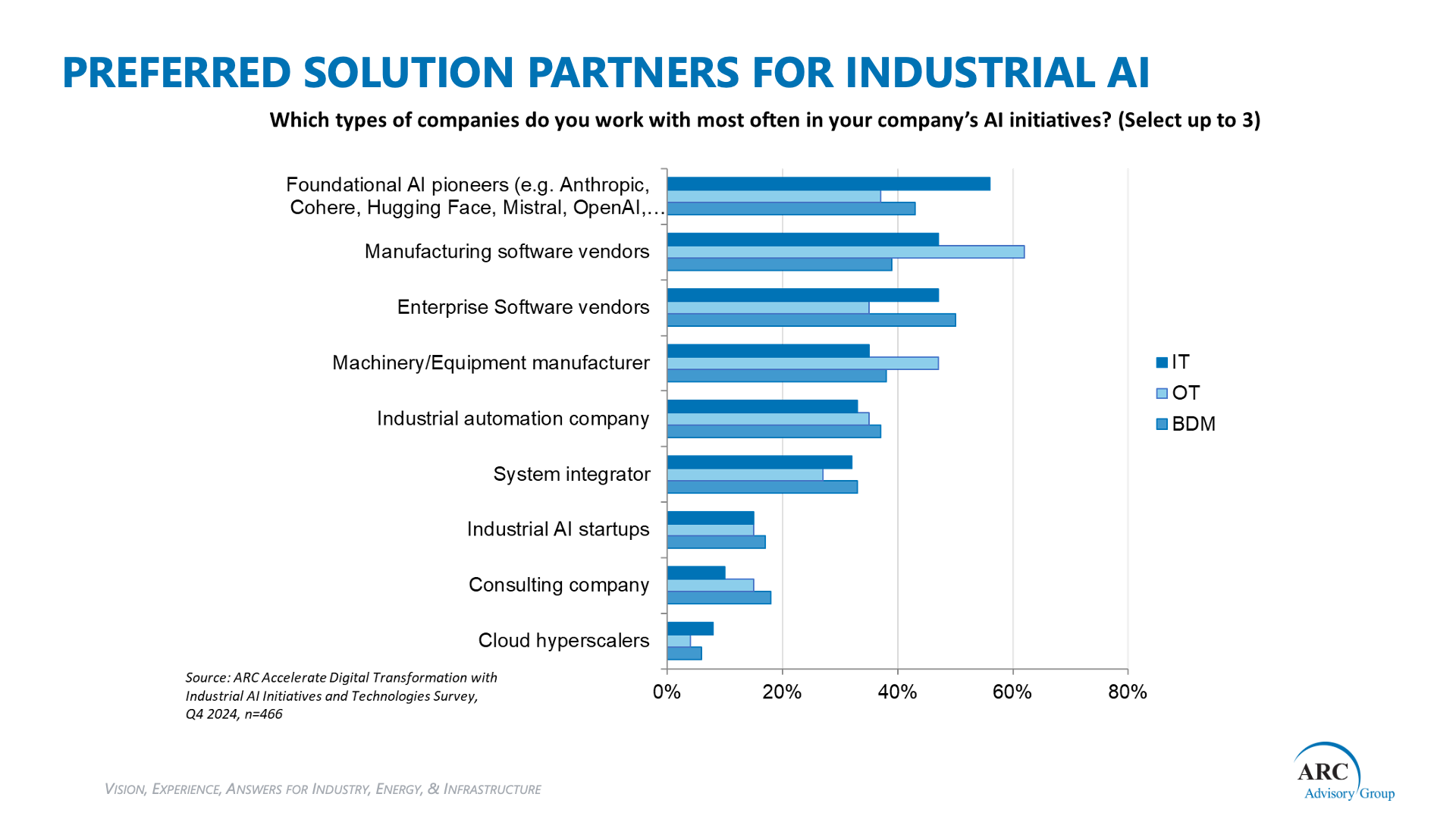
The data from ARC's recent survey on preferred solution partners for Industrial AI reveals clear trends that should shape your AI strategy. Industrial organizations are not approaching AI in a vacuum. They are leaning heavily on partners with proven domain expertise.
Manufacturing Software Vendors Lead the Pack—with OT: Manufacturing software vendors are the most frequently chosen partners for AI initiatives in their domain. This reflects a preference for AI solutions that are deeply integrated with the specific processes, systems, and workflows that energy and manufacturing production organizations rely on. This underscores the need to prioritize AI solutions that fit within a company’s existing operations, and not introduce new complexities, inefficiencies, or risks.
Industrial Automation and Machinery/Equipment Vendors—a Close Second with OT: Industrial automation and machinery/equipment companies are another critical partner for Industrial AI initiatives. Their expertise in the machinery, hardware, and control systems that underpin industrial operations makes them essential for AI projects that seek to optimize production processes, predict equipment failures, and improve overall operational efficiency.
Enterprise Software Vendors are Trusted by BDMs to Infuse AI: While important, enterprise software vendors are less frequently chosen by OT than manufacturing and automation specialists when it comes to their Industrial AI production operations use cases. However, IT and especially BDMs see them as essential for overall business management. Adopting enterprise software vendors' AI capabilities can be a quick and low-risk win—provided the organization has avoided excessive customization, which can hinder the integration of AI upgrades.
Foundational AI Pioneers are Favored by IT: A significant observation is that IT departments in industrial organizations are increasingly opting to collaborate directly with Foundational AI pioneers, including companies like Anthropic, Cohere, Meta, Mistral AI, and OpenAI. This reflects a desire to leverage the latest advances in AI and customize foundation models to their enterprise specific “language” and needs. This signals that for more sophisticated AI initiatives, organizations may need to develop their own AI solutions and not simply rely on ready-made solutions from enterprise software vendors. IT leaders are the most likely of the three groups to take this approach.
Consulting Companies and Hyperscalers Lag in Direct Engagement: Interestingly, the data shows that industrial organizations are less likely to directly engage with consulting firms and cloud hyperscalers for their AI initiatives. This may indicate a preference for partners who can provide actionable solutions and direct expertise over generalized consulting services. While hyperscalers will play a vital role in all this, their influence comes more in the form of infrastructure investment and ecosystem enablement.
These findings have significant implications for IT, OT, and BDM leaders:
IT Leaders: IT managers are the most likely to lead AI initiatives. They must carefully evaluate the software and technology platform selections and vendor partnerships needed to support AI, and this includes considering partnerships with Foundational AI players to create custom models when the ready-made solutions are not the right fit.
OT Leaders: OT leaders can leverage the domain expertise of automation and equipment vendors and should engage with IT and the data science team at their company to define their needs for specific industrial use cases.
BDM Leaders: Business decision-makers must ensure that AI investments are aligned with business objectives and that initiatives address the challenges and opportunities specific to their operations, with support from IT, OT, and the data science team, and working with the governance council to allocate funding and prioritize use cases.
While the survey results show that industrial organizations aren't as likely to directly partner with cloud hyperscalers for their Industrial AI projects, the role of these technology giants cannot be overlooked. Cloud hyperscalers like AWS, Google, and Microsoft are the driving force behind the AI (R)evolution. They are investing heavily in AI infrastructure, data centers, and edge computing capabilities. They are building out their partner ecosystems with industrial automation and manufacturing software companies so that their customers can tap into the domain expertise that's critical to success in the industrial space. These hyperscalers are essential to the advancement of Industrial AI:
AI Infrastructure: Hyperscalers provide the scalable infrastructure needed to power AI models, including the necessary computing power and storage for processing massive data sets. Microsoft, for example, has committed to significant investments in AI infrastructure.
AI Services: They offer a wide range of AI services, including machine learning, computer vision, and natural language processing. This enables industrial organizations to leverage AI technologies without the need for extensive in-house expertise.
Ecosystem Development: Hyperscalers are actively building out their partner ecosystems, collaborating with industrial software vendors, and startups. This is critical to provide end-to-end solutions that can address the specific needs of the industrial sector. As highlighted in ARC's analysis of both AWS re:Invent 2024 and Microsoft Ignite 2024, these hyperscalers are focusing on building partner ecosystems to provide tailored solutions that combine industry knowledge with their technological capabilities.
Industrial AI is different from general-purpose AI. It requires a deep understanding of the unique processes, systems, and data that are specific to the industrial sector. This is where the preference for manufacturing software vendors, industrial automation companies, and engagement with AI pioneers becomes clear. These partners offer the domain expertise and solutions that are needed to extract value from AI in a specific industrial setting. Also, most industrial organizations need to hire or develop internal data scientists and other AI experts who understand both AI and the industrial domain.
The ARC Industry Leadership Forum in Orlando, Feb 10-13, is a unique opportunity to learn from industry leaders, network with peers, and gain actionable insights into the future of Industrial AI. Here's what you can expect:
Peer Learning: Hear directly from your peers about their experiences, strategies, and challenges in adopting AI in the industrial sector.
Expert Analysis: Gain in-depth analysis from ARC analysts about the latest trends in Industrial AI. ARC's Industrial AI Impact Assessment Model for People, Processes, and Technology offers a structured framework to assess the impact of AI in a company.
Strategic Guidance: Get recommendations on how to prioritize your AI investments, select the right partners, and build the necessary infrastructure and governance models.
Cutting-Edge Insights: Learn about the latest advancements in Industrial AI, including the benefits and risks of Generative AI and other AI techniques like Causal AI, and new architectural evolutions like AI Agents and Multi-Agent Orchestration. Explore the critical role of Industrial-Grade Data Fabrics and the importance of building robust and secure data management frameworks.
By attending the ARC Industry Leadership Forum in Orlando, Feb 10-13, industrial executives can gain a deeper understanding of how to compete in the new age of Industrial AI, learn from the experiences of industry leaders, and accelerate their digital transformation journeys. This is a great opportunity to network with manufacturing and technology vendors, and industrial end users to help your company get on the right path with your Industrial AI strategy.
For ARC Advisory Group recommendations for navigating the AI Wars, closing the digital divide by embracing Industrial AI, and governing and guiding major decisions about enterprise, cloud, industrial edge and AI software, please contact Colin Masson at [email protected] and set up a meeting at the ARC Leadership Forum!