Representative End User Clients







Representative Automation Clients







Representative Software Clients








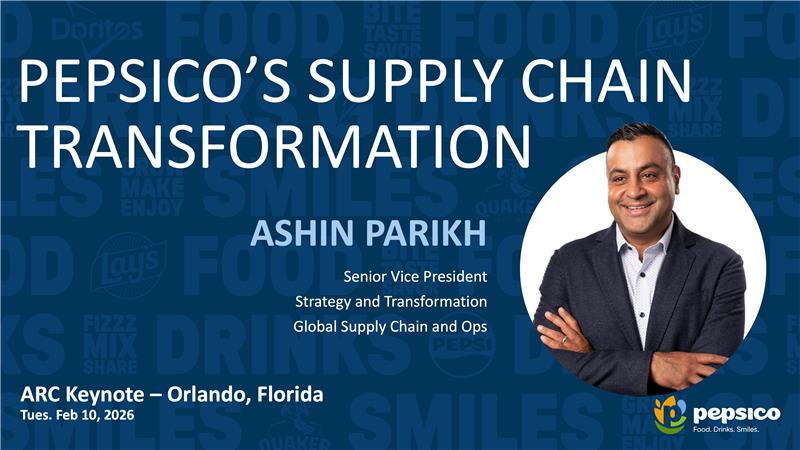
If there was one overarching theme at the 30th Annual ARC Industry Leadership Forum in Orlando last week, it was this: the era of "pilot purgatory" is officially over for the market leaders. We are now firmly operating in what I’ve been calling the Schism of Speed.
As we detailed in our Industrial AI Pacesetters 2026 Report and the Q4 2025 Industrial AI, Energy, and Robotics Survey, the market has irrevocably fractured. The top 13 percent of industrial organizations—the Pacesetters—have stopped treating Artificial Intelligence as a siloed IT experiment and have weaponized it as a core operational strategy.
As I sat listening to the opening keynote by Ashin Parikh, Senior Vice President of Strategy and Transformation, Global Supply Chain and Ops at PepsiCo, I realized the audience was getting a masterclass in exactly what this "Pacesetter" DNA looks like in the wild.
Later in the day, I had the privilege of moderating an executive panel featuring Ashin alongside Chase Christensen of Jabil, Steve Blackwell of AWS, Chad Wright from Boston Dynamics, and Axel Lorenz from Siemens. But before I dive into the panel insights in a future post, I want to unpack the PepsiCo keynote, because it perfectly validated the aggregate data we’ve been tracking at ARC.
PepsiCo operates at a staggering scale: over 200 countries, 291 manufacturing sites, and more than 1 billion consumer touchpoints per day. But the metric that stood out to me wasn’t its $92 billion in net revenue; it was its 60 Petabytes of Enterprise Data and the 15,000+ associates driving its transformation.
In our Q4 2025 survey, we found that the number one barrier to scaling AI is a shortage of specialized talent (42 percent), followed closely by fragmented data architectures. The Pacesetter playbook dictates that you cannot scale intelligence on fragmented infrastructure. PepsiCo has solved this by cultivating a massive internal army of data scientists, ML engineers, and—crucially—what I highlighted in my recent blog, Industrial AI Needs Context Engineers, NOT Prompt Engineers, professionals who can bridge the gap between data science and physical supply chain physics.
One of the most profound shifts highlighted in our Q4 2025 research is the transition from passive GenAI (chatbots) to Agentic AI. A massive 56 percent of our survey respondents stated that Level 3 Autonomous Operations models are their highest investment priority over the next 2–3 years.
Ashin brought this to life brilliantly. He explained how PepsiCo is building a Multi-Agent framework utilizing over 1,500 AI agents and bots. He shared a specific, high-value supply chain example:
Instead of a human supervisor staring at a dashboard waiting for a bottleneck, PepsiCo’s Intelligent Vision system spots pallets stacking up at inbound staging. The Agentic AI then takes over, determining that this will block outbound flow in 20 minutes, locating available labor in Zone B, and proactively recommending or taking action to reroute the workforce.
As Ashin perfectly summarized it:
"Vision gives the operation eyes. Agentic AI gives it a brain. Robots give it hands. This is how you move from 'We automate tasks' to 'We run an adaptive, self-correcting operation.'"
We’ve been tracking the evolution of Digital Twins for years, but 2026 is the year the Industrial Metaverse is proving its capital efficiency. Building on their work announced at CES 2026, Ashin showcased how PepsiCo is using the Siemens Digital Twin Composer, powered by NVIDIA, to fundamentally change how it designs and operates.
Our survey data shows 41 percent of companies plan to implement Digital Twins in the next three years, but PepsiCo is already reaping the rewards. By adopting a "digital-first design approach," PepsiCo is co-designing with AI to simulate and optimize layouts before pouring a single yard of concrete. The proof of value is undeniable: it achieved a 25 percent capital reduction at its Grand Prairie warehouse using engineering and operational twins, and a 54 percent dock optimization at its Lancaster Mixing Center.
It is pulling massive amounts of factory data from facilities—some half a century old—into photorealistic, AI-powered simulations. It’s the ultimate de-risking tool for CapEx.
Perhaps my favorite quote from Ashin’s keynote was this:
"After a century of mechanizing the humans, we are at the frontier of humanizing the machine."
This perfectly aligns with our findings on the "Connected Frontline Worker." The fear narrative that AI is simply a headcount reduction tool is dead wrong. Our survey showed only 16 percent of industrials cite "replacing workers" as a primary goal; the vast majority (55 percent) are focused on augmenting worker productivity and safety. PepsiCo's vision of a Hybrid Human & AI Workforce is about giving its supply chain teams super-intelligence, reducing the reliance on decades of tribal knowledge just to solve routine operational problems.
PepsiCo has proven that bridging the Intelligence Divide requires a cohesive strategy: a unified data fabric, Agentic AI, immersive physical simulation, and a workforce empowered to orchestrate it all. It is not just surviving the Schism of Speed; it is defining the curve.
In my next post, I’ll be reflecting on the keynote from Jabil's Chase Christensen and exploring how contract manufacturing is adapting to these exact same forces, before bringing it all together with our Executive Panel insights featuring Siemens, AWS, and Boston Dynamics.
Stay tuned. The Industrial AI (R)Evolution is moving faster than ever.
(To dive deeper into the data driving these trends, members of the ARC Executive Insight Service can access our full "Industrial AI Pacesetters 2026 Report" and selected insights from our "Q4 2025 Industrial AI, Energy, and Robotics Survey" via the ARC client portal. For customized benchmarking, vendor analysis, and specialized market intelligence, explore ARC Advisory Group's Voice of Market Service.)
For ARC Advisory Group recommendations for Navigating the AI Wars—including the Industrial Robot Wars—Closing the Digital Divide by Embracing Industrial AI, assembling your Industrial-Grade Data Fabric, and governing and guiding major people, processes, and technology decisions about enterprise, cloud, industrial edge, and AI, please contact Colin Masson at [email protected].
Or set up a meeting with my fellow Analysts and I, at ARC Advisory Group to find out more about our Executive Insights Service for Industrial organizations, and Industrial AI Insights Service for Vendors.