Representative End User Clients







Representative Automation Clients







Representative Software Clients








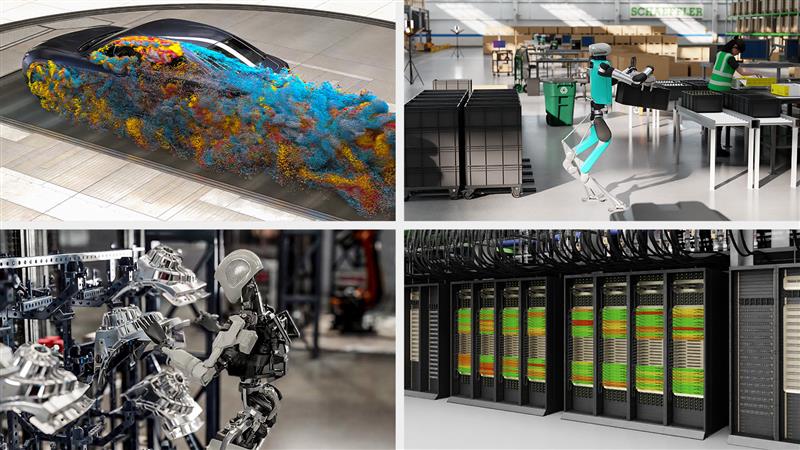
At NVIDIA's GTC 2025 this week, anticipation filled the air as many speculated on how NVIDIA would respond to the recent waves stirred by DeepSeek. Would it pivot its strategy or take a defensive stance? Instead, NVIDIA delivered a clear message—an unwavering commitment to innovation, especially in Industrial AI. Its role in scaling AI for industrial applications remains crucial, and GTC 2025 underscored this with more than just technological breakthroughs. The event highlighted real-world industrial deployments and strategic partnerships that are actively shaping the Industrial AI R(E)volution.
The DeepSeek Question: Innovation and the Rise of Reasoning AI
Before delving into the industrial highlights, let's address the obvious: DeepSeek. The excitement surrounding its recent advancements and potential influence on the AI landscape was undeniable. The lingering question was, "How will NVIDIA respond?" Rather than engaging in a direct showdown, NVIDIA took a different approach—reinforcing its strengths. It doubled down on what it does best: advancing AI infrastructure and software, with a sharp focus on delivering the computational power essential for the future of AI.
In his keynote, Jensen Huang devoted considerable time to distinguishing between non-reasoning and reasoning AI. He emphasized the substantial computational demands of reasoning AI, which encompasses complex problem-solving, planning, and decision-making. This focus not only validates DeepSeek’s approach—centered on intricate modeling and reasoning—but also signals the broader trajectory of AI’s evolution.
Huang stressed that unlocking the full potential of reasoning AI would require a 100x increase in computational power. This remark highlights both the immense challenge ahead and the significant opportunity for NVIDIA to lead the charge in providing the necessary infrastructure.
"To achieve true reasoning AI, we will need 100x more computational power than what we have today," Huang stated. "This is not just about scaling up; it's about fundamentally rethinking how we build and deploy AI systems."
This insight aligns with a key finding from my research: NVIDIA's true strength lies in its ecosystem. By offering a comprehensive suite of hardware, software, and development tools, it supports a wide range of AI applications, from cloud-based training to edge inference. Huang’s emphasis on reasoning AI and the immense computational power required reinforces that NVIDIA doesn’t see DeepSeek as a threat. Instead, it remains focused on providing the foundational tools that will drive progress across the entire AI industry.
Huang’s emphasis on reasoning AI also indirectly addresses market concerns about potential shifts in AI development. By underscoring the need for significantly greater computational power, he reaffirms the critical role of NVIDIA’s hardware and software platforms, independent of the specific models or competitors in the space.
In his keynote, Huang reinforced NVIDIA’s commitment to enabling developers and industries to build the next generation of AI applications. While he didn’t mention DeepSeek by name, his message was clear: NVIDIA remains laser-focused on providing the tools and platforms that drive innovation, regardless of the changing landscape of AI players and models.
"Our goal is to democratize AI, to make it accessible to every industry, every developer, every creator," Huang stated. "We are building the infrastructure that will power the future of AI, enabling breakthroughs that were once thought impossible."
Industrial AI Takes Center Stage: Real-World Impact
What truly stood out at GTC 2025 was the strong focus on industrial applications. Through numerous customer stories, NVIDIA showcased how its technology is delivering real-world impact across manufacturing, energy, logistics, and beyond.
Manufacturing Excellence: Several manufacturers demonstrated how they are leveraging NVIDIA's Omniverse platform for digital twin development, enabling predictive maintenance, process optimization, and virtual commissioning. These showcases highlighted the increasing significance of physical intelligence—or Physical AI, as NVIDIA brands it—where digital simulations seamlessly integrate with real-world operations, driving efficiency and innovation across industries.
BMW showcased how the company is leveraging NVIDIA's Omniverse platform for digital twin development, enabling predictive maintenance, process optimization, and virtual commissioning.
"With NVIDIA Omniverse, we've been able to reduce our commissioning time by 30percent," said Dr. Milan Nedeljković, Member of the Board of Management of BMW AG, Production. "The ability to simulate and optimize our processes in a virtual environment has been transformative."
General Motors (GM): GM showcased its use of NVIDIA's DRIVE Sim platform to accelerate the development and validation of its autonomous driving systems. This is particularly significant for the future of smart factories and logistics, where autonomous vehicles and robots will be integral. By leveraging NVIDIA's AI capabilities, GM can simulate a vast array of driving scenarios, allowing for more efficient testing and refinement of its autonomous driving algorithms.
Siemens also highlighted its use of Omniverse to create highly realistic digital twins of manufacturing facilities, allowing for improved planning and optimization.
Energy Transformation: Energy companies showcased how they are utilizing NVIDIA's AI solutions for grid optimization, renewable energy forecasting, and autonomous inspection of critical infrastructure. This emphasis on sustainability and efficiency aligns with the Industrial AI (R)Evolution, where AI plays a key role in optimizing resources and minimizing environmental impact.
Shell highlighted the use of NVIDIA's AI solutions for grid optimization, renewable energy forecasting, and autonomous inspection of critical infrastructure.
GE Vernova showed how the company uses NVIDIA technology to improve the reliability and efficiency of power grids.
Logistics Revolution: Logistics providers demonstrated how NVIDIA's Metropolis platform is enhancing warehouse automation, autonomous vehicle navigation, and supply chain optimization. The ability to process and analyze vast amounts of sensor data in real-time is crucial for improving efficiency and resilience in today's complex supply chains.
FedEx demonstrated how NVIDIA's Metropolis platform is enhancing warehouse automation, autonomous vehicle navigation, and supply chain optimization. The company showcased how AI is improving package sorting and optimizing delivery routes, driving greater efficiency across its logistics operations.
Amazon Robotics also displayed how it uses NVIDIA platforms to increase the efficiency of its warehouse automation.
These customer stories reinforce that NVIDIA's technology is not just theoretical; it's delivering real-world value across a wide range of industrial applications.
Partnerships Powering the Industrial AI Ecosystem
Beyond customer success stories, GTC 2025 highlighted a series of strategic partnerships that further cement NVIDIA's role in the Industrial AI landscape. Collaborations with leading industrial automation companies and software providers are playing a key role in bridging the gap between IT and OT, ensuring the seamless integration of AI into industrial workflows.
Siemens:
Expanded partnership to integrate NVIDIA Omniverse and AI into the Siemens Xcelerator platform. This collaboration aims to create a comprehensive digital twin ecosystem for industrial automation.
This integration will enable customers to design, simulate, and optimize manufacturing processes in a virtual environment, leading to improved efficiency and reduced downtime.
Rockwell Automation:
Collaboration to bring NVIDIA's AI and simulation capabilities to Rockwell's industrial automation solutions. This partnership focuses on enhancing industrial control systems with AI-powered analytics and predictive maintenance.
The integration of NVIDIA's AI platform into Rockwell's FactoryTalk platform will enable manufacturers to optimize production processes and improve overall equipment effectiveness (OEE).
Schneider Electric:
Partnership to develop AI-powered solutions for energy management and industrial automation. This collaboration focuses on integrating NVIDIA's AI platform into Schneider Electric's EcoStruxure platform.
The integration will enable customers to optimize energy consumption, improve grid stability, and enhance the reliability of critical infrastructure.
Cadence:
Cadence and NVIDIA are partnering to accelerate electronic systems design using computational lithography and digital twins.
This partnership aims to optimize the design and verification of complex electronic systems, including semiconductors and integrated circuits, using NVIDIA's accelerated computing platform.
This will dramatically improve the time to market for new electronic products.
Ansys:
NVIDIA and Ansys announced a collaboration to accelerate simulation workflows using GPU-accelerated computing.
This partnership will enhance the performance of Ansys' simulation software, enabling engineers to run complex simulations faster and more efficiently.
This will lead to improved product design and optimization across various industries, including automotive, aerospace, and manufacturing.
ServiceNow:
ServiceNow and NVIDIA are working together to bring GenAI capabilities into enterprise workflows.
This partnership will allow customers to leverage NVIDIA's AI platform within the ServiceNow platform to automate tasks, improve customer service, and enhance employee productivity.
This will enable businesses to streamline operations and drive innovation.
SAP:
NVIDIA and SAP are collaborating to integrate generative AI into enterprise applications, significantly enhancing business processes across various industries. This will allow for new ways to utilize data that resides within SAP systems, and enhance predictive capabilities across the entire SAP ecosystem. This partnership is especially important for industrial users of SAP, as it will allow for more predictive maintanence, more efficient supply chain management, and enhanced digital twin capabilities.
SightMachine:
NVIDIA and SightMachine are partnering to enhance manufacturing analytics and process optimization. This collaboration focuses on leveraging NVIDIA's AI platform to improve SightMachine's manufacturing execution system (MES) capabilities, enabling real-time insights and predictive quality control.
This will allow for more edge-based AI inferencing on manufacturing lines and increase overall equipment effectiveness.
These partnerships are crucial for scaling Industrial AI at the edge, where real-time data processing and analysis are essential for many industrial applications. By combining Nvidia’s edge computing solutions with the expertise of its partners, these collaborations are driving the seamless deployment of AI in industrial environments, making real-time decision-making more efficient and effective.
Agentic AI and the Model Context Protocol (MCP)
The rise of Agentic AI, where AI systems autonomously plan and execute tasks, is a key trend I’m exploring in my upcoming blog series on the Model Context Protocol (MCP). At GTC 2025, Nvidia reinforced its commitment to this new wave of AI, highlighting how its technology is shaping the future of autonomous decision-making and intelligent systems.
Nvidia's advancements in AI inference and runtime environments are key to enabling autonomous agents to operate efficiently and effectively. Its support for frameworks and protocols that enhance contextual understanding and knowledge sharing is equally important. While specific MCP integrations weren’t the primary focus at GTC 2025, the underlying technology and philosophy were clearly reflected. Stay tuned for my upcoming blogs, where I'll dive deeper into how Nvidia’s offerings align with MCP and the broader evolution of Agentic AI.
Re-Energizing Industrial Metaverses: Physical AI Realized
The concept of Industrial Metaverses—where digital twins seamlessly integrate with real-world operations—is experiencing renewed momentum. Nvidia’s Omniverse platform is at the heart of this resurgence, offering the tools and infrastructure needed to create and deploy immersive industrial environments that drive efficiency, optimization, and innovation.
This perfectly aligns with the vision of Physical AI, where digital simulations directly influence real-world actions. By enabling a seamless integration of digital and physical environments, Nvidia is equipping industries with the tools to optimize processes, enhance efficiency, and accelerate innovation across various sectors.
Key Announcements from GTC 2025: Impacting the Industrial Sector
Here’s a concise summary of the key announcements for IT/OT leaders and business decision-makers in the industrial sector:
Next-Generation AI Infrastructure (NVIDIA Blackwell Platform):
Nvidia introduced the Blackwell platform, featuring the GB200 Grace Blackwell Superchip, built to support trillion-parameter AI models. This breakthrough significantly boosts capabilities for complex simulations and AI-driven optimizations in industrial environments.
This platform provides the ability to handle massive datasets and complex AI workloads, which is crucial for applications like digital twin simulations, autonomous robotics, and advanced predictive maintenance.
NVIDIA NIM Microservices:
NVIDIA NIM microservices are designed to accelerate the deployment of GenAI models across various industries. This allows for the rapid integration of AI capabilities into existing industrial workflows.
These microservices simplify the process of deploying trained AI models, enabling faster time-to-value for Industrial AI initiatives.
Enhanced Omniverse Platform:
Updates to Omniverse include improved real-time simulation capabilities, enhanced physics-based rendering, and expanded support for industry-standard CAD and simulation tools.
These enhancements enable more accurate and realistic digital twin simulations, facilitating better design, optimization, and control of industrial processes.
6G AI-RAN and the Industrial Edge:
One of the most significant announcements at GTC 2025 was NVIDIA's advancements in 6G AI-RAN. This technology has profound implications for the Industrial Edge, enabling faster, more reliable, and more intelligent wireless connectivity.
NVIDIA's AI-RAN platform will enable the development of software-defined 6G networks that can be optimized for specific industrial applications.
This will facilitate the deployment of advanced AI applications at the edge, such as real-time quality control, autonomous mobile robots (AMRs), and predictive maintenance.
The ability to process and analyze data locally, with ultra-low latency, will be critical for enabling the next generation of Industrial AI applications.
This will allow for more edge-based processing of sensor data and allow for less reliance on cloud-based processing, and therefore increase security, reduce latency, and increase efficiency.
Advancements in Edge AI (NVIDIA IGX Platform):
NVIDIA showcased advancements in the IGX platform, designed for industrial edge computing. These enhancements focus on real-time sensor data processing and low-latency AI inference.
This is critical for applications requiring immediate responses, such as real-time quality control, autonomous mobile robots (AMRs), and safety systems.
Expanded Partnerships with Industrial Automation Leaders:
NVIDIA announced new and expanded partnerships with companies such as Siemens, Rockwell Automation, and Schneider Electric, focusing on integrating AI into industrial automation systems.
These partnerships facilitate the seamless integration of AI into existing industrial control systems, enabling smarter and more efficient automation.
NVIDIA Isaac Robotics Platform Updates:
Updates to the Isaac platform include enhancements to simulation tools, AI perception capabilities, and robot control algorithms.
These enhancements accelerate the development and deployment of intelligent robots for manufacturing, logistics, and other industrial applications.
NVIDIA Metropolis Platform Enhancements:
Updates to Metropolis include enhanced video analytics, AI-powered sensor fusion, and improved edge-to-cloud connectivity.
These enhancements improve the ability to monitor, analyze, and optimize operations in various industrial settings, including smart factories, logistics hubs, and critical infrastructure.
Recommended Watching and Reading:
In conclusion, Nvidia’s GTC 2025 reinforced its commitment to driving the Industrial AI (R)Evolution. By delivering cutting-edge technology, forging strategic partnerships, showcasing real-world industrial deployments, and advancing key Edge AI and Physical AI innovations, Nvidia is solidifying its position as a dominant player in the AI Wars and a critical enabler of the future of industrial automation.
Engage with ARC Advisory Group
For ARC Advisory Group recommendations for navigating the AI Wars, closing the digital divide by embracing Industrial AI, assembling your Industrial-grade Data Fabric, and governing and guiding major decisions about enterprise, cloud, industrial edge, and AI software, please contact Colin Masson at [email protected] or set up a meeting with me, or my fellow Analysts at ARC Advisory Group.