Representative End User Clients







Representative Automation Clients







Representative Software Clients










PTC announced a robotics design-to-simulation workflow that connects its cloud-native Onshape computer-aided design (CAD) and product data management (PDM) platform with the NVIDIA Isaac Sim simulation framework. The workflow is designed to help enable teams to simulate robot designs while maintaining a single source of truth, supporting time savings, reducing errors, and accelerating development, while also helping to enable physical AI through downstream robotic training in NVIDIA Isaac Lab.
Robotics design requires continuous iteration, with engineers frequently updating mechanical designs and testing those changes in simulation. In many traditional workflows, this process can be slow and manual, requiring teams to recreate joints, actuators, and other physical elements after exporting CAD models.
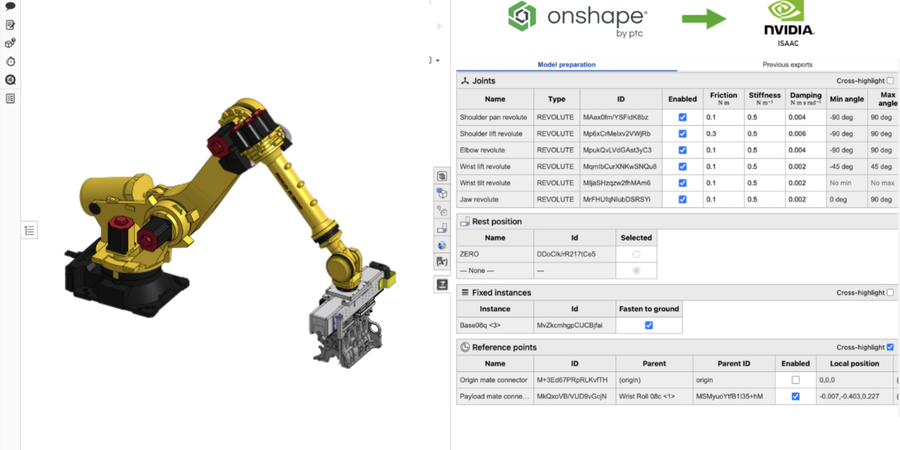
The Onshape–Isaac Sim workflow helps to address these challenges by:
Maintaining a Single Source of Truth: Mechanical relationships are defined once in Onshape and carried directly into Isaac Sim.
Reducing Manual Rework: Eliminates the need to recreate joints, actuators, and physical constraints after CAD export.
Enabling Automatic Updates: Simulation models update automatically when design changes occur.
Accelerating Development Cycles: Supports faster transition from CAD to physics-based simulation.
Supporting Physical AI Workflows: Enables downstream robotic training in NVIDIA Isaac Lab.
The integration is supported by a cloud-native architecture built on Amazon Web Services, helping to enable design and simulation environments to remain synchronized throughout development. This helps engineers, researchers, and AI developers to focus on testing system behavior and improving performance versus preparing models for simulation.
With Onshape and its broader portfolio, PTC continues to further advance its Intelligent Product Lifecycle approach, focused on helping to enable manufacturers to build a product data foundation, extend the value of that data across the enterprise, and support AI-driven development processes.
Follow ARC Advisory Group for the latest trends in sustainability, automation, and next generation technology.