Representative End User Clients







Representative Automation Clients







Representative Software Clients








The pharmaceutical industry plays a central role in Singapore’s economy and is a key pillar of the country’s high-value manufacturing strategy. Eight of the world’s top 10 biopharmaceutical companies have established manufacturing operations in Singapore, reflecting the city-state’s capabilities in advanced pharmaceutical production. Government initiatives and incentives to support biopharma R&D and manufacturing, along with purpose-built infrastructure such as Tuas Biomedical Park, have helped attract and anchor substantial investment.
In recent months, Singapore’s pharmaceutical sector has seen strong performance, with production rising more than 120 percent year on year in October 2025, driven primarily by increased manufacturing of active pharmaceutical ingredients (APIs) and biologics. As companies manage increasingly diversified pipelines—including biologics, advanced formulations, and emerging precision medicines—pharmaceutical manufacturing places greater demands on process control, monitoring, automation, and operational flexibility.
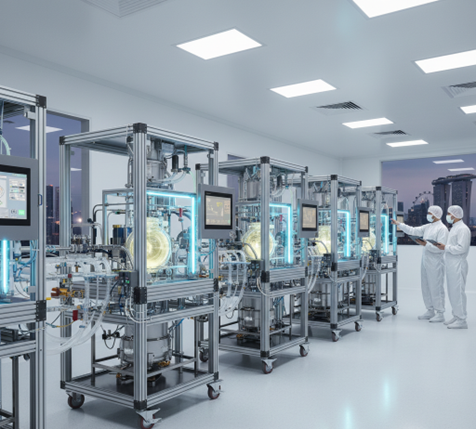
Flexible manufacturing refers to the design of facilities and processes that can adapt quickly to changing production needs. Flexibility can be achieved through multiple approaches, such as single-use systems, modular layouts, standardized process units, or digitalized process control, depending on facility design and product requirements. The goal is to reduce downtime between product runs, support smaller or variable batch production, and improve operational efficiency. Flexible manufacturing also enables manufacturers to respond more rapidly to shifts in demand or pipeline priorities while maintaining consistent quality standards.
Single-use technology (SUT) is one approach that supports flexible and agile manufacturing. At Amgen’s biomanufacturing facility in Singapore’s Tuas Biomedical Park, operational since 2014, SUT is applied across bioreactors and other process components, replacing traditional stainless-steel systems with pre-sterilized disposable bags and tubing. For Amgen, SUT enables each production campaign to start with a clean, pre-validated system, reducing cleaning and sterilization requirements, lowering the risk of cross-contamination, and maintaining consistent product quality. This strategy is particularly well suited to Singapore, where space is limited and high-value biologics production must be both efficient and environmentally sustainable. By using SUT, the facility achieves substantial reductions in water and energy consumption, lower carbon emissions, and a smaller physical footprint while supporting multi-product operations within a single facility.
Another approach to supporting flexible manufacturing is the use of modular production systems. Sanofi’s Modulus facility, inaugurated in November 2024 and expected to be fully operational by mid-2026, consists of 34 standardized production modules that can be configured into multiple production lines. This allows different vaccines or biopharmaceuticals to be produced in parallel, while individual modules can be reconfigured within days to switch to new products or platforms. By enabling rapid adaptation without shutting down the entire facility, this modular strategy provides operational agility and complements other flexibility approaches.
Continuous manufacturing (CM), which has been explored in the pharmaceutical industry since the early 2000s to improve efficiency, reduce variability and operational costs, and shorten lead times, is covered in ICH Q13, titled Continuous Manufacturing of Drug Substances and Drug Products. Updated in late 2022, the guideline provides direction on the development, implementation, and lifecycle management of continuous and hybrid manufacturing processes, including scientific approaches, process control, monitoring strategies, and regulatory considerations. It defines hybrid and fully integrated continuous approaches and supports broader adoption while ensuring product quality and compliance.
In continuous or hybrid processes, raw materials are fed steadily into the system, producing finished products without the downtime associated with discrete batch steps. Batch production, by contrast, processes materials in separate lots with distinct start-stop cycles. Continuous manufacturing enables higher equipment utilization, shorter lead times, and more consistent product quality. Modern systems often incorporate real-time monitoring, process analytical technology (PAT), and automation, allowing immediate quality control, reduced variability, and faster response to process deviations.
GSK was an early adopter of continuous manufacturing in Singapore. In 2014, its Jurong site built a commercial continuous processing plant, followed in 2019 by an S$130 million investment in new facilities, including two continuous manufacturing plants and an expanded production building. Established in 1982, the site has evolved from bulk production to a leading new product introduction site, producing 13 APIs for medicines across HIV, oncology, respiratory, allergy, antiviral, and neurological conditions.
Novartis announced plans to expand its biopharmaceutical manufacturing footprint in Singapore with a US$256 million investment in March 2024, focused on the production of therapeutic antibody drugs. The expanded facility is expected to be operational by early 2026 and is planned to incorporate continuous manufacturing processes, including N-1 perfusion technology, along with automation and digitalized production technologies to improve efficiency, scalability, and operational consistency.
Adoption of continuous or hybrid processing depends on product suitability, technical readiness, and regulatory considerations. For most manufacturers, these approaches complement rather than replace batch production. Modular infrastructure, process-level innovations, and digital tools expand the toolkit available for pharmaceutical production, providing flexibility in where and how products can be made. Together with flexible manufacturing approaches such as SUT and modular layouts, process innovation enhances production control, consistency, and sustainability, supporting a more adaptable, efficient, and resilient pharmaceutical manufacturing ecosystem in Singapore.