Representative End User Clients







Representative Automation Clients







Representative Software Clients









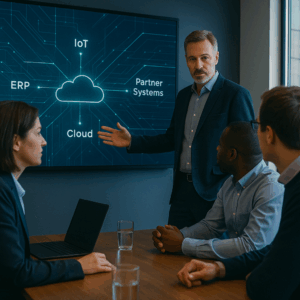
The cyber threat environment is evolving at a pace that supply chain executives cannot afford to ignore. What was once the domain of amateur hackers experimenting with viruses has become an organized global economy of cybercrime-as-a-service, state-sponsored digital warfare, and AI-enabled attack vectors.
In today’s interconnected supply chain ecosystem, the attack surface is vast, heterogeneous, and porous. The same technologies that have improved visibility and efficiency—IoT sensors, cloud platforms, and AI-driven forecasting—have also multiplied vulnerabilities. Every connected partner, every device, and every API call represents a potential point of intrusion.
This section explores the major categories of threats defining the modern supply chain cyber landscape.
Once primarily targeting corporate desktops, ransomware now cripples OT (operational technology) environments, locking up warehouses, factories, and even shipping ports.
Attackers demand multimillion-dollar payments in cryptocurrency, betting that downtime costs will force compliance.
Phishing emails, texts, and calls remain the most common initial entry point.
The difference today is AI-powered personalization, producing messages convincing enough to deceive even experienced professionals.
Employees, contractors, or suppliers with legitimate access can become threat vectors, intentionally or through negligence.
Example: a subcontractor clicks a malicious link, providing attackers with credentials that expose the broader enterprise.
APTs represent the most dangerous cyber adversaries: well-funded, highly skilled groups, often state-backed, that infiltrate networks quietly and remain undetected for extended periods.
Tactics: Stealthy infiltration, lateral movement, and long-term data exfiltration.
Motivation: Strategic advantage, intellectual property theft, espionage, or sabotage rather than immediate ransom.
Impact on Supply Chains: Theft of sensitive supplier designs, disruption of critical infrastructure, and destabilization of global trade routes.
Supply chains increasingly rely on edge technologies such as connected trucks, smart containers, robotic picking systems, and industrial control systems (ICS).
Devices often lack robust security controls.
Many ship with default passwords or unpatched firmware.
Compromised devices are frequently used as botnet nodes in distributed denial-of-service (DDoS) attacks.
Systems designed for reliability rather than cybersecurity, such as SCADA systems controlling port cranes.
Previously isolated environments are now connected to IT networks for analytics, expanding the attack surface.
A single compromised OT endpoint can halt operations.
Cloud platforms and SaaS ecosystems form the backbone of modern supply chain IT. While they provide agility, they also introduce concentration risk.
Shared Responsibility Gaps: Misunderstandings about security ownership remain common, with misconfigured storage among the leading causes of breaches.
Supply Chain of SaaS: SaaS providers often depend on additional vendors, creating hidden fourth-party exposure.
API Exploits: Poorly secured APIs can expose sensitive transactional and operational data.
Attackers are beginning to exploit the same AI capabilities enterprises are adopting.
Automated Phishing Campaigns: AI generates personalized lures at scale with near-perfect language and tone.
Deepfake Social Engineering: Synthetic voice or video impersonation is used to authorize fraudulent transactions.
Data Poisoning: Manipulation of training data to distort forecasting or decision outputs.
Adversarial Attacks: Subtle input manipulations that cause AI systems to misclassify or misinterpret data, such as confusing vision systems in warehouse robotics.
Modern attackers follow a structured lifecycle rather than acting randomly:
Reconnaissance: Mapping the extended ecosystem and identifying weak vendors.
Initial Access: Phishing, exploiting misconfigured APIs, or using stolen credentials.
Lateral Movement: Expanding across interconnected systems, such as ERP, WMS, and supplier portals.
Privilege Escalation: Gaining administrative access.
Impact: Ransom, data theft, sabotage, or operational disruption.
The complexity and interdependence of supply chains create opportunities at every stage.
JBS Foods (2021): A ransomware attack shut down operations across the US, Canada, and Australia, leading to supply disruptions and an $11 million ransom payment.
Kaseya (2021): Exploitation of IT management software enabled attackers to compromise hundreds of downstream customers, illustrating fourth-party risk.
Toll Group (2020): Two ransomware attacks in a single year halted deliveries and resulted in losses totaling tens of millions.
These incidents demonstrate that no node in the supply chain is too large or too small to be targeted.
Extensive third-party networks multiply risk.
Global dispersion introduces uneven regulatory and security standards.
Operational urgency often deprioritizes cyber hygiene.
Limited visibility into full digital dependency maps.
Threat awareness alone is insufficient. Effective executive response requires proactive defense, including:
Investment in supply-chain-specific threat intelligence.
Regular red-team exercises and penetration testing across IT and OT environments.
Cybersecurity scorecards for vendors and partners.
AI-driven anomaly detection to identify early signs of compromise.
The supply chain threat landscape is expanding rapidly.
Traditional risks such as ransomware and phishing are evolving through AI.
IoT, OT, and cloud dependencies introduce new vulnerabilities.
Advanced persistent threats exploit interdependencies.
Executive-level action is required, including continuous monitoring, risk scoring, and ecosystem oversight.
In Part 3, Mapping the Digital Supply Chain, the focus shifts inward to mapping digital interdependencies across ERP, SaaS, IoT, and partner systems to pinpoint where risks truly reside.
Call to Action: Download the full guide for deeper analysis and practical frameworks supporting the development of a more resilient supply chain.